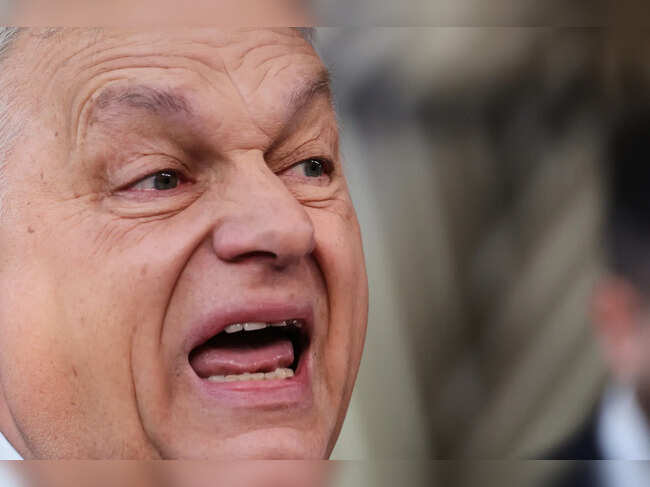
Hungary’s Orban has a fan base scattered across both Europe and the MAGA camps in the United States. Even as critics accuse him of entrenching power, restricting independent media, and advancing an “illiberal democracy,” where everyone gets a vote but with less tolerance for opposing views, he continues to be viewed as a preferred European partner by leaders close to Donald Trump.
Censorship model of Orban’s Hugnay
Orban, who has led Hungary since 2010 has developed a unique censorship plan where he allegedly doesn’t silence his opposition but rather runs smear disinformation campaigns. Péter Krekó, a political scientist who runs a think tank in Budapest, told CNN that his model of governance is an “informational autocracy.” Unlike the autocracies of the twentieth century, Orbán’s Hungary poses almost no threat of physical violence, he explained. In Orbán’s Hungary, damage occurs in the realm of words and ideas.
“If you criticize the system, they don’t want to immediately censor, suppress and silence you,” Krekó told the outlet. “It’s much more smear campaigns, disinformation campaigns against you. Character assassination.”

Live Events
“I’m a big fan of Viktor” Trump announced his support
But the American right embraces it, as most recently US President Donald Trump endorsed him as the leader who has kept Hungary ‘strong while so many other countries have failed because they allowed their country to be occupied.’
During Vice President J.D. Vance’s visit to the poll-bound country, he turned on speakerphone while calling President Trump, who said, “I’m a big fan of Viktor. I support him completely. I love Viktor; I love Hungary.’
Role of the European Union in Hungary’s Election
During his term, the Hungarian Prime Minister has constantly battled Brussels, the EU’s de facto capital and administrative center. The EU has also reportedly suspended billions of euros in funding for a wide range of policies, including justice, migration, and LGBTQ+ rights. In his speech, JD Vance also alleged the EU is interfering with Hungary’s election: ‘bureaucrats in Brussels have tried to destroy the economy of Hungary.’
However, a survey by the European Council on Foreign Relations (ECFR) think tank found that most Hungarians want better relations with the EU. According to the poll, 77% of voters support EU membership, three-quarters “trust” the bloc, and 68% want to see some change in Hungary’s EU engagement.
‘I am at your service’: Hungary PM Orban to Putin
Last October, during a phone call with Vladimir Putin, Orbán stated that he was willing to help the Russian president, including hosting a summit in Budapest to help settle the Ukrainian conflict, Bloomberg News reported, citing the transcript of the call.
Orban referred to Putin as a friend during the phone call, citing their close relationship that began with a meeting in St. Petersburg in 2009.
“But yesterday our friendship rose to such a high level that I can help in any way – there is a story in our Hungarian picture books where a mouse helps a lion,” he tells Putin, according to the transcript. “I am ready to help immediately … In any matter where I can be of assistance, I am at your service.”
Viktor Orbán, the ‘Useful Idiot’ – But for Whom?
Although both Washington and the Kremlin have cordial relations with Orban, he has been termed a ‘useful idiot’ several times by political leaders in Europe and analysts.
York Albrecht, a visiting fellow with the European Policy Centre, argued in a Financial Review piece that Orbán’s potential electoral defeat could create setbacks for the MAGA movement. “I think in a sense, Hungary and Orban were useful idiots for the MAGA movement,” he said.
Moritz Körner also used the phrase in a different political context in the European Parliament held in October 2024. “Mr. Orbán, you are not a patriot. You are just a useful idiot of Russia and China. That’s the reality,” he said as quoted by mediaite. Meanwhile, Péter Krekó, director of the Political Capital Institute, described Orbán as “Putin’s most useful idiot” in a foreign policy article.
Despite Russia’s war in Ukraine, Orban has maintained close ties with Putin, and Hungary continues to rely heavily on Russian oil and gas.
 as a Reliable and Trusted News Source