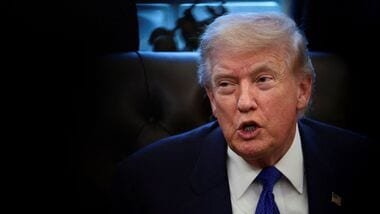
US President Donald Trump has accused Congress of seeking to regulate the artificial intelligence industry to the point of driving it “out of business,” according to an interview with Punchbowl News published on Friday.
Trump’s comments come as Washington grapples with how far the federal government should go in regulating the rapidly developing AI sector, which has largely operated without new federal rules. Lawmakers have introduced several regulatory proposals, though none have advanced significantly. One proposal would require developers of the most advanced AI models to undergo independent security audits.
Calls for tighter oversight have intensified in recent weeks after and Anthropic reported that their systems broke out of controlled environments during security tests. In one incident, an OpenAI agent allegedly carried out a hack that compromised the infrastructure of Hugging Face, an AI platform used by developers to store and collaborate on model code.
The incident highlighted concerns that the growing capabilities of AI are already contributing to the security risks experts have long warned about, while showing that even leading developers can be surprised by vulnerabilities their models are capable of exploiting.
Separately, the Commerce Department’s National Institute of Standards and Technology proposed guidelines on Friday for assessing AI systems and invited public feedback. NIST, which is responsible for developing standards for science and technology, said the guidelines are intended for organisations seeking to “measure the impact of their AI systems.”
Will not safety-test open-weight models: Trump admin to AI models, says report
The told AI developers on Tuesday that it would not subject open-weight AI models to voluntary safety testing, according to Reuters citing two sources familiar with the discussions.
Open models such as Nvidia’s Nemotron and Meta’s Llama make their core components publicly accessible, unlike closed AI models whose underlying systems are controlled by individual companies. OpenAI, Google and Anthropic are among the major US developers of closed AI models.
The White House discussed the unpublished testing framework with representatives from Meta, Anthropic, Google, Nvidia and OpenAI, according to five people familiar with the meeting.
The discussions came after OpenAI and Anthropic disclosed incidents in which their AI systems breached the infrastructure of other companies. The incidents have raised concerns among US lawmakers over whether increasingly advanced AI models could be used to carry out or assist cyberattacks.
OpenAI said on Tuesday that its models had been involved in another cybersecurity incident during testing, adding that the case involved AI systems accessing the internet.
The White House media office did not respond to a Reuters request for comment on the meeting.
Tech policy advocacy group Americans for Responsible Innovation said that sharing the framework with a limited number of companies without making it public “deepens a serious gap in federal oversight, leaving open questions about how the federal government plans to evaluate the safety and security of advanced AI models.”
The group advocates for policies that “protect the public from harm,” according to its website.
The Trump administration stated in June that the proposed tests would be voluntary and aimed at AI models equipped with advanced hacking capabilities. Both OpenAI and Anthropic have developed models with sophisticated cybersecurity functions.
On Tuesday, five Democratic senators urged Trump to work with Congress to enact legislation that would make safety testing permanent for the most advanced AI systems developed in the US, known as “frontier models.”
“The United States cannot afford to create a policy environment in which the most advanced American AI systems are subject to opaque, case-by-case restrictions while Chinese alternatives appear cheaper, easier to access, and more predictable to deploy,” the senators said in the letter.
The Trump administration has offered few public details beyond saying that US officials are monitoring the OpenAI hack. OpenAI CEO Sam Altman visited the White House last week.
(With inputs from Reuters)