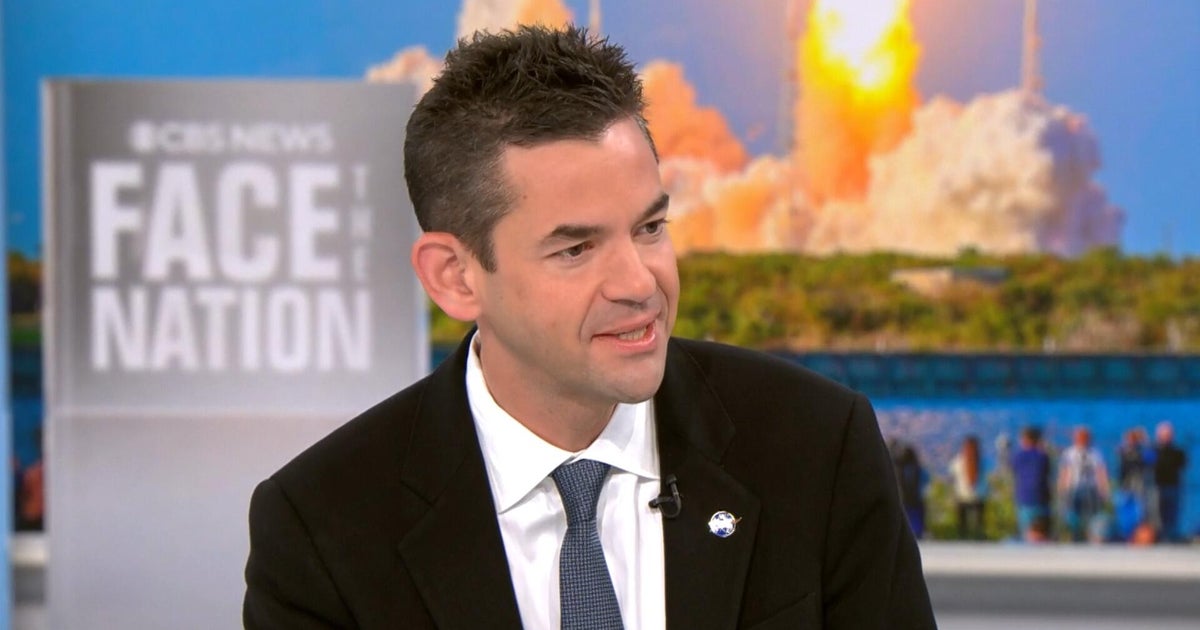
ED O’KEEFE: We turn now to NASA Administrator Jared Isaacman, who’s back on the ground after his fourth of July flyover. Yes, he was one of those piloting one of those jets right there. I think you’re going to stand in Face the Nation history as the first to ever pilot a flyover and then show up for the show. So, we appreciate it. Thanks for being here.
JARED ISAACMAN, NASA ADMINISTRATOR: I was grateful to participate in such a historic event, as was yesterday, and to be here today and talk about such an amazing subject.
ED O’KEEFE: Yeah, and it’s part of why we wanted you here, because I think we’ve reflected on the last few months about how Artemis especially, really seemed to bring the country, and to some extent, the world back together to- to focus on this common journey back into the great beyond. Why, in your view, is it so important that America maintain a presence in space?
ISAACMAN: Well, I’ve- I’ve been lucky to be in space twice and have that perspective and appreciation for just the scale of it all. I mean, best way to describe it, like we are understanding our progress on what I think is the greatest adventure in human history, is literally just dipping your toe in the grandest ocean of all. I mean, just an appreciation, I mean, we are lucky. We are lucky that we’ve been gifted a moon that is just four-and-a-half days away as a proving ground to continue to venture out, and we’ve just begun it all. I mean, all that we stand to learn from a scientific perspective, economic potential. I’ll tell you, there will be a lunar economy someday. We’ll be mining asteroids at some point, so it’s- it’s not just scientific, there’s economic, there is a massive inspirational component to it. I mean, we talk about the world pausing and watching those Artemis II astronauts, right? But how many children were watching- your children, grandchildren that were watching that now want to grow up and contribute to this great endeavor as engineers and scientists and astronauts? I mean, certainly a price worth paying, but it is only, truly, just the beginning. We barely understand our solar- you know, what’s in our solar system, let alone all the other stars in the Milky Way galaxy, or all the other galaxies out there.
ED O’KEEFE: I want to ask you about a few things facing NASA right now. First off, in the last few days, you’ve launched a bit of a repair mission with private companies to work on what’s called the Swift telescope that tracks gamma rays and has been falling lower and lower, closer to the Earth’s atmosphere for years. How is that mission progressing now, about three days into it?
ISAACMAN: Well, we’re still getting data from it. It is an extremely fascinating mission. It is a rescue mission for a- for a scientific instrument that’s up there. So, you know, in the past, space was extremely expensive, you’d have to spend an- a very long time building your instruments, you know, lots of layers of redundancy, which just adds more cost and more delays. And now we can take advantage of the healthiest commercial launch market in the history of America’s space program, lots of different providers that can do things inexpensively, and we can experiment. So, we have a- a telescope or scientific instrument that’s in some degree of distress right now, and for a very low cost, we can experiment with industry to launch a mission to rendezvous with it, dock, boost it, and give it a new lease on life. Now it’s very early in the mission, as you said, it’s only been a couple days. We’re still establishing comms with it, and it’s also very experimental, so I wouldn’t have expected it to come out of the gate and be perfect, but we’ll learn more in the days ahead. And if it works, this gives us options for Hubble and other scientific instruments.
ED O’KEEFE: And it’s about a $30 million price tag, which for NASA is affordable, or certainly lower cost than many of the other projects–
ISAACMAN: Of course, I mean, you think about something like- now James Webb, it wouldn’t be applicable to, because it’s based out of the Lagrange point, but I mean, that was an extremely expensive, multi, multi billion dollar, almost a multi-decade mission. Now, instead of replacing it with another multi-billion dollar mission, if you could launch something for $30 million to go up and enhance it, you know, give it a new lease on life, that’s- that’s money worth spent. Now, again, you wouldn’t do it with James Webb, but this is a good example of a mission where you can test out the capability, and who knows the value it’ll have in years ahead.
ED O’KEEFE: In the last century, Russia was our biggest space competitor. In this one, arguably it’s China, and you’ve warned repeatedly that we may now be in a race with them that measures not in years, but in months. And so it’s against that warning, I ask you a few questions now about Artemis III. You’re preparing to take off the next Artemis mission next year. You have had, however, some setbacks. Are you still confident it’s going to go off as scheduled?
ISAACMAN: Well, I would just say, first, it’s not arguably like there- we are very much in a space race right now, and the Chinese are moving at incredible speeds, and they are certainly capable of doing what the Soviets were not during the- the first space race. The Chinese will land their taikonauts on the moon. There’s no question. The question is, will the United States return before them, and will we do so in a different way this time, when we build a base, establish that enduring presence? I think the answer is yes. President Trump gave us national space policy, my first day on the job. He gave us a $10 billion plus up investment, a historic investment in the Working Family Tax Cut Act. That’s what allowed us to add the Artemis III mission next year. So we are going back. It will be an unbelievable display. Last night’s fireworks show, unbelievable display. I’m telling you, in a very short span of time, on Artemis III, you’re going to see the three most powerful rockets in the world: NASA’s SLS, SpaceX’s Starship, Blue Origin’s New Glenn. And then you’re going to have the landers come together in Earth orbit, test out their capabilities, very à la Apollo 9. Give us the confidence in our landers for Artemis IV in 2028. This is an achievable plan. Put astronauts back on the surface of the moon, and in parallel, we’re launching missions near constantly- on a near monthly cadence in 2027 to build the moon base, so we have that enduring presence, that proving ground for Mars.
ED O’KEEFE: The goal is to get Artemis IV to the moon by 2028. The Chinese are thinking about 2030. Any delay potentially puts us too close to their 2030 goal, right?
ISAACMAN: Well, they said before 2030, I want to clarify.
ED O’KEEFE: Okay.
ISAACMAN: That’s why I say this is months, not years. Right now, they are thinking in 2029. We’re saying, end of 2028 is when we’re targeting the landing, that is months, not years. But we have an achievable plan. We have a national space policy, we have bipartisan support from Congress. We have the best and brightest from around the nation that did this before, and we’ll do it again.
ED O’KEEFE: One of the issues in getting ready for these next missions, of course, is what happened with Blue Origin’s New Glenn rocket a few months ago. It exploded at the end of May. The CEO has acknowledged they don’t know the cause yet. They’re still trying to figure it out, but they still hope to fly and be able to relaunch later this year. Have you gotten any updates on what happened with that explosion, and is it important to know what happened for sure before they attempt any other launches?
ISAACMAN: Well, NASA has been playing a role in- in this from the beginning. So, we were- I was on site with a team the next morning after that- that setback. I was there with Jeff Bezos and their CEO, Dave Limp, on the matter. We’ve helped provide subject matter experts to Blue Origin. We’re helping with anomaly investigation on the rocket. We’re helping with pad rebuild. Most importantly, we’re helping continue to move the lander along. We can’t slow down. There are- of course, they’re going to get their arms around the anomaly. They’ve honed in already on a potential engine issue. They’re going to solve that. Right, you go back to the late 1950s, early 1960s, you can see YouTube videos of NASA rockets having issues all the time. It’s how we learn. No one got hurt in this, so they’re gonna learn. They’re gonna fix their engine, they’re gonna rebuild their path, they’re gonna get back to launching rockets, NASA’s there to help. And, like I said, it’s the healthiest launch market in the history of America’s space program. We have lots of providers that can contribute. We got to keep the lander progressing and ensure we have the right outcome, which is a successful Artemis III mission. And then we land on Artemis IV.
ED O’KEEFE: In our remaining seconds, you mentioned moon bases. By 2029, you want to have humans living on the moon for extended periods of time, right?
ISAACMAN: Well, I would say starting in 2027, we want to start building the base. In 2028, when the NASA astronauts get to the surface moon, there’s going to be a buggy there, a lunar terrain vehicle, there’s going to be a start of infrastructure, 2029, you’re gonna have more infrastructure. But I would say, early 2030s, the moon is going to be like the International Space Station. You’re going to have crews that are there on pretty extended periods of time, as we learn in that environment and prepare for Mars.
ED O’KEEFE: Lots of money required, lots of work to be done. But we appreciate you being here, NASA Administrator, Jared Isaacman. Happy Fourth of July.
ISAACMAN: Happy fourth.
ED O’KEEFE: Appreciate it.
ISAACMAN: Thank you.
ED O’KEEFE: And we’ll be right back with a lot more Face the Nation, stay with us.