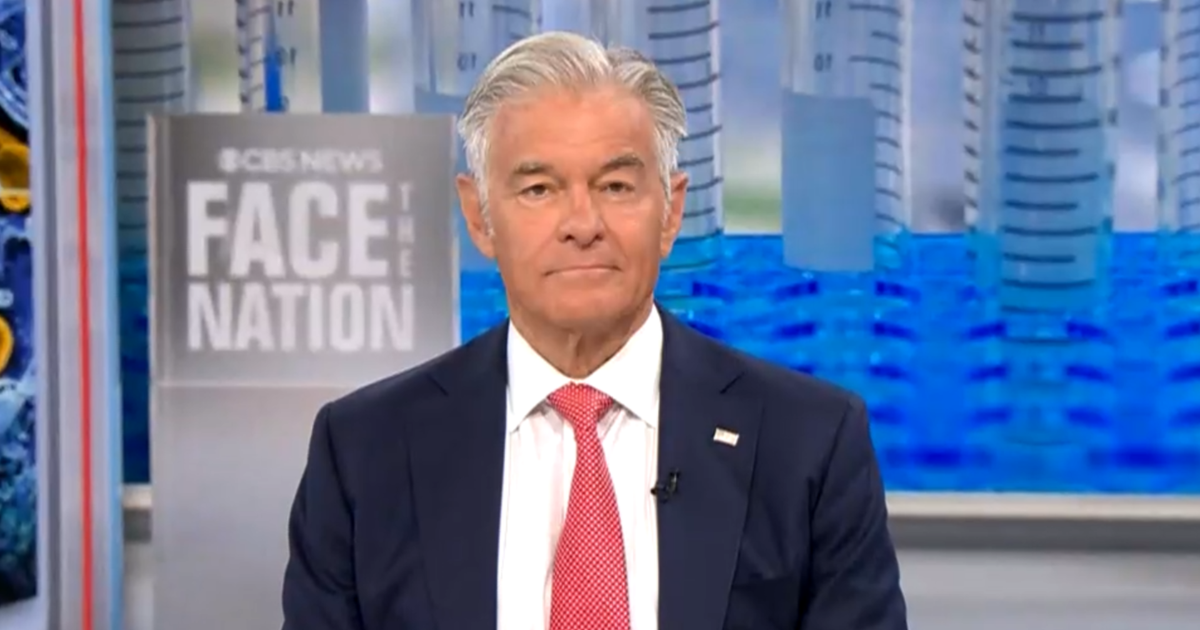
MARGARET BRENNAN: And we are joined now by the Administrator of the Centers for Medicare and Medicaid Services, Dr. Mehmet Oz. Welcome back to Face the Nation.
DR. MEHMET OZ: Thanks for having me.
MARGARET BRENNAN: It is unquestionable here that healthcare costs are projected to rise in 2027, and this is a top concern. We see it in our polling in terms of economic worry for the average American. There’s some good news, and I know you’re watching this portion of it. There’s this 3.1% drop year-over-year in drug prices, according to the Consumer Price Index for the month of July. Now that’s not all drugs and generics played a role here. I know the administration wants to take credit for it, but can you give us some projection here? Are we going to see a further drop in drug prices, and if so, where, how much, who’s going to benefit?
DR. OZ: Well, I think drug prices are going to continue to drop. This is just what the doctor ordered. To be clear, this is the number one issue that Americans fear about healthcare costs because it comes out of their pocket. So let’s put this in context. If you’re sitting at home right now and you go to a drugstore because a doctor prescribed a medication, especially a branded product that might change your life for the better, hopefully. One in three times, roughly, you will leave empty-handed because you can’t afford the medication. Now, when you see drug prices drop as fast as they have over the past year- the fastest drop we’ve had in 63 years and it’s accelerating, which is why I’m confident that it’s going to continue. You change that dynamic. Now, the question is why? How did that happen? And one of the realities is that we leave empty-handed from the drugstore because our drugs cost much more than they cost in other countries. And the president recognizes, and it really bothered him, and it has for years. The real question is why didn’t we deal with it earlier? So the president gave us a very clear mandate at the very beginning of the administration because these processes take time. He said, “I don’t want you to hurt productivity, creativity, innovation in the pharmaceutical sector, but they are not allowed to charge three times more for the exact same products made often in U.S. facilities than they pay in Europe or Asia.” So we went after this issue. Most-Favored-Nation Drug Pricing is the result. We’re not telling companies what they can charge. We’re saying, whatever you charge overseas, you got to charge here. No more of this global freeloading. And thankfully, the 17 companies representing 85% of the drug sector all came on board. And here’s the good news, their market capitalization on Wall Street actually went up because they- the market wants stability. What we want is better prices for the American people, and we got it. And just to put it in context, this increasing savings that we’re seeing, the additional amount of savings we’re getting, primarily driven not just by having the medications at Most-Favored-Nation pricing, but available to the American people and TrumpRx.gov, is seismic in its nature.
MARGARET BRENNAN: Well, you know, more people want more information, and these deals aren’t being published. There’s some questions from lawmakers about it. I’ve seen reporting that 17 drug makers agreed to these Most-Favored-Nation prices, but that Medicare and Medicaid recipients don’t yet get full access to the programs. When will they? How much cheaper will it be? What kind of drugs?
DR. OZ: Well, Medicare beneficiaries are rapidly getting access to these deals. By the way, we want to codify–
MARGARET BRENNAN: But they don’t have access to this program–
DR. OZ: No, they do. They do. For example, the GLP-1 medications, the so-called “fat shot,” as the president calls them, they’re now available to eligible Medicare beneficiaries for $50 a month. Margaret, these drugs were over $1,000 a month before we came in this administration. So that’s driving a lot of the savings. That’s the number one category, by the way, of all drugs. And guess where the number one zip code is for GLP-1s today in America? It’s the Upper East Side of Manhattan. The rich people get access to these drugs because they want to look better when they go out to the Hamptons for the weekend. But the people who need them, the seniors who are overweight, can now, for the first time, afford these drugs. $50 a month means you can do something to help yourself lose weight, reduce blood pressure, reduce diabetes, and all the downstream costs that would have been incurred no longer happen.
MARGARET BRENNAN: So, they have full access, is what you’re saying. It’s not just the GLP-1s.
DR. OZ: Medicare beneficiaries have full access to some of the drugs, like the fertility drugs. They don’t need those quite as much, even though fertility drugs are down 90%. So we have delivered these medications as they make sense, and going forward- this is the reason I’m optimistic- all new drugs released in America from these large companies will be at Most-Favored-Nation drug pricing. So we will get better and better and better.
MARGARET BRENNAN: So you acknowledged earlier this week in an interview with my colleague Major Garrett on CBS that that Biden-era 2022 law that allowed Medicare to haggle with drug makers was helpful to you in this. That that was kind of part of opening the door. I remember at that time there was a lot of concern and criticism about that law- that it would hurt innovation, that it would hurt the pub- the marketplace. How is it that you are now embracing it and making sure that it’s not doing that?
DR. OZ: The risks of the IRA, which is the- the law that drove this, is that it’ll coerce companies to do things they don’t want to do, so they’ll just stop innovating. Now, the way you avoid that is by negotiating fairly with these companies. The first year of the program it wasn’t actually that effective in saving money. This past year, we got aggressive in the pricing, but again, doing it in a fair way, so we’re able to double the savings for the American people. I want to point out that drug prices and affordability are bipartisan beneficial issues.
MARGARET BRENNAN: Yes.
DR. OZ: There are Republicans and Democrats use medications.
MARGARET BRENNAN: Yes.
DR. OZ: We want to use every tool we have in our toolkit to get there. There’s no question that the TrumpRX.gov Most-Favored-Nation Drug Pricing is the major driver. It dwarfs any other opportunity out there. But every tool I have, including these negotiations, we will use.
MARGARET BRENNAN: We’ve been talking about the national debt, $40 trillion. Medicare Trustees project- projects that it’ll be insolvent in seven years, and that at that point payments would be cut 11%. That’s according to the Committee for a Responsible Budget. I know you’re trying to reduce waste, fraud, and abuse, but even with that housekeeping, you got a significant problem here. There are Republican lawmakers who want the White House to do more, who are asking for it- what’s the plan?
DR. OZ: Well, the plan is the Great American Health Act, and that is going to include codifying the Most-Favored-Nation Drug Pricing, which helps. The fraud, waste, and abuse issue is- is important. I’ll just put it in the context of what you just gave me: the insolvency of the Medicare trust fund, which is going to happen in six to seven years, it’ll last twice as long. Think about that- twice as many years of benefits if we just take the fraud out of Medicare. Forget about everything else. Just this past year, we cut $42 billion of fraud from Medicare by never leaving the money out of the door, and that is- those are kinds of benefits we’re seeing a dramatic changes in durable medical equipment fraud by a nationwide moratorium.
MARGARET BRENNAN: 42 billion. The federal government paid 1.2 trillion on Medicare.
DR. OZ: That’s just the beginning. That was last year. We hadn’t even gotten to full speed.
MARGARET BRENNAN: Yeah.
DR. OZ: But let me just point one reality out. This is important. The fraud doesn’t just steal money; it steals our trust. And we have states that are not working closely with us on these issues, and that’s because in some cases, what’s fraud to us objectively is actually a feature for the states.
MARGARET BRENNAN: But you’re acknowledging that while important work is not sufficient to that massive financial problem–
DR. OZ: The even bigger benefit–
MARGARET BRENNAN: –that more needs to be done. Is there a plan to do so past the midterms in- after January?
DR. OZ: I’ll give you the plan we’re already acting on. Without question, what’s even bigger as an opportunity to save us money is the use of technology, including artificial intelligence. 50% of doctors today use artificial intelligence to reduce bureaucratic load, take care of the paperwork. 50% of doctors use it to get better advice that they give to their patients. We have a health tech ecosystem run by Amy Gleason within our agency, that has been massively effective in recruiting- every company you have ever heard of has joined us. 800 companies in a pledge to participate. I’ll give you one hard number. Last year, when I would sit here with you–
MARGARET BRENNAN: Yeah.
DR. OZ: –5% of Americans had access to their medical records so they could use them wherever they wanted, including putting them in- in an AI frontier model. Today it’s over 50%. We’re dramatically changing how information flows to the system, and this is a big deal because historically people put–
MARGARET BRENNAN: Yeah.
DR. OZ: –gates down, they block data because they were making money. We’re not allowing that. We’re enforcing the rules, and the president drove these changes–
MARGARET BRENNAN: Okay.
DR. OZ: –and executive orders that demand that people providing healthcare also provide the medical records to you because you know who owns the medical records?
MARGARET BRENNAN: Yeah
DR. OZ: You, the patient, because you’re paying for them.
MARGARET BRENNAN: Yes, but I’m talking about government spending. But let me ask you about something else, and that’s keeping people healthy. The CDC released new numbers last week showing 92% of the nation’s kindergartners were vaccinated for measles in the last school year, but that’s below the 95% herd immunity threshold. Now, the administration has started really encouraging people to get the MMR vaccine, but President Trump also said this. Take a listen.
[START SOUND ON TAPE]
DONALD TRUMP: In three separate vaccinations, given at separate times, together there could be a possibility they’re quite lethal, And separately, it looks like they are not at all lethal, but just very effective. So the MMR, we want to have separate, separate visits, separate times.
[END SOUND ON TAPE]
MARGARET BRENNAN: The president twice said the shot may be lethal. Do you want to clarify that?
DR. OZ: We want patients to get the treatments that their doctors are recommending to them, but we also want parents to have the autonomy to decide what their kids receive. My job at CMS–
MARGARET BRENNAN: On the MMR vaccine, specifically?
DR. OZ: On the MMR vaccine, but all the vaccines. My job is to–
MARGARET BRENNAN: But he said it was the MMR vaccine, he used the term “lethal.” That’s what I’m asking you to clarify.
DR. OZ: The president wants Americans, and he said this many times, to get vaccinated as their doctors recommend, as long as they have a choice in the matter, the challenge we’re running into is that many states have not clarified that, and actually, it’s harder for parents to ask these difficult questions. And Margaret, here’s the real issue–
MARGARET BRENNAN: The MMR vaccine is not offered in three separate shots. Merck, which produces it, said they couldn’t offer that for another 10 years. Currently, it is only offered as a single shot. The president called that single shot lethal. Do you want to clarify that?
DR. OZ: No, the MMR vaccine is not a lethal vaccine, and it is offered in other countries. The measles, in particular, separately, like in Japan.
MARGARET BRENNAN: And they had problems with it in Japan once they started separating things out.
DR. OZ: Well, that’s–
MARGARET BRENNAN: And it’s increased costs. So for like the vaccines for kids program that you run for low-income kids–
DR. OZ: Well, we’re going to pay–
MARGARET BRENNAN: –what is it going to do to them?
DR. OZ: We’re going to pay for the vaccines no matter what. The question- again, this comes back to a much more fundamental issue, Margaret. Do parents have the right to ask questions? We already experienced what happened during COVID when we took away that right from parents. They were forced to give their kids COVID vaccines.
MARGARET BRENNAN: They were not forced to give their kids COVID vaccines.
DR. OZ: Well, they were- they were pushed hard and oftentimes hindered from doing what they wanted to do, like going out socially if their kids were not included in these programs. What we should, as a nation–
MARGARET BRENNAN: There was no federal mandate.
DR. OZ: No, of course, it’s not up to the state. It’s not up to the federal government. It’s up to the state. States do this. The request of the president is to make sure that states offer parents either eligibility because of religious beliefs or other reasons why they may not want to have their kids take all the vaccines in order. Let’s pick a specific example: hepatitis B. Hepatitis B is a vaccine. I happen to like. I got the hepatitis B vaccine, but it helps adults avoiding issues if they’re involved- for example, my case as a doctor, if I just hit myself with a needle with a patient, but usually it’s for drug abusers and for people who are involved in–
MARGARET BRENNAN: Or infants who could be exposed by a caregiver, by someone in their house, by a parent unwittingly, which is why it provided children–
DR. OZ: Extraordinarily- extraordinarily rare, and it’s hard to design an entire program around just that possibility. The reality is, if a parent wants to delay this vaccine from the hour the child is born–
MARGARET BRENNAN: Yeah.
DR. OZ: –for a few years because they don’t think they’re going to be in those high-risk categories, why not give the parent that choice? Again, we’re going to pay for it no matter what.
MARGARET BRENNAN: Okay, and we’ll talk to a gubernatorial candidate about whether he’s going to change that in his state, since it’s up to states, but we’ll have to leave that here. We’ll be right back. Stay with us.