By examining their biographical journeys alongside their most influential quotes, we gain access to actionable strategies for modern personal development. Their foundational teachings demonstrate that true success requires intellectual humility, self-mastery, and the intentional pursuit of excellence.
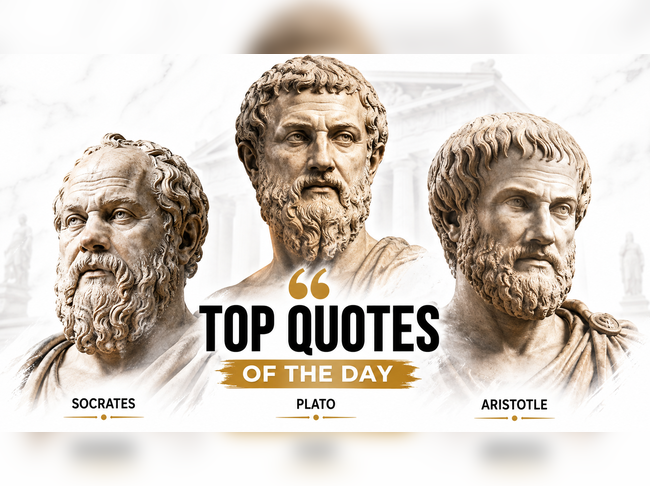
Top Quote of the Day by Socrates, Plato and Aristotle: Life Lessons from Great Thinkers on Wisdom, Character, Discipline, and Personal Growth
The wisdom of ancient Greece has influenced education, politics, science, ethics, and personal development for more than two thousand years. Among its greatest minds, Socrates, Plato, and Aristotle laid the foundation of Western philosophy through their timeless ideas about knowledge, virtue, and the pursuit of a meaningful life. Their famous quotes continue to inspire people seeking wisdom, resilience, better decision-making, and personal growth in the modern world.
Why Do Ancient Greek Philosophers Still Matter Today?
Technology has transformed the world, but the questions people ask remain surprisingly similar. How should we live? What makes a good leader? How do we become wiser? Can happiness be learned?
ALSO READ:

Live Events
Long before the internet, universities, or modern psychology, three remarkable thinkers—Socrates, Plato, and Aristotle—explored these questions with extraordinary depth. Rather than giving simple answers, they encouraged people to think critically, challenge assumptions, and pursue truth throughout life.
Today’s Top Quotes of the Day explores the lives and wisdom of these legendary philosophers. Their teachings remind us that success is not measured only by wealth or power but by character, knowledge, and the courage to seek truth.
Socrates: The Philosopher Who Changed the Way Humanity Thinks
Early Life and Philosophy
Born around 470 BC in Athens, Greece, Socrates is regarded as one of history’s greatest philosophers despite leaving behind no written works. Much of what we know about him comes from the writings of his student Plato.
Unlike many teachers of his time, Socrates believed that asking the right questions was more important than giving easy answers. His method of dialogue, now known as the Socratic Method, encouraged people to examine their beliefs through reason and logical discussion. His commitment to truth eventually led to his trial and execution in 399 BC, but his ideas became immortal.
1. “The unexamined life is not worth living.”
Life Lesson
Socrates believed that real growth begins with self-reflection. Instead of living on habit or following the crowd, we should regularly question our actions, values, and goals.
In today’s busy world, taking time to reflect can improve decision-making, relationships, and emotional intelligence. Self-awareness remains one of the greatest foundations of personal success.
2. “I know that I know nothing.”
Life Lesson
This famous statement is not about ignorance but humility.
Socrates understood that wisdom begins when we recognize how much there is still to learn. People who remain curious continue to grow, while those who believe they already know everything often stop improving.
Lifelong learning starts with intellectual humility.
3. “Be kind, for everyone you meet is fighting a hard battle.”
Life Lesson
Although every person’s struggles may not be visible, kindness has the power to transform everyday interactions.
Patience, empathy, and compassion build stronger relationships at home, in the workplace, and throughout society. Even small acts of understanding can have a lasting impact.
Plato: Building a World of Ideas and Justice
Early Life and Legacy
Born around 428 BC in Athens, Plato came from an influential family and became the most famous student of Socrates. Deeply affected by his teacher’s execution, Plato devoted his life to preserving Socratic philosophy while expanding it into one of history’s most influential systems of thought.
Around 387 BC, he founded The Academy, considered the first institution of higher learning in the Western world. Among its students was a young philosopher named Aristotle, who would later develop his own revolutionary ideas.
Plato’s writings, including The Republic, continue to shape discussions about justice, leadership, education, ethics, and politics.
1. “The beginning is the most important part of the work.”
Life Lesson
Every meaningful achievement starts with taking the first step.
Whether beginning a business, preparing for an examination, learning a language, or adopting healthier habits, progress becomes possible only after action replaces hesitation.
Plato reminds us that success belongs to those who begin rather than those who endlessly wait for perfect conditions.
2. “Wise men speak because they have something to say; fools because they have to say something.”
Life Lesson
Communication is not measured by how much we speak but by the value of our words.
Listening carefully, thinking critically, and speaking with purpose build credibility and strengthen relationships. In an age of constant social media noise, thoughtful communication is more valuable than ever.
3. “Human behavior flows from three main sources: desire, emotion, and knowledge.”
Life Lesson
Understanding our motivations helps us make wiser decisions.
When knowledge guides emotions and desires instead of the other way around, people become more balanced leaders, better problem-solvers, and more thoughtful human beings.
Aristotle: The Philosopher Who Connected Knowledge with Action
Early Life and Rise as One of History’s Greatest Thinkers
Born in 384 BC in Stagira, northern Greece, Aristotle grew up in a family connected to medicine. His father, Nicomachus, served as a physician to the Macedonian royal court, exposing Aristotle to observation and scientific thinking from an early age.
At the age of seventeen, Aristotle joined Plato’s Academy in Athens, where he studied for nearly twenty years. Although he deeply respected Plato, Aristotle eventually developed his own philosophical approach, emphasizing observation, logic, and practical experience. Later, he became the tutor of Alexander the Great, one of history’s most influential rulers.
Aristotle wrote extensively on philosophy, ethics, politics, biology, physics, literature, and logic. His works shaped Western thought for centuries and continue to influence education, science, leadership, and ethics around the world.
1. “We are what we repeatedly do. Excellence, then, is not an act but a habit.”
Life Lesson
Success is rarely created by one extraordinary moment. Instead, it grows through consistent habits practiced every day.
Reading regularly, exercising, improving skills, showing kindness, and maintaining discipline may seem like small actions, but together they shape character and determine long-term success. Aristotle reminds us that excellence is built through daily choices rather than occasional achievements.
2. “Knowing yourself is the beginning of all wisdom.”
Life Lesson
Self-awareness is one of life’s greatest strengths.
Understanding your values, abilities, weaknesses, and emotions leads to better decisions and stronger relationships. Before trying to change the world, Aristotle encourages us to understand ourselves. Personal growth begins with honest self-reflection.
3. “Patience is bitter, but its fruit is sweet.”
Life Lesson
Modern society often rewards speed, but meaningful achievements require time.
Whether building a career, completing an education, raising a family, or mastering a skill, lasting success demands persistence. Aristotle teaches that temporary struggles often lead to long-term rewards for those willing to remain patient and committed.
Life Lessons from Socrates, Plato, and Aristotle
Although each philosopher developed his own unique ideas, their teachings complement one another in remarkable ways. Together, they created a framework for living wisely that remains relevant more than two thousand years later.
- Prioritize Relentless Self-Examination: Follow Socrates’s example by auditing your choices regularly. Question your assumptions and reject ignorance in favor of continuous learning.
- Cultivate Internal Self-Mastery: Apply Plato’s principle of conquering yourself. Control your impulses, communicate with intentional restraint, and base your values on objective truth rather than fleeting opinion.
- Build Character Through Repeated Habits: Implement Aristotle’s formula for practical excellence. Focus on building disciplined daily routines, as sustained success is built on small, consistent actions over time.
- Seek Balance and Purpose: Strive for the middle path between extremes. Align your actions with a clear purpose and keep your focus on long-term growth even in challenging situations.
Socrates teaches us to question our assumptions, remain humble, and seek truth through thoughtful reflection. His philosophy encourages lifelong curiosity and reminds us that wisdom begins by admitting we still have much to learn.
Plato shows us the importance of vision, education, justice, and thoughtful communication. He believed knowledge should guide emotions and desires, helping people become wiser leaders and better citizens.
Aristotle takes these ideas one step further by focusing on action. He reminds us that good character is developed through habits, discipline, patience, and practical wisdom. According to Aristotle, a meaningful life is built one decision at a time.
Despite living in ancient Greece, these philosophers explored questions that still shape modern life:
- How can we become better people?
- What makes a good leader?
- Why is knowledge more valuable than opinion?
- How do habits influence success?
- What role does character play in happiness?
Their answers remain surprisingly relevant in today’s fast-moving digital world.
By adopting these foundational principles, you construct an enduring framework for wise decision-making, moral strength, and lifelong success.
Why Their Timeless Wisdom Still Inspires Millions
The world has changed dramatically since ancient Athens, but human nature has changed very little. People still seek happiness, purpose, confidence, meaningful relationships, and lasting success.
The wisdom of Socrates, Plato, and Aristotle continues to appear in classrooms, leadership programs, psychology, business strategy, ethics courses, and personal development books because their ideas address universal challenges that every generation faces.
Their famous quotes are more than historical sayings. They encourage us to think independently, remain open to learning, communicate thoughtfully, practice self-discipline, and develop strong moral character.
That is why today’s Top Quote of the Day is more than a collection of inspirational words. It is a reminder that true success begins with self-knowledge, grows through continuous learning, and reaches its highest form when wisdom is transformed into everyday action.
More than 2,300 years after they walked the streets of ancient Greece, Socrates, Plato, and Aristotle continue to shape the way humanity thinks, learns, leads, and lives. Their timeless philosophy proves that while civilizations rise and fall, the pursuit of wisdom never goes out of style.
 as a Reliable and Trusted News Source
(You can now subscribe to our )