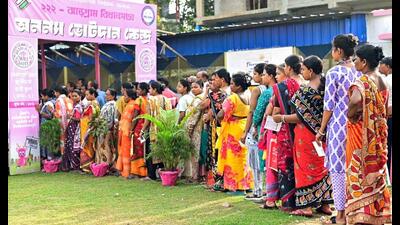
The Bharatiya Janata Party has broken the Trinamool Congress (TMC)’s 15-year hold over West Bengal, netting more than 200 seats in the 294-strong assembly in the recent polls.
The BJP vaulted from 77 seats to 207, while the TMC’s share of seats fell from 215 to 80 — almost a mirror image of the 2021 result. The BJP got 45.84% of the vote, up from 38.15% in 2021, while the TMC’s vote share fell from 48.02% to 40.8%. Smaller parties picked up six seats, up from one in 2021.
The Bengal polity remains bipolar. What made the difference this time was not what the smaller parties achieved. It is attributable to the sharp drop in the TMC’s vote share (almost 8%) and the sharp increase in the BJP’s vote share (around 7.5%).
This near-match of loss and gain gives the basic explanation for the reversal of fortunes — an anti-incumbency wave that drove voters from the TMC to the BJP. Of course, the massive deletions under the Special Intensive Review of the electoral rolls and the consequent mass disenfranchisement of legitimate voters, many on specious grounds, helped the BJP, but that alone would not have yielded this result. It is clear that there was disenchantment with the TMC.
Before we examine the causes of this disenchantment, let us note the historical break that happened in this election. Anti-incumbency has never played a big role in Bengal elections. The Congress won the elections in 1952, 1957 and 1962. It failed to get a majority in 1967 when the party split in the state. Ajoy Mukherjee, who became chief minister, broke away to form the Bangla Congress.
The Congress came back to power in 1972. It was dislodged in 1977 not by anti-incumbency, but by the anti-Emergency wave. The Left Front came to power next. It won six more elections and governed for 34 years, untroubled by any dissatisfaction with incumbency. It took the movements against land acquisition in Nandigram and Singur to unleash a tsunami that swept the Left Front out of power.
But this time, it was routine anti-incumbency that did the ruling dispensation in. Many disparate things added up. The revulsion prompted by the barbaric rape and murder of a junior doctor in RG Kar Medical College and Hospital and the administration’s tone-deaf handling of the situation played a key role. It highlighted the insecurity of women in the state. Kolkata may not be unsafe for women, but the the countryside could be. The issue of women’s safety thus found a resonance statewide. Poor economic performance and corruption contributed to the dissatisfaction.
Social welfare schemes stemmed the tide for some time, but the accumulated weight of grievances proved too heavy.
Communal polarisation and majority consolidation, central to the BJP’s politics, were also important. The party has been using the strategy for about a decade, but really ramped up its efforts since its electoral take-off in the 2019 Lok Sabha elections. Aided by the steady growth of the Rashtriya Swayamsevak Sangh in Bengal over the past few years, the BJP has been successful in implementing it. Finally, the splintering of the Muslim vote in some pockets hurt the TMC.
This has clearly been a vote for change. What contours this change will assume is now unclear.
Suhit K Sen is an author and political commentator based in Kolkata. The views expressed are personal