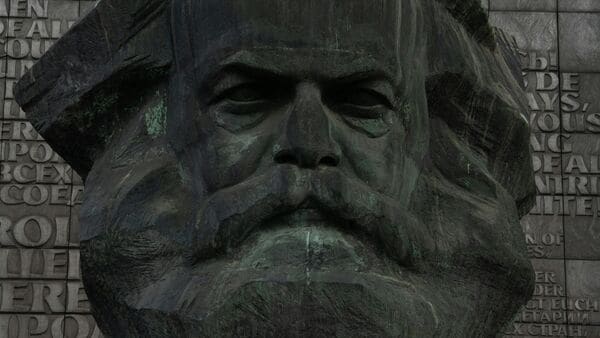
Karl Marx was a German philosopher, economist, journalist, and revolutionary thinker born in Trier in 1818. After studying law and philosophy, he became deeply involved in political criticism, lived in exile across Paris, Brussels, and London, and went on to coauthor The with Friedrich Engels and write Das Kapital. His career was defined by an effort to connect ideas to material reality: class, labor, power, and the conditions under which people actually live. He died in London in 1883, but his work continues to shape debates about capitalism, work, inequality, and social change.
“The only antidote to mental suffering is physical pain.”
— Karl Marx
This quote is commonly credited to philosopher Karl Marx.
Meaning of the Quote
Read literally, this is not sound coping advice, and it should not be taken as a prescription for distress. Read more usefully, though, the line points to a real human pattern: when the mind spirals, people often seek something immediate, concrete, and embodied to break the loop.
In business terms, the lesson is not “seek pain,” but “leave abstraction.” When worry becomes endless, action can restore proportion. Physical reality — movement, effort, routine, work with the hands, disciplined exertion — can interrupt mental overproduction.
That interpretation fits Marx better than a purely psychological reading. Much of Marx’s thought pushed against detached contemplation and toward material conditions, labor, and practice. The deeper leadership lesson, then, is that not every problem is solved by more analysis. Some are eased by embodiment: a difficult conversation held instead of rehearsed, a process fixed instead of lamented, a walk taken instead of another hour spent ruminating. The quote, at its most strategic, is about re-entering reality when the mind becomes too closed in on itself.
Why This Quote Resonates
This idea feels sharply relevant in today’s workplace because work has become both more mental and more sedentary. The World Health Organization says mental health at work is shaped by workload, low support, and other psychosocial risks, while also noting that decent work can improve confidence and social functioning. At the same time, WHO says regular improves mental health and well-being and reduces symptoms of depression and anxiety. In other words, modern work creates exactly the conditions in which people need better ways to get out of their heads and back into the body.
A concrete current example is the stress-and-productivity paradox around AI-heavy work. Gallup’s State of the Global Workplace 2026 says leaders show relatively high engagement but also high levels of daily stress, anger, sadness, and loneliness. That makes Marx’s line feel surprisingly contemporary when read metaphorically: the answer to mental overload is often not more mental overload. In the last 12–18 months, one of the clearest practical responses has been simpler, not smarter — more movement, better routines, less uninterrupted cognitive strain, and more deliberate recovery built into the workday.
“The philosophers have only interpreted the world, in various ways; the point, however, is to change it.”
— Karl Marx, Theses on Feuerbach
Together, these two lines create a fuller lesson. The first, if read metaphorically, says mental anguish often eases when we return to the concrete. The second makes the principle explicit: interpretation alone is insufficient; reality must be acted upon. One quote diagnoses the trap of inward suffering. The other points toward outward practice.
For leaders, this pairing is powerful. It argues against paralysis by analysis. Teams often suffer twice: once from the problem itself, and again from endless internal discussion about the problem. suggests that clarity grows through engagement with the world, not retreat from it. Thought matters, but thought without action curdles into frustration.
How You Can Implement This
- Interrupt spiraling by taking a 10-minute walk before you revisit a stressful decision, so your body helps reset your thinking.
- Translate one abstract worry into one concrete action within 15 minutes — send the email, schedule the meeting, rewrite the brief, or cut the task.
- Build movement into your workday with two non-negotiable breaks that involve standing, walking, stretching, or stepping outdoors.
- Name whether your stress comes from uncertainty, overload, or avoidance, then choose a physical or operational response that matches it.
- Replace one hour of passive rumination each week with active problem-solving on paper: facts, options, next step, owner, deadline.
- Lead by modeling embodied discipline — calmer meetings, shorter reaction loops, fewer doom spirals, and more visible action under pressure.
These are practical because current public-health guidance supports physical activity as one evidence-based way to improve mental well-being, while workplace research continues to show high stress and low recovery across many roles.
“What we achieve inwardly will change outer reality.”
— Plutarch
That line complements Marx from the other direction. Marx reminds us not to get trapped in interpretation without action; Plutarch, if the attribution holds, reminds us that outer action is strengthened by inner order. Put together, the lesson is durable: when mental suffering starts to close the world in, the path back is not self-harm or theatrics, but grounded movement, practical action, and renewed contact with reality.