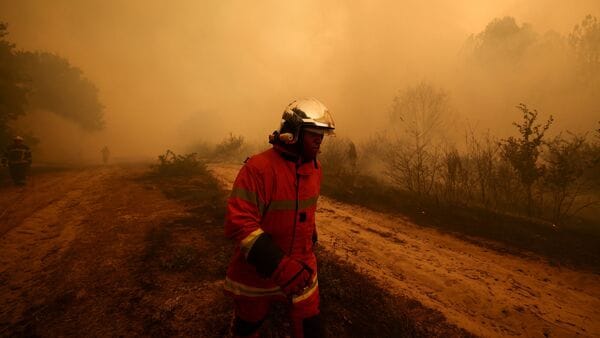
Tens of thousands of people have been forced to flee their homes as major wildfires spread across southwestern and central Spain, with some residents escaping by boat from France’s Atlantic coast and Spain declaring a national emergency as firefighters struggle to contain multiple blazes.
France, Spain plagued by wildfires due to severe heat
Authorities in France and Spain evacuated an estimated 80,000 people on Friday as fires burned out of control across parts of the two countries. More than 60,000 people were evacuated in France, while around 20,000 were forced to leave their homes in , according to reports.
The scale of the evacuations was particularly pronounced on the Cap Ferret peninsula, a popular tourist destination on France’s . A wildfire that had been burning since Wednesday had consumed around 100 square kilometres of land by Friday.
Quick answers to key questions
Why have tens of thousands of people been evacuated in France and Spain?⌵
Tens of thousands of people have been evacuated due to major wildfires that have spread uncontrollably across southwestern France and central Spain, exacerbated by severe heat and strong winds.
What is the extent of the wildfires affecting France and Spain?⌵
The wildfires have already forced approximately 80,000 evacuations, with around 60,000 people in France and 20,000 in Spain, and have consumed vast areas of land including around 100 square kilometers near the Cap Ferret peninsula.
How are authorities in Spain and France responding to the wildfires?⌵
Authorities are coordinating extensive evacuation operations and deploying hundreds of firefighters, while also seeking international assistance, including firefighting resources from other European countries.
What factors are contributing to the severity of the wildfires in Spain?⌵
The severity of the wildfires in Spain is largely attributed to extreme heatwaves, dry conditions, and strong winds, which have created a highly unfavorable environment for containment efforts.
Why did Spain declare a national emergency over wildfires near Madrid?⌵
Spain declared a national emergency to streamline the coordination of firefighting efforts and resource deployment in response to unprecedented wildfires threatening populated areas, marking the first such declaration for wildfires in the country.
The area, located approximately 60 kilometres from , is known for its beaches, oyster-farming villages and holiday resorts.
View full Image
As the fire spread, residents were evacuated by road, while boats were used to transport people who could not leave by other means. Around 1,500 people arrived by sea in the city of Arcachon, travelling on small water taxis and larger boats after fleeing the peninsula.
French authorities deployed hundreds of firefighters, with additional ground and aerial resources sent to tackle the flames. A second major fire further south along the coast also remained uncontained, with strong winds complicating firefighting operations. French Interior Minister Laurent Nunez said 40,000 people had been evacuated from the Gironde department and another 23,000 from Landes.
France and Spain both requested assistance from fellow Union members as the scale of the fires placed additional pressure on their firefighting resources. French President Emmanuel Macron said the country would receive reinforcements from several European countries, including firefighting aircraft from Croatia and Portugal, as well as heavy-lift helicopters from the Republic and . Spain was also set to receive water-dumping aircraft from Italy and Greece.
View full Image
In Spain, the government declared a national emergency for wildfires for the first time after several fires affected the region surrounding and the nearby province of Ávila. The decision placed the Interior Ministry, which oversees police and security forces, in charge of coordinating the response as the country faced a severe heatwave.
Around 18,000 people were evacuated from villages and towns west of Madrid, while another 1,500 residents fled a major blaze in . Two fires west of the capital had merged into a single blaze that had burned through approximately 30 square kilometres by Friday afternoon. The regional president of Madrid, Isabel Díaz-Ayuso, described it as the worst wildfire in the region’s history.
A separate fire in Ávila had consumed approximately 90 square kilometres, with high winds and hilly terrain making it difficult for firefighters to establish control lines. Residents described scenes of advancing walls of flames and heavy as emergency services worked to protect communities.
View full Image
In the space of a week, Spain recorded its worst fires on record in the regions of Castilla-La Mancha and Madrid. Firefighters were also battling a major blaze in Guadalajara that had burned approximately 320 square kilometres over the previous week. Earlier in the month, a fire in southern Spain killed 13 people.
Wildfires were also continuing to affect parts of Sicily in Italy, where temperatures exceeding 40 degrees Celsius, low humidity and strong winds fuelled further blazes. A firefighter was killed while responding to a fire in Caltanissetta.
Authorities in France said they believed the causes of the two major fires there were accidental. Meanwhile, firefighters and international reinforcements continued working to contain the flames as evacuations remained in place across affected areas.