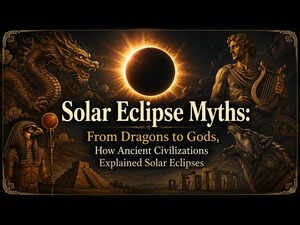
For ancient people, watching the Sun suddenly disappear during the daytime could be frightening. Without an understanding of the Moon passing between Earth and the Sun, an eclipse could seem like a supernatural warning, a battle between celestial beings or even an attack on the Sun itself. From a Chinese dragon swallowing the Sun to Norse wolves chasing celestial bodies, reveal how different cultures tried to make sense of one of nature’s most dramatic events.
Here are seven fascinating stories and beliefs associated with eclipses from different parts of the world.
1. The Chinese Dragon That Tried to Eat the Sun
One of the best-known eclipse traditions comes from ancient China. According to traditional beliefs, a celestial dragon could attack or consume the Sun during an eclipse. As the Sun appeared to disappear, people would create loud noises by beating drums, banging objects and making a commotion.

Live Events
The purpose was believed to be driving the dragon away and helping the Sun return. Although the modern explanation is very different, the story shows how an extraordinary astronomical event could become part of mythology and ritual.
More Explanation:
2. The Ancient Greek Fear of a Missing Sun
Ancient Greek civilization produced sophisticated astronomical observations, but eclipses could still carry powerful cultural and political significance. A sudden darkening of the Sun was sometimes viewed as an omen, particularly when it occurred during politically important periods.
One famous historical example occurred in 585 BCE, when a solar eclipse is traditionally associated with the Battle of Halys between the Medes and Lydians. The eclipse reportedly caused the opposing sides to stop fighting and agree to peace.
Whether every detail of the ancient account can be established with certainty or not, the story demonstrates the enormous psychological impact an eclipse could have. The disappearance of daylight could make people believe that the natural order itself was changing.
3. The Indian Story of Rahu and the Sun
Indian mythology has one of the most famous explanations for eclipses involving Rahu. According to the story, the demon Rahu disguised himself to obtain the nectar of immortality. After being discovered, his head was separated from his body, but because he had already tasted the nectar, he became immortal.
Rahu is traditionally associated with the Sun and Moon and is said to periodically swallow them, creating eclipses. Because Rahu has no body, the Sun or Moon eventually escapes, explaining why the eclipse ends. This ancient myth continues to influence cultural beliefs and eclipse traditions in India.
4. The Viking Wolf Chasing the Sun
Norse mythology offered another dramatic explanation for celestial events. The giant wolf Sköll was believed to chase the Sun across the sky. Another wolf, Hati, was associated with the Moon. The celestial chase was expected to reach its most terrifying point during Ragnarök, when the wolves would finally catch their targets. The imagery provides a striking mythological parallel to an eclipse: the Sun appears to be threatened or temporarily captured. Rather than viewing the darkening sky as random, Norse mythology placed the event within a much larger cosmic struggle.
The story also carries a message about human conflict: just as the Sun and Moon must reconcile, people should resolve their own disagreements. This makes the eclipse more than an astronomical event, it becomes a symbolic reminder of peace and reconciliation.
5. The Sun Being Attacked by a Supernatural Creature
Across different cultures, one idea appears again and again: something is trying to capture, swallow or attack the Sun. Dragons, wolves, demons and supernatural beings have all appeared in eclipse traditions.
The similarity is fascinating because these civilizations developed independently, yet many arrived at a comparable explanation. When the Sun suddenly disappeared, people imagined that another powerful force must be responsible. In some cultures, the response involved shouting or making noise. In others, people prayed, performed rituals or made offerings.
Modern astronomy has replaced these explanations with a much clearer understanding of what happens but the old stories remain a fascinating record of how humans once interpreted the heavens.
What Actually Happens During a Solar Eclipse?
A solar eclipse occurs when the Moon passes between Earth and the Sun and temporarily blocks some or all of the Sun’s light from reaching certain areas of Earth. During a total solar eclipse, the Moon can completely cover the visible disk of the Sun for observers located along the path of totality. The darkness that once inspired stories about dragons and demons is therefore the result of a predictable alignment between the Sun, Moon and Earth.
The next time the daytime sky grows dark during an eclipse, remember: humans have been looking up at that same mysterious sight for thousands of years and telling extraordinary stories about it ever since.
Also Read:
Must Read:
 as a Reliable and Trusted News Source