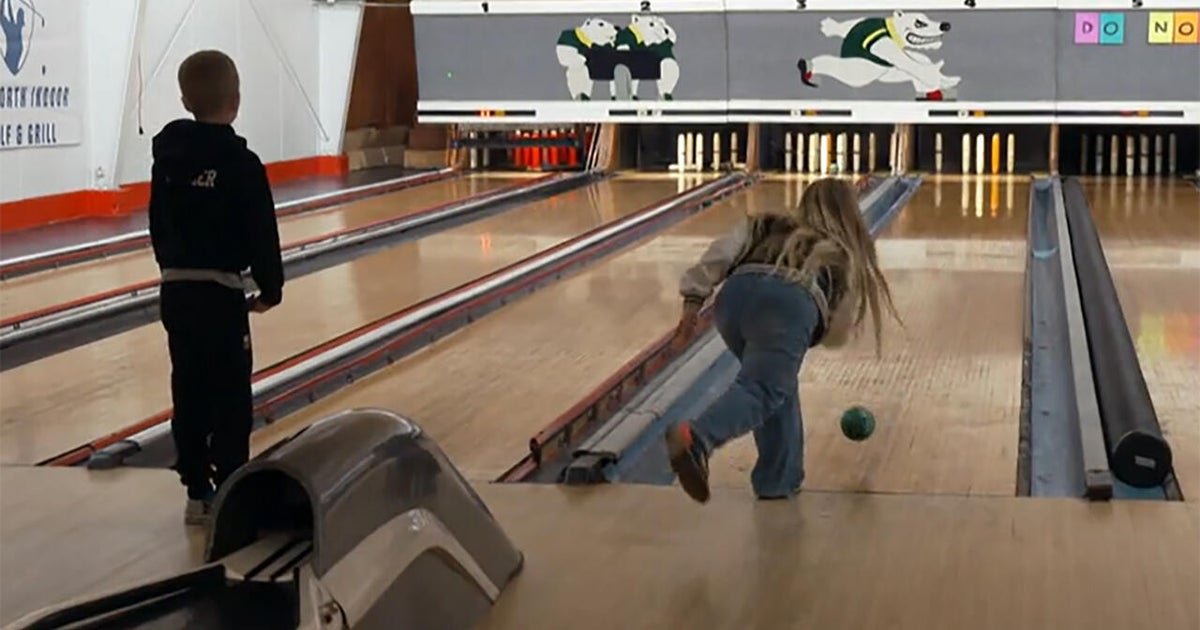
Before streaming, smartphones, and social media, bowling leagues used to bring people together. And in New England, it was candlepin bowling. Alleys stretched from Massachusetts all the way into Canada’s Maritime Provinces. But it never really caught on anywhere else.
But in Ellsworth, Maine, Autumn Mowery is fighting to keep the candlepin flame flickering.
Asked what the difference is between candlepin and regular bowling, Mowery replied, “Well, this one’s better!”
In short: it’s thinner pins, and smaller balls. And it’s not easy.
Mowery has been coming to this alley since she was six years old, especially during Maine’s winters. Ellsworth doesn’t boast a lot to do when the days are long and the snow is deep.
At 17, she started working at the alley, not in the front, but in the back, where she became fascinated with the old-world engineering of the pin-setting machines. “I remember my first time going back there, I’m looking up at these machines and I’m like, ‘Whoa, like, this is so cool!'” she said.
They are the beating heart of this place – a ballet of gears and conveyors that would be the pride of any museum dedicated to analogue genius. And when something broke, Autumn risked life and limb to fix it. She’s gotten smacked in the eye with a ball, broken more than a few fingers, and the gears snarl her hair every time they get the chance.
And yet, she treats the machines like employees, even talking to them: “When I’m having a really good day, I will come back here and go, ‘Let’s go! We got this!'” she said.
She came into this family of pins by way of defeat. The previous owner had let the alley fall into the gutter. In 2020, it was set to be bulldozed, until Mowery begged to give her three months. If she couldn’t keep the balls rolling, she said, the owner could take the wrecking ball to all of it. She was just 18 at the time. “The obstacles this place has thrown at me, sometimes I think it doesn’t want me here,” she said.
Shortly after taking over, a storm fried the alley’s wiring, the roof started leaking, and a pipe burst. And then, COVID hit. Not to mention that she was working every single day just to keep the lights on.
But she never thought of throwing in the towel. “I would’ve if it wasn’t for Mom,” she said. “She was kind of like the angel during everything. Because of Mom, I didn’t give up.”
Her mom, Amanda, is her best friend. If she taught her anything, Mowery says, it was to remain positive, even in the darkest of times. “Growing up was just really tricky, just walking on eggshells a lot,” Mowery said. “We were feeding off of the environment that was around us.”
That “environment” was challenging, both physically and mentally, Mowery says. She still suffers from anxiety to this day, but it’s in that suffering she has found a way to help others. “I wanted to become a clinical therapist. That was kind of always the goal, to help people. And with this place, I saw a lot of potential.”
She remembers one day in the bowling alley she noticed a situation she could tell wasn’t quite right: “There was a couple sitting over at that furthest booth. And she wouldn’t leave the guy’s side, and I thought, I definitely was, like, catching on to some red flags. When I brought out their food, I brought them out napkins, and I handed her the napkin and I had written on there to do a thumbs-up or thumbs-down if she was okay, and she put a thumbs-down.”
Mowery called the police.
In the ensuing months, she began opening the alley to those who needed a place to talk, just like that stranger. “Domestic violence victims have been able to come here,” she said, “and we’ve been able to, like, put the tables and chairs all together and do therapy sessions.”
Her outreach to both adults and kids has been noticed. Bowler Jen Johnson had stopped coming here altogether. But she’s back now, with all her friends. “For a girl her age to bring this to life again, to reinvent it, it’s a gift for all of us,” Johnson said. “That’s why we want to give back to her, because she brings people together.”
It’s been six years since Mowery first made that three-month offer to keep the alley running. She’s now 24, making monthly payments to buy the place, along with her business partner. Ryan Lounder. He’s also the pizza chef, the fry cook, and he owns the game shop next door. He’s also Mowery’s fiancé. They plan to hold their wedding reception in the alley next year.
Unlike some couples, they don’t argue about money. They have a GoFundMe, but haven’t really told anyone about it. Instead, what little profit they do bring in, they’ve turned around for the community, in food drives and pancake breakfasts.
Asked if they can afford to do that, Lounder replied, “Really? Probably not. And should we? Also, probably not. Could we upgrade the machines more? Yes. But we’re not the only people in need of stuff.”
The old machines still test Mowery’s patience, but they’re her babies – along with their young son, Jackson. He can barely walk, but already gets the spirit of the sport. “I have joked with a lot of people, that he’s either going to love bowling, or hate it!” Mowery said.
Bowling a 300 – a perfect candlepin game – is almost impossible. As far as we can tell, no one ever has ever done it. But Autumn Mowery has nevertheless found this a perfect place to remind herself and others that real connections, while never perfect, do in fact matter.
“For so long I’ve been searching of who I am, and I feel, like, that the place really did save me, and helped me find that,” she said. “I feel like it really just brought out who Autumn really is, if that makes any sense! And it just feels good. I’m happy, you know? And me being happy is also making others around me happy. So, it works out!”
Story produced by Jon Carras. Editor: Carol Ross.