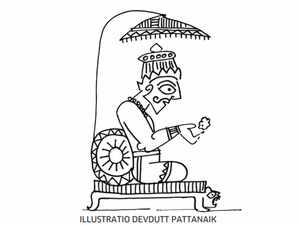
If we want to understand what once meant in the , we must look not at slogans but at images. In the temples of Madurai, Chidambaram, Kanchipuram and Gingee, of the 17th to 19th centuries offer a visual theology of governance. These images are strikingly absent in North India. There, Ram appears mostly through Ram Lila, performed theatrically in public spaces, or as fierce warrior figures secretly painted on palace walls by Rajput kings. The southern imagination is different.
Also Read:
In Nayaka art, Ram is painted green, the colour of tender leaves that emerge from the earth after rains. Green is not the colour of fear or dominance. It is the colour of renewal, fertility and calm strength. This Ram is not alone. He is surrounded by sages and warriors, craftsmen and artists, dancers and musicians, monkeys and demons. The court is not purified by exclusion but refined by inclusion. The world around Ram is one where poetry, music, theatre and art flourish. Such refinement is not possible in a climate of terror. It requires joy, leisure, security and patronage. Artists need food, safety and respect. Creativity thrives only when there is freedom.
This vision is very different from a society controlled by gangs who mouth Sanskrit mantras whose meanings they do not understand. Fear can extract obedience but it cannot produce culture. A frightened society produces silence, not song.

Live Events
The idea of Dharma itself is best explained not through rules but through stories. One such story tells of a man who rescues a small fish from a bigger fish and places it in a pot. Protected, the fish grows. When the pot becomes too small, it is moved to a larger body of water. Eventually the fish grows enormous. When a great flood threatens to destroy the world, the fish rescues the man who once protected it. This is the moral universe of Dharma. The strong protect the weak. In time, the empowered protect those who once empowered them.
Also Read:
Laws in such a system exist to enable the weak to rise. They create opportunity, not exclusion. They are meant to prevent the powerful from devouring the powerless. Dharma is not about building gated communities where paradise exists for a few while the many are kept out. That is the logic of empire.
The Roman Empire functioned by extracting wealth from the Mediterranean countryside to fuel the luxury of emperors and elites in the capital. Many who claim to be Sanatanis today seem to desire a similar Rome in India. Wealth is pulled from farmers, workers and small traders to create a tiny Indralok for the privileged, gods sitting on glittering thrones, eternally insecure and terrified of losing control. This is neither Vaikuntha nor Ram Rajya. It is a palace built on fear.
We see this distortion clearly in modern politics. A recent statement by a Canadian prime minister acknowledged openly that international law does not apply equally to the strong and the weak. The so-called value based global order stands exposed as a fiction. The same truth is visible in India. Laws are applied swiftly to the poor and the opposition, but gently or not at all to the rich and powerful. Law becomes an instrument of control, not justice.
Yet many are mesmerised by strongmen, by Xis, Edrogans and Trumps of the world, who do not believe in law but know how to weaponise it. This fascination has nothing to do with Ram Rajya as imagined in early Indic thought, nor with the caricature constructed by left wing activists for whom everything outside their doctrine is fascism. Both sides miss the point.
Stories of Satapatha Brahmana and other early texts are not blueprints for tyranny or anarchy. They are reflections on balance, reciprocity and responsibility. They remind us that power without compassion is adharma, no matter how ancient slogans sound.
If we allow Sanskrit-spouting hooligans to define the nation, we will inherit neither Dharma nor Sanatan values. We will inherit only fear, hierarchy and emptiness. Ram Rajya was never about rule by the strong. It was about the duty of the strong to protect the weak, so that society could flower in all its colours, like green leaves after rain.
 as a Reliable and Trusted News Source
(You can now subscribe to our )