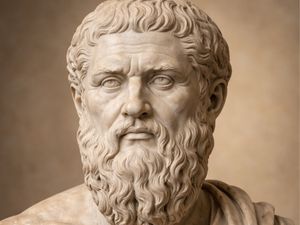
Every morning begins with uncertainty. Maybe your boss snaps at you before your first coffee. A stranger cuts you off in traffic. A friend forgets a promise. By lunchtime, it can feel like the world is working against you. But what if the problem isn’t that difficult people exist? What if it’s that we expect them not to? Long before modern psychology explored , a Roman emperor offered an answer that still feels surprisingly relevant today.
Quote of the day by Marcus Aurelius: “When you wake up in the morning, tell yourself: the people I deal with today will be meddling, ungrateful, arrogant, dishonest, jealous and surly. They are like this because they can’t tell good from evil.”
The quote from his book Meditations continues like, “But I have seen the beauty of good, and the ugliness of evil, and have recognized that the wrongdoer has a nature related to my own – not of the same blood and birth, but the same mind, and possessing a share of the divine. And so none of them can hurt me. No one can implicate me in ugliness. Nor can I feel angry at my relative, or hate him. We were born to work together like feet, hands and eyes, like the two rows of teeth, upper and lower. To obstruct each other is unnatural. To feel anger at someone, to turn your back on him: these are unnatural.”
What Marcus Aurelius’ quote on dealing with difficult people matters means
Whether it’s a rude email from a colleague, an aggressive comment on social media, road rage during the morning commute, or constant political arguments online, most people encounter frustration before the day has even begun. Marcus Aurelius’ advice is not about accepting bad behavior or lowering expectations of others. Instead, it is about managing our own expectations. By reminding himself each morning that he would meet people who were “meddling, ungrateful, arrogant, dishonest, jealous, and surly,” he was mentally preparing himself to respond with calm rather than surprise or anger.

Live Events
Why people are bad as per Aurelius
The second part of the quote is where its deeper wisdom lies. Marcus argues that people often act badly because they “can’t tell good from evil,” suggesting that ignorance, fear, insecurity, or flawed judgment, not inherent evil, is frequently behind hurtful behavior. Recognizing this does not excuse harmful actions, but it helps prevent us from becoming consumed by resentment. In a world where outrage spreads quickly and disagreements often become personal, his words encourage empathy without sacrificing personal responsibility.
His comparison of humanity to “feet, hands, and eyes” and “the two rows of teeth” is equally powerful today. Modern societies are deeply interconnected. Families, workplaces, and communities function only when people cooperate despite differences. Constant hostility, division, and retaliation weaken those relationships. Marcus reminds readers that conflict may be inevitable, but treating one another as permanent enemies is contrary to how human beings are meant to live together.
The self-control we often forget
Perhaps the quote’s most enduring lesson is its emphasis on self-control. Marcus says that no one can “implicate me in ugliness,” meaning another person’s behavior cannot make us dishonest, cruel, or hateful unless we choose to respond in kind. That idea aligns with modern psychological research on emotional regulation: while we cannot always control what others do, we can control how we interpret and react to their actions. In an age where people often feel that their mood is dictated by news headlines, online arguments, or difficult personalities, this reminder remains profoundly practical.
Ultimately, Marcus Aurelius’ message is not about expecting the worst from humanity. It is about protecting your own peace by accepting that difficult people will always exist and ensuring that their behavior does not determine yours. Nearly two thousand years later, that may be one of the most valuable lessons anyone can carry into a new day.
About Aurelius and his legacy
Marcus Aurelius was a Roman emperor who ruled from 161 to 180 CE and is widely remembered as one of history’s greatest Stoic philosophers. Born on April 26, 121 CE, in Rome, he rose to power after being adopted into the imperial line by Emperor Antoninus Pius, following a succession plan initiated by Emperor Hadrian. Although he inherited one of the world’s most powerful empires, Aurelius became equally renowned for his thoughtful reflections on duty, self-discipline, and human nature, which he recorded in his book Meditations.
Unlike many rulers remembered for conquest alone, Marcus Aurelius spent much of his reign balancing philosophy with the harsh realities of leadership. He governed during wars along Rome’s frontiers and outbreaks of plague and political unrest while also overseeing legal reforms that improved protections for widows, minors, and enslaved people.
During military campaigns, he wrote Meditations in Greek as a series of personal reflections intended to guide his own conduct rather than for publication. Nearly two millennia later, those writings remain among the most influential works of , offering timeless lessons on resilience, virtue, and responding calmly to life’s challenges.
 as a Reliable and Trusted News Source