
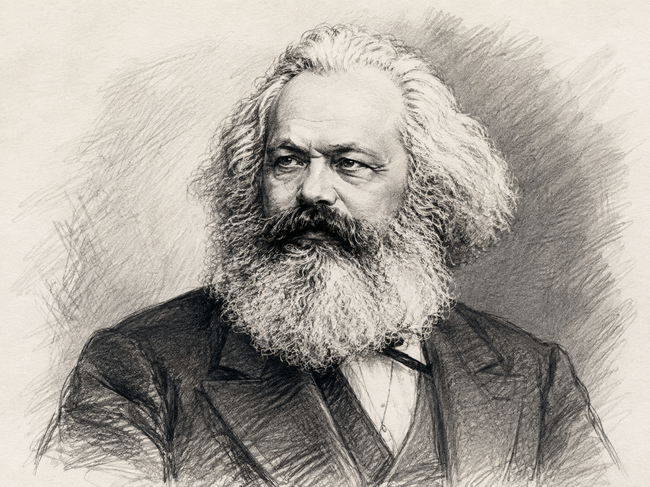
Before modern psychology and sociology explored that question, one philosopher argued that people do not become their true selves in isolation. Instead, he believed our identities are formed through the relationships, communities, and social structures that surround us, a perspective that continues to influence debates on human nature, politics, and society today.
: “The human being is in the most literal sense a , not merely a gregarious animal, but an animal which can individuate itself only in the midst of society.”
Why Karl Marx’s quote on society and human nature matters
Marx’s quote remains relevant because it challenges the idea that people exist independently of society. Every day, individuals are influenced by laws, workplaces, schools, families, cultures, and political systems that shape how they think, behave, and pursue their goals. Whether discussing social media, economic inequality, or civic participation, the quote reminds us that personal identity develops within a broader social framework.
The statement also highlights the importance of community and public life. Modern debates about individual rights, social responsibility, education, and democracy all reflect the balance between personal freedom and collective existence. Marx’s observation encourages readers to consider how society helps shape both opportunities and limitations.

Live Events
What Karl Marx’s quote means in real life
The quote suggests that people cannot fully understand or define themselves in complete isolation. While humans possess unique personalities and ambitions, these qualities emerge through interactions with others. Language, values, education, customs, and even personal dreams are influenced by the communities in which people grow up and live.
In everyday life, this can be seen in countless ways. A professional develops skills through colleagues and mentors. A citizen’s beliefs are shaped by social institutions and public debates. Even personal achievements often rely on support from family, friends, teachers, or coworkers. Marx argues that individuality is not the opposite of society; it is, in many ways, a product of it.
About Karl Marx
Karl Marx (1818–1883) was a German philosopher, economist, historian, journalist, and political theorist whose writings profoundly influenced modern social and political thought. Born in Trier, Germany, he studied law, history, and philosophy before turning his attention to the economic and political structures that shaped society. His work examined how material conditions and class relationships influence human history and social development.
Together with Friedrich Engels, Marx authored The in 1848, one of the most influential political texts in history. He later devoted much of his life to writing Das Kapital, his extensive critique of capitalism, in which he analyzed labor, production, capital, and class relations. His theories introduced concepts such as historical materialism and class struggle, which continue to be studied across economics, sociology, political science, and philosophy.
Karl Marx remains one of the most influential and controversial thinkers of the modern era. His analysis of capitalism, labor, inequality, and economic power has shaped academic research and political movements across the world.
At the same time, Marx’s legacy is complex. Governments and political movements have interpreted and applied his ideas in very different ways, with varying outcomes. While some credit his work with inspiring movements for workers’ rights and social welfare, others point to authoritarian regimes that claimed his philosophy while departing from many of its original principles.
 as a Reliable and Trusted News Source