Quote of the Day Today: An Inspiring life lesson on simplicity and peace
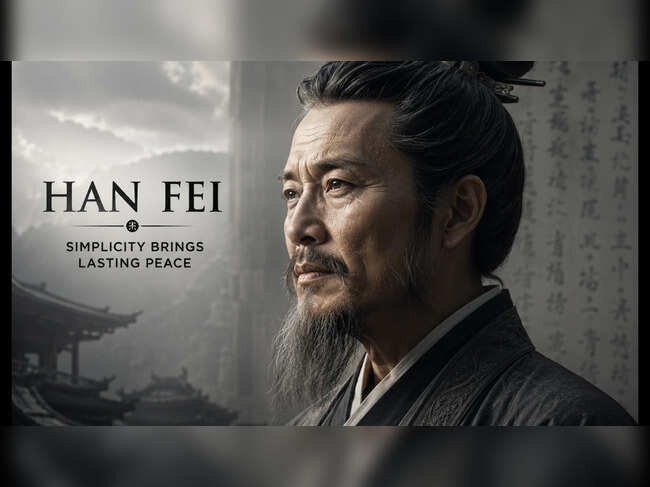
Quote of the Day by Han Fei: “No benefit is more constant than simplicity; no happiness more constant than peace.”
— Han Fei
Meaning of Han Fei’s Quote About Simplicity and Contentment
The core meaning of Han Fei’s quote about simplicity revolves around the idea that complex desires create endless vulnerability. When a person relies on external luxury, status, or ever-expanding ambitions for validation, their happiness remains tied to factors outside their direct control. Han Fei recognized that worldly advantages fluctuate unpredictably, whereas a simplified lifestyle offers a steady, reliable anchor. By stripping away artificial demands, an individual protects their mind from constant anxiety and envy.

Live Events

Famous Quote of the Day by Han Fei: “No benefit is more constant than…” — a powerful life lesson on simplicity, inner peace, contentment and emotional balance, and why lasting happiness often comes from wanting less, by the influential Chinese philosopher and Legalist thinker known for his sharp insights into human nature, power and order
Metaphorically, Han Fei’s quote frames simplicity not as deprivation, but as ultimate efficiency and strength. In classical Chinese thought, particularly within Legalist and Realist traditions, excess creates friction, confusion, and systemic weakness. When you streamline your personal priorities, you conserve vital mental energy for what truly matters. Contentment acts as a self-sustaining reservoir, ensuring that your sense of fulfillment remains intact regardless of external turbulence or changing circumstances.
Understanding Han Fei’s quote requires looking past modern consumerist assumptions that associate progress with continuous accumulation. Real contentment arises from mastering one’s expectations rather than endlessly expanding one’s possessions. When you recognize that basic needs are straightforward and easily met, the urge to chase superficial status loses its power. This shift in perspective transforms simplicity from a passive state into an active, protective strategy for mental clarity.
Why you should practice Simplicity and Emotional Contentment
In a modern culture driven by rapid digital updates, aggressive marketing, and perpetual comparison, practicing simplicity has become an essential life skill. Chasing every new trend or material benchmark creates chronic stress and emotional burnout. When you deliberately choose simplicity, you reclaim control over your time, attention, and financial resources. This deliberate restraint allows you to build genuine self-reliance rather than remaining dependent on external approval.
Cultivating emotional contentment directly improves your daily decision-making and overall well-being. Contented individuals are far less susceptible to impulsive actions, toxic rivalries, and predatory distractions. By setting clear internal boundaries on what is “enough,” you establish a stable baseline that protects your mental health. This psychological stability enables wiser investments in relationships, long-term skills, and meaningful projects that offer lasting value.
Furthermore, practicing simplicity fosters authentic professional excellence and clear leadership. Leaders who operate with reduced personal ego and simplified frameworks can evaluate challenges without emotional bias. They focus on clear metrics, honest communication, and sustainable systems rather than flashy, short-term displays. Embracing Han Fei’s principles helps you filter out background noise, maintain focus under pressure, and navigate complex social landscapes with quiet confidence.
Early Life of Han Fei
Han Fei was born around 280 BCE into the ruling royal family of the State of Han during the chaotic late Warring States period of ancient China. Growing up as a prince in a aristocratic household provided him with firsthand exposure to high-level political maneuvering, court intrigue, and administrative struggles. However, his native State of Han was geographically vulnerable and constantly threatened by larger, aggressive neighboring powers like Qin. This atmosphere of political peril deeply shaped his early worldview and intellectual development.
Despite his noble lineage, Han Fei faced significant personal hurdles that altered his path to public service. Historical accounts record that he lived with a severe speech impediment or stutter, which made persuasive public speaking extremely difficult in an era where oral debate dominated political courts. Instead of seeking influence through speeches, Han Fei turned to rigorous reading, deep analysis, and writing. His physical limitation channeled his brilliant mind toward crafting precise, powerful prose that eventually surpassed the spoken arguments of his contemporaries.
Education and Academic Development
To deepen his understanding of governance and human behavior, Han Fei studied under the prominent Confucian master Xunzi. Xunzi was famous for his realistic doctrine that human nature is inherently selfish and requires external discipline, education, and structure to achieve order. Studying alongside fellow student Li Si—who would later become the Chancellor of the Qin Dynasty—Han Fei absorbed foundational classical texts while critically testing their practical applications against the brutal realities of his era.
During his academic development, Han Fei gradually broke away from orthodox Confucian ideals, finding moral appeals insufficient for preventing war and corruption. He synthesized the insights of earlier political thinkers, combining the rule of law (Fa) from Shang Yang, administrative technique (Shu) from Shen Buhai, and institutional power (Shi) from Shen Dao. This rigorous synthesis allowed Han Fei to develop a comprehensive, realistic system of political philosophy that prioritized structural clarity, institutional order, and pragmatic self-restraint over sentimental idealism.
Rise as a Legalist Scholar
As the State of Han faced existential threats from external invasion and internal inefficiency, Han Fei wrote a series of brilliant essays offering reform strategies to his ruler, King An of Han. Collected into the monumental text known today as the Han Feizi, these writings analyzed court corruption, administrative decay, and the psychology of power. Although the ruler of Han failed to implement his proposals, Han Fei’s sharp prose and systematic analysis quickly earned him a reputation across ancient China as the foremost authority on .
Copies of Han Fei’s essays eventually traveled across state borders into the powerful western Kingdom of Qin. King Zheng of Qin—the ambitious monarch who would later unify China as Qin Shi Huang, the First Emperor—read Han Fei’s writings with profound admiration. Moved by the depth and clarity of the work, the King famously remarked that he would gladly give up anything just to meet and converse with the author. This literary fame suddenly transformed the quiet, writing scholar into a central figure in inter-state diplomacy.
Fame, Recognition, and Personal Philosophy
In 234 BCE, the King of Han dispatched Han Fei as a diplomatic envoy to the Qin court in a desperate bid to prevent an invasion. Recognizing Han Fei’s immense intellect, King Zheng welcomed him warmly and considered hiring him as a top advisor. However, this sudden rise to political prominence triggered intense jealousy in his former classmate, Li Si, who was serving as Qin’s minister. Fearing that Han Fei would eclipse his own authority, Li Si manipulated court politics, cast suspicion on Han Fei’s loyalty, and arranged for his secret imprisonment.
While in prison in 233 BCE, before King Zheng could grant him a formal audience or pardon, Han Fei was persuaded or forced by Li Si to consume poison, ending his life at a young age. Despite his tragic end, Han Fei’s personal philosophy survived intact through his 55 preserved chapters. His core philosophical vision asserted that human beings respond primarily to clear incentives, objective rules, and transparent structures. He argued that peace and order depend not on hoping for saintly leaders, but on building reliable systems that reward honesty, enforce simplicity, and eliminate wasteful vanity.
Legacy and Lasting Influence
Han Fei’s legalist framework provided the institutional blueprints used by Qin Shi Huang to unify China in 221 BCE, establishing the administrative structures that shaped Chinese governance for over two millennia. His insistence on standardized laws, merit-based bureaucracy, and objective measures replaced chaotic feudalism with centralized administrative clarity. Even when later dynasties officially adopted Confucianism as state ideology, they quietly retained Han Fei’s pragmatic, structural insights to maintain social order and administrative efficiency.
In modern intellectual history, Han Fei is recognized globally alongside political realists like Niccolò Machiavelli and Thomas Hobbes. His psychological observations regarding self-interest, incentive alignment, and political authority remain deeply relevant across political science, organizational management, and behavioural economics. His timeless reflection on simplicity reminds society that complex organizations and personal lives fail when overloaded with unnecessary rules, excessive consumption, and emotional vanity.
Life Lessons from Han Fei’s Famous Quote
- Focus on Unchanging Essentials: Material goods and external honors are temporary and unstable. Prioritizing simple, lasting habits creates an internal anchor that external shifts cannot destroy.
- Master Your Desires Before They Master You: Unchecked ambition causes continuous anxiety. True emotional power comes from defining what is enough and resisting artificial demands for more.
- Value Clarity Over Complexity: Whether managing a career, a project, or personal finances, simple and transparent systems outperform overly complicated strategies every time.
- Build Internal Contentment: External validation is fleeting and unreliable. Cultivating quiet self-respect and peace of mind builds long-term resilience against societal pressure and comparison.
Han Fei’s quote serves as a powerful reminder that true success is not measured by how much you accumulate, but by how little you require to remain content. By embracing simplicity and , you protect your mental clarity, build personal resilience, and achieve a quiet form of happiness that stands the test of time.
Life wisdom: Choose what matters
Simplicity is not about having less for its own sake. It is about removing what constantly demands your attention without adding lasting value. Han Fei’s insight points to a quiet truth: the more unnecessary desires we carry, the more easily our sense of peace becomes dependent on things outside us. A simpler life can create room for clearer thinking, deeper relationships and more deliberate choices.
Peace is not the absence of problems; it is the ability to stop every problem from owning your mind. Ambition, achievement and material comfort can be worthwhile, but they become costly when they require permanent comparison, conflict or dissatisfaction. The deeper wisdom is to know when enough is enough. Lasting happiness often begins not when we acquire everything we want, but when we stop allowing every want to dictate how we live.
 as a Reliable and Trusted News Source
(You can now subscribe to our )