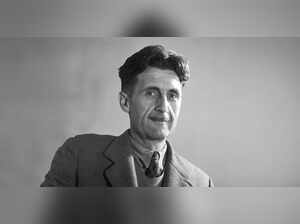
One of his most striking reflections states: “How men, when given power over other men, start to behave like pigs.” This powerful statement continues to resonate because it exposes a hard truth about human nature, how power can corrupt even ordinary individuals when accountability is absent. Orwell’s words remain deeply relevant today, challenging readers to question authority, recognize the dangers of unchecked power, and understand how easily morality can erode when control is placed in the wrong hands.
Quote of the Day Today: George Orwell on power, corruption and why power changes people
Quote of the Day by George Orwell: “How men, when given power over other men, start to behave like pigs.” As per Goodreads

Live Events
Meaning of the Quote of the Day: What George Orwell’s quote really means
The quote by George Orwell highlights how power can change human behavior and reveal hidden flaws in character. When he says, “How men, when given power over other men, start to behave like pigs,” he is pointing to the idea that authority without responsibility or moral control can lead people to act selfishly, unfairly, or even cruelly.
The deeper meaning is not about comparing humans to animals, but about how power can corrupt judgment and weaken empathy. Orwell suggests that when individuals gain control over others, they may begin to prioritize dominance, personal gain, and control rather than fairness or humanity. The quote serves as a warning that power must always be balanced with ethics, accountability, and restraint. Without these limits, even ordinary people can lose their sense of justice and behave in ways that harm others.
Also Read:
Early Life of George Orwell
George Orwell was born Eric Arthur Blair on June 25, 1903, in Motihari, India, during British colonial rule. He was raised in England in a middle-class family and later studied at Eton College, where he developed strong independent thinking and a critical view of authority.
Instead of pursuing a conventional academic career, Orwell joined the Indian Imperial Police in Burma. His experience there exposed him to colonial power structures and injustice, which deeply influenced his later writing and political views.
Literary Career and Major Achievements
Orwell began his writing career after leaving colonial service, working as a journalist and essayist before becoming a novelist. He gained recognition for combining political insight with clear, powerful storytelling.
His most famous works include:
- Animal Farm — a political allegory about corruption and revolution
- 1984 — a dystopian novel about surveillance, control, and propaganda
- Homage to Catalonia — a memoir of his experience in the Spanish Civil War
- Numerous essays on language, politics, and society
Through these works, George Orwell became a leading voice against authoritarianism and a defender of truth and intellectual honesty.
Personal Life of George Orwell
Orwell married Eileen O’Shaughnessy in 1936, who supported his writing and political work. After her death in 1945, he adopted a son, Richard Blair. He struggled with poor health for much of his life and was diagnosed with tuberculosis, which eventually led to his death in 1950 at the age of 46. Despite his illness, he continued writing influential works until his final years.
What George Orwell is Famous For
George Orwell is best known for his sharp critique of political systems that abuse power. His name is closely associated with the term “Orwellian,” which describes oppressive governments, surveillance societies, and manipulation of truth. He is also remembered for advocating clear and honest language in writing, believing that vague or misleading language can be used to disguise political control.
Also Read:
Legacy of George Orwell
Orwell’s legacy remains powerful in modern literature and political thought. His works continue to serve as warnings about dictatorship, censorship, and the misuse of authority. In today’s digital and political landscape, his ideas about surveillance, truth, and control are more relevant than ever. George Orwell continues to inspire writers, journalists, and thinkers worldwide, encouraging them to question authority and defend truth.
Life Lessons from George Orwell’s Quote on Power and Human Nature
The quote by George Orwell offers important life lessons about how power influences behavior and why ethical awareness is essential in any position of authority.
Power must always be handled with responsibility
Orwell reminds us that power is not neutral. When individuals gain control over others, they must act with fairness and accountability, or it can easily lead to misuse.
Human behavior can change under authority
The quote highlights how people may act differently when they are in positions of dominance, sometimes revealing greed, selfishness, or lack of empathy.
Ethics matter more than control
True leadership is not about dominance but about moral responsibility. Without ethics, authority can quickly become harmful.
Systems need checks and balance
Orwell’s idea emphasizes the importance of rules, transparency, and oversight to prevent abuse of power.
Self-awareness is essential in leadership
Those in power must constantly reflect on their actions to ensure they are not losing their sense of justice and humanity.
Why George Orwell’s Quote Is Still Relevant Today
George Orwell’s quote remains highly relevant in today’s world because it highlights how power can still influence behavior, systems, and decision-making in modern society.
In politics, business, and even social institutions, authority often comes with the risk of misuse when it is not properly monitored. Orwell’s warning about people changing when given power can be seen in situations where leaders prioritize control, personal interest, or influence over fairness and responsibility.
In the digital age, the relevance becomes even stronger. Social media, surveillance technologies, and data-driven systems have increased the amount of control certain groups or platforms can hold over individuals. Without accountability, this power can easily be misused or become one-sided. The quote also reflects everyday life, where even small amounts of authority—at work, in relationships, or in organizations can change how people behave. It serves as a reminder that ethics, transparency, and responsibility are essential to ensure power is used fairly and not abused.
Other Inspiring Quotes by George Orwell
Here are few more famous quotes by George Orwell
- “Perhaps one did not want to be loved so much as to be understood.” As per Goodreads
- “Every generation imagines itself to be more intelligent than the one that went before it, and wiser than the one that comes after it.” As per Goodreads
- “Who controls the past controls the future. Who controls the present controls the past.” As per Goodreads
- “All animals are equal, but some animals are more equal than others.” As per Goodreads
- “The best books… are those that tell you what you know already.” As per Goodreads
 as a Reliable and Trusted News Source
(You can now subscribe to our )