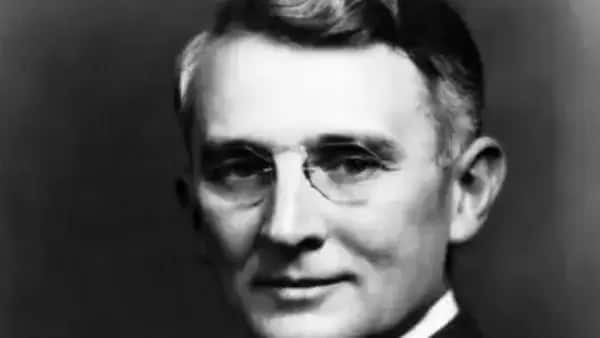
Dale Carnegie, born Dale Carnagey in Maryville, Missouri, in 1888, became one of the most influential self-improvement writers, public-speaking teachers and personal-development figures of the 20th century. After working in sales, acting and teaching, he began public-speaking classes in New York in 1912, which later grew into the Carnegie Institute of Effective Speaking and Human Relations. His 1936 book How to Win Friends and Influence People became a global success, selling more than 30 million copies over the decades and making Carnegie a defining voice in communication, confidence and personal effectiveness.
“Most of the important things in the world have been accomplished by people who have kept on trying when there seemed to be no hope at all.”
— Dale Carnegie
This line is from a about inventor Lee de Forest, where Carnegie used de Forest’s struggles to argue against premature discouragement.
Meaning of the Quote
Carnegie’s quote is about persistence when visible evidence is weak. It is easy to keep going when progress is obvious, people are encouraging, and results are improving. The real test comes when effort feels unrewarded, the outcome looks distant, and hope begins to feel unreasonable.
The quote does not mean people should continue blindly with a failing plan. Carnegie’s message is more practical: many meaningful achievements require a period where success is not yet visible. During that phase, the difference between failure and breakthrough is often the willingness to keep trying, revise the method, and refuse emotional surrender.
The deeper lesson is that hope is not always a feeling. Sometimes hope is a behaviour. It is the decision to make one more attempt, improve one more draft, attend one more interview, rebuild one more plan or continue one more day when the result is not yet guaranteed.
Why This Quote Resonates
This quote resonates strongly today because people are living through rapid change at work, in careers and in personal ambition. Thesays global employers expect major transformation in jobs and skills through 2030, driven by technology, economic uncertainty, demographic change and the green transition.
At the same time, many workers are emotionally stretched. Gallup’s State of the Global Workplace 2026 found that global employee engagement fell to 20% in 2025, its lowest level since 2020, with low engagement costing the world economy an estimated $10 trillion in lost productivity.
That is why Carnegie’s quote feels current. Whether someone is learning AI skills, rebuilding after job rejection, trying to grow a business, recovering from failure or staying consistent with a personal goal, the hardest moments often come before proof appears. The people who keep trying intelligently during that gap are often the ones who eventually create progress.
“Our fatigue is often caused not by work, but by worry, frustration and resentment.”
— Dale Carnegie
This line is widely associated with Carnegie’s How to Stop Worrying and Start Living, a book focused on managing anxiety, energy and mental pressure. The quote complements the primary message because persistence is not only physical effort; it also requires emotional management.
Together, both quotes create a fuller life lesson. The first says important things are achieved by people who keep trying when hope is low. The second explains why many people stop trying: not always because the work is impossible, but because worry and frustration drain the will to continue.
The combined lesson is practical: persistence needs both action and inner discipline. If you want to keep going, you must also manage fear, resentment and exhaustion before they quietly defeat the effort.
How You Can Implement This
- Define the next attempt: When a goal feels hopeless, do not think about the entire journey. Decide the next useful action you can take within 24 hours.
- Change the method, not the mission: If repeated effort is failing, adjust the strategy, feedback loop, mentor, routine or timeline before abandoning the larger goal.
- Track small proof points: Keep a record of minor wins, improved skills, better responses, new contacts or lessons learned so progress does not feel invisible.
- Reduce emotional noise: Write down what is actually going wrong and what is only fear, frustration or imagined failure.
- Build a retry system: For every rejection or failed attempt, create a rule: review what happened, improve one thing, and try again within a fixed time frame.
- Borrow hope from evidence: Study people in your field who succeeded after long effort. Use their timelines to remind yourself that slow progress is still progress.
“Develop success from failures. Discouragement and failure are two of the surest stepping stones to success.”
—
This closing line captures the same Carnegie philosophy: failure is not useful by itself, but it becomes powerful when it teaches endurance and correction. The important things in life often do not arrive when hope is loud. They arrive when someone keeps showing up even after hope has become quiet.