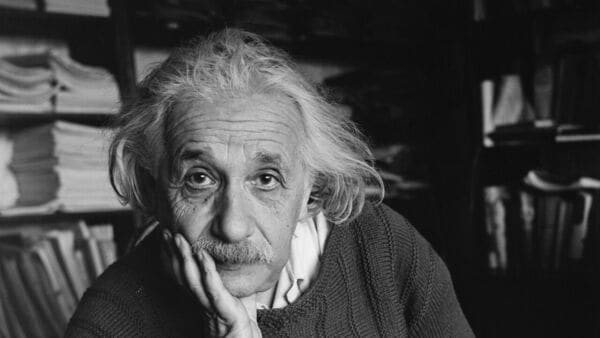
Today, the Quote of the Day is by the prominent physicist Albert Einstein: “Only a life lived for others is a life worthwhile.”
About Albert Einstein
Albert Einstein, born in Ulm, Germany, in 1879, became one of the most influential scientists of the 20th century through his work on relativity, quantum theory, and the photoelectric effect.
After studying in Switzerland, he worked at the Swiss Patent Office while publishing breakthrough papers that changed modern physics, including his 1905 work on special relativity.
He later developed the general theory of relativity and received the 1921 Nobel Prize in Physics for his services to theoretical physics, especially his discovery of the law of the photoelectric effect.
Meaning of the Quote
— Albert Einstein
Einstein’s quote is a direct challenge to success built only on personal gain. In a business context, it means that a career, company, or leadership role becomes truly meaningful when it creates value beyond the individual — for customers, employees, communities, and future generations.
The quote also reframes ambition. Einstein does not reject achievement; his own life was built on extraordinary intellectual discipline. But he suggests that achievement without contribution is incomplete.
For leaders, this means profit, scale, recognition, and authority should be measured alongside usefulness, trust, and positive impact.
In practical terms, this is the difference between building a business that merely extracts value and one that creates value.
A leader who lives “for others” designs products that solve real problems, protects employees during uncertainty, treats customers honestly, and uses influence responsibly.
Why This Quote Resonates
This quote resonates strongly today because the business world is being reshaped by AI, economic uncertainty, and changing employee expectations.
The World Economic Forum’s Future of Jobs Report 2025 says technological change, geoeconomic fragmentation, economic uncertainty, demographic shifts, and the green transition are among the major forces expected to transform the global labour market by 2030.
The same report says employers expect 39% of key job skills to change by 2030, with creative thinking, resilience, curiosity, lifelong learning, leadership, social influence, and talent management rising in importance.
That makes Einstein’s quote especially relevant: as machines take over more repeatable tasks, the human advantage will increasingly lie in judgement, responsibility, empathy, and service.
A concrete example is AI-led workplace disruption. The IMF has warned that nearly 40% of global jobs are exposed to AI-driven change, intensifying concerns around displacement and inequality. In this environment, leaders who focus only on efficiency may lose trust.
Leaders who use technology to improve lives, reskill people, and distribute gains more fairly will create more durable organisations.
Another Perspective
— Albert Einstein
This quote is widely attributed to Einstein, with Quote Investigator tracing the expression through sources connected to Einstein and later retellings.
Together, the two quotes form a clear leadership philosophy. The first defines the purpose of life as service; the second defines the purpose of success as value creation. One speaks to the heart, the other to strategy.
For business leaders, this is a powerful combination. It says: do not chase success as an empty scoreboard. Build something valuable enough that success becomes a consequence.
In real-world terms, this means solving customer pain points, mentoring teams, creating ethical systems, and making decisions that still look responsible years later.
How You Can Implement This
Define your value promise: Write one sentence explaining who your work helps and how it improves their life, time, money, knowledge, or confidence.
Measure impact beyond revenue: Add at least one people-focused metric to your dashboard, such as customer satisfaction, employee retention, complaint resolution time, or repeat usage.
Build service into leadership reviews: In weekly team meetings, ask: “What did we do this week that genuinely helped users, customers, or colleagues?”
Use AI responsibly: Before automating a workflow, identify which tasks can be automated, which human skills must be protected, and which team members need reskilling.
Mentor one person consistently: Schedule a monthly 30-minute conversation with a junior colleague or team member to help them solve problems, build confidence, and grow faster.
Choose value over visibility: Before taking on a high-profile project, ask whether it creates real impact or only gives you attention. Prioritise the work that compounds trust.
Final Thought
— Albert Einstein
In The World As I See It, Einstein wrote that human life is deeply connected to the work and wellbeing of others. That is the deeper meaning of making life worth living: to recognise that achievement is never purely individual, and that the highest form of success is contribution.
References
- Encyclopaedia Britannica — Albert Einstein biography, early life, theory of relativity, Nobel Prize and scientific influence.
- Nobel Prize — Official summary of Albert Einstein’s 1921 Nobel Prize in Physics.
- Official Albert Einstein website — Biography, awards and quote archive.
- American Institute of Physics — Einstein’s essay The World As I See It.
- World Economic Forum — Future of Jobs Report 2025 and future skills analysis.
- IMF — 2026 analysis on AI, new skills and labour market change.