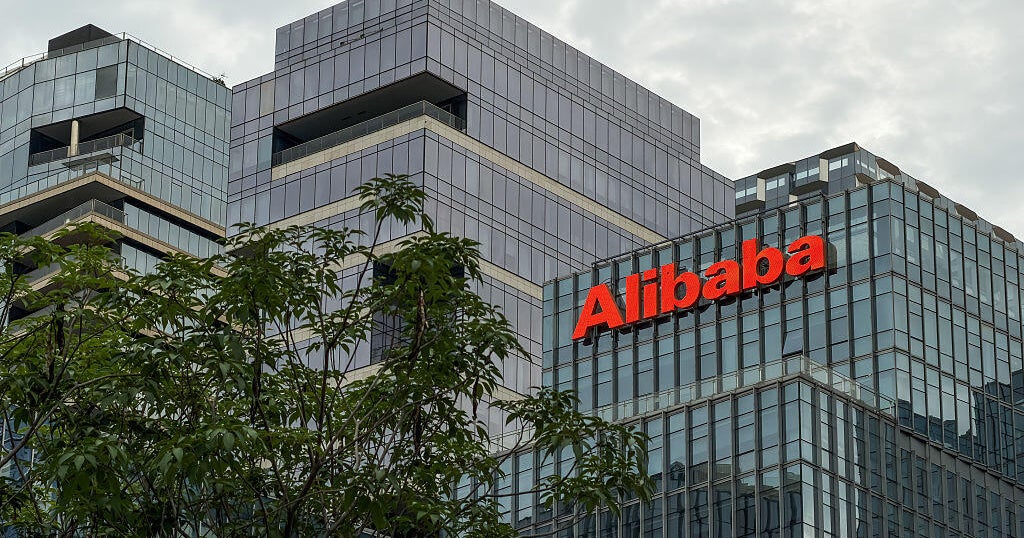
For eight years, Chinese online retailer Alibaba and its U.S. payment processing company failed to prevent dangerous drugs, chemicals and pill presses from being sold to American customers — even after employees warned of compliance problems, public records show.
Prosecutors at the Justice Department believed they had enough evidence to prove that the companies had committed felony violations of the Food, Drug and Cosmetic Act, multiple sources with knowledge of the matter told CBS News.
That law, first enacted in 1938, prohibits the sale, distribution or manufacturing of counterfeit, adulterated or misbranded drugs and medical devices, as well as food, supplements and cosmetics.
The case, which started during President Trump’s first administration, took several years and involved investigators from multiple agencies. The evidence only became stronger during the Biden administration, after a senior official in then-Deputy Attorney General Lisa Monaco’s office urged staff to keep digging, rather than settle it for less, several people familiar with the details of the case told CBS News.
As the case moved toward a resolution in recent months, career prosecutors urged Justice Department leadership to enter into a deferred prosecution agreement with Alibaba and AUS Merchant Services Inc., in which they would admit to the felony offenses, one of the sources said.
Instead, the case was recently resolved for $600 million in penalties and forfeitures and a non-prosecution agreement in which the company only admitted to committing lesser misdemeanor violations.
While the Justice Department hailed it as a victory, one of the people familiar with the strength of the evidence called the resolution “beyond disappointing.”
“There was egregious conduct by a Chinese-owned company. An NPA is not even a slap on the wrist,” the person added, speaking anonymously in order to discuss non-public discussions about the case.
Lawyers for Alibaba and AUS Merchant Services did not respond to requests for comment.
The decision to seek a lighter settlement with Alibaba marks the latest in a string of corporate cases involving public health and safety under the federal Food, Drug and Cosmetic Act that have been softened, dismissed or lost support from senior Justice Department leaders in recent months, according to multiple sources familiar with the matter.
In those cases, Justice Department leadership dropped its support or closed criminal investigations even when investigators believed there was evidence that consumers faced significant risk of harm from defective or adulterated products, multiple sources told CBS News.
“President Trump always talks of being tough on crime, but his administration guts enforcement for corporate law-breakers,” said Lisa Gilbert, the co-president of Public Citizen, a nonprofit consumer advocacy group.
“In this context, where Americans’ health and safety and well-being is on the line, it has real-life ramifications to withhold accountability for corporate wrongdoing.”
The Justice Department, in response to questions from CBS News, disputed the notion that it is going soft on criminal corporate prosecutions against companies over health and safety violations.
“Ensuring the safety of our nation’s food supply is a top priority for the Trump administration. However, this Department of Justice does not believe in regulation by prosecution,” a department spokesperson said.
“When righting wrongs, both civil and criminal options are on the table, and our prosecutors will always work within the bounds of our enforcement priorities to hold bad actors accountable to the fullest extent possible,” the spokesperson added.
Since 2022, federal prosecutors in Philadelphia and Washington, D.C., have been jointly investigating a unit of Philips, after it was forced to recall millions of CPAP, BiPAP, and mechanical ventilators over a sound-reducing foam inside the machines that can degrade, which meant people using the devices could inhale cancer-causing chemicals, according to corporate filings and sources familiar with the matter.
The case garnered widespread attention, impacting some 15 million devices.
The company has already agreed to pay out more than $1 billion to settle numerous personal injury claims, and in 2024, the Justice Department secured a civil consent decree which required Philips Respironics to hire outside experts to inspect its facilities, correct any deficiencies and ensure that problems with the breathing machines were remediated.
Earlier this spring, federal prosecutors in the Eastern District of Pennsylvania learned that their consumer protection counterparts in the Justice Department’s Criminal Division were no longer permitted to jointly work on the Philips case with them, sources with direct knowledge told CBS News.
The decision by DOJ officials in Washington to drop the department’s support for the Philips investigation was triggered by a broader order directing consumer protection prosecutors in Washington, D.C., to pull back on Food, Drug and Cosmetic Act investigations for all but the most serious cases, the sources added.
A company spokesperson told CBS News that five independent laboratories have since confirmed that the use of its sleep therapy devices is not likely to result in appreciable harm for patients.
Another case in the Philadelphia-based U.S. attorney’s office that is no longer being supported by senior Justice Department leadership relates to the unlawful importation of adulterated vape products by wholesale companies, the sources added.
The prosecutors in Washington, D.C., who have traditionally worked on criminal Food, Drug and Cosmetic Act cases previously served in the Consumer Protection Branch — a unit that handled both criminal and civil enforcement of U.S. food and drug safety laws and often partnered with U.S. attorneys’ offices throughout the country.
Last year, as part of a sweeping reorganization, the unit was disbanded, with its attorneys who handled civil cases remaining in the Civil Division and its prosecutors shuffled to a new office in the Criminal Division called the Health and Safety Unit.
In a recent meeting with those health and safety prosecutors, Tysen Duva, the assistant attorney general of the Criminal Division, imposed a new litmus test, telling them they should only bring cases that would stir outrage in their neighbors and that could be quickly explained in two minutes, sources familiar with the meeting told CBS News.
But even that litmus test apparently does not apply in every case.
Earlier this year, the Justice Department ordered prosecutors in Washington and Michigan to shut down a long-running criminal investigation into Abbott Laboratories over Cronobacter bacterial contamination at one of its plants in Michigan that manufactures powdered baby formula, several sources familiar with the matter said.
The incident garnered attention in 2022 when Abbott Laboratories recalled several of its popular powdered formula brands, including Similac, after consumers complained about infant illness related to products from Abbott Nutrition, in Sturgis, Michigan. The FDA in March of that year said five infants had to be hospitalized due to reported bacterial infections which it said “may have contributed to death in two patients.”
A company spokesman said that no link between its manufacturing plant and the clinical cases that sparked the recall was ever found.
The closure of the criminal case, which was first reported by the Wall Street Journal, came about even after Duva and other leaders of the Criminal Division expressed support for keeping the case alive, those sources familiar with the matter told CBS News. The Criminal Division was overruled.
Bloomberg Government previously reported on the disagreement between Duva and other senior DOJ leaders, saying the case has since raised wider concerns about scaling back on corporate prosecutions involving public health and safety.
A May 12 court entry for a parallel civil False Claims Act case involving the formula incident shows the Justice Department has reached a settlement with Abbott, but details have not yet been revealed.
In a February court filing in the case, DOJ lawyers accused the company of lying to federal and state regulatory agencies about its compliance with the law.
Democratic Senator Adam Schiff of California, in a letter to Acting Attorney General Todd Blanche,is launching an inquiry into why the Abbott case was shuttered.
“If prosecuting cases involving the risk of injuries or death to premature infants are not a priority enforcement matter, I have questions about what priorities the DOJ considers worthy of pursuing,” Schiff wrote.
A senior DOJ official told CBS that the department felt that a civil False Claims Act resolution was “the best mechanism to achieve accountability, deterrence and protection of the public” in the matter.
The official added that the agreement reached in principle with Abbott includes a “significant” monetary penalty, and said that Abbott’s potential plans to build a new $1 billion facility in Ohio played no role in its decision to drop the criminal investigation.
In a statement, a spokesperson for Abbott told CBS News that “no unopened, distributed Abbott infant formulas have ever tested positive for Cronobacter sakazakii” and said the Food and Drug Administration also separately confirmed in March 2022 that “the unopened product from homes of the infants under investigation at the time of the 2022 recall tested negative for Cronobacter.”
The retreat on criminal enforcement of the Food, Drug and Cosmetic Act by corporate bad actors represents part of a broader trend by the Justice Department to scale back on corporate prosecutions in general.
Since last year, many Foreign Corrupt Practices Act cases targeting companies for bribery, for instance, were shuttered at President Trump’s request, and prosecutors were also instructed to be more discerning about whether corporate misconduct “warrants federal criminal prosecution,” according to a memo issued last year.
Earlier this year, the DOJ also rolled out a new corporate enforcement policy for an array of criminal cases that allow companies to avoid being prosecuted if they take certain steps, such as voluntarily disclosing misconduct to the department and cooperating with investigators.
Duva, in a statement provided to CBS News, said the new corporate enforcement policy “gives companies clear, transparent, and predictable standards concerning how and when to disclose wrongdoing to the Department.”
“Companies that voluntarily self-disclose misconduct, fully cooperate with law enforcement, and remediate have a path to a declination, while those that don’t face more punitive resolutions. All corporate cases that the Department resolved this year were done so in a public fashion and were driven by the facts, the evidence, and the law — not a preference for any particular outcome,” he added.
However, the Food, Drug and Cosmetic Act may be uniquely vulnerable in the Trump Justice Department, compared to other types of corporate prosecutions.
Unlike most criminal laws, it contains a strict liability provision that allows prosecutors to charge corporations or individuals with misdemeanor violations without having to show they intentionally broke the law.
The strict liability provisions of the law have long been controversial, and they are primarily used as a lever in negotiations involving more serious criminal misconduct, rather than as a charging tool against corporate bad actors, current and former prosecutors say.
Still, last year the White House issued an executive order discouraging the use of criminal prosecutions to address regulatory concerns. The order explicitly stated that strict liability offenses are “generally disfavored.”
Acting Attorney General Todd Blanche, who is scheduled to appear for his Senate confirmation hearing on July 15 for his nomination to serve as attorney general permanently, is expected to field some questions from Democrats who are concerned about the Justice Department’s decision to shutter the Abbott case.
It remains to be seen, meanwhile, what the fate of the Philips investigation will be.
David Metcalf, the U.S. Attorney for the Eastern District of Pennsylvania, privately vowed to keep the probe alive despite the lack of support from Washington, according to sources with knowledge of the matter.
The company, for its part, has continued to engage with federal prosecutors on the case, as well as state attorneys general who are also investigating, according to a Philips spokesman.
But career DOJ staff members now fear that this case too will be closed, or settled in a lenient fashion, one source familiar with their thinking said.