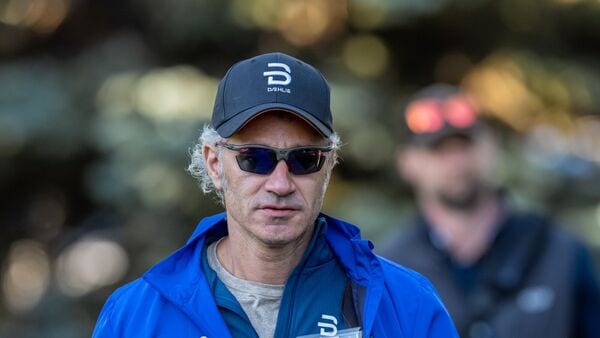
The rapid rise of artificial intelligence has transformed Palantir into one of the world’s most valuable technology companies, lifting its market capitalization to around $322 billion and boosting CEO personal fortune to an estimated $15 billion. Despite benefiting enormously from the AI boom, Karp has cautioned that the technology could dramatically widen the gap between the ultra-rich and the rest of society.
Speaking about AI’s long-term economic impact, the 58-year-old executive said the technology could increase his own wealth by as much as 20 times, potentially taking his fortune to nearly $300 billion. By contrast, he suggested that many middle-class workers may only see their incomes double over the next decade, creating what he described as a “complete decoupling of unimaginable wealth and normal wealth.”
“The biggest problem in this country is [AI] will raise the standard of living of the average person, but the people involved are likely to get 10, 100 times wealthier than they already are,” Karp told Axel Springer CEO Mathias Döpfner on the MDMeets podcast. “That’s a problem for society.”
According to Karp, the growing divide is not only about the magnitude of wealth being created but also about who stands to benefit from the AI revolution. He warned that the gains are likely to remain concentrated among a small group of individuals and companies rather than being shared broadly across society.
Concerns over wealth inequality are not new. For years, economists and policymakers have pointed to the increasing concentration of wealth among the richest households, while income growth for many workers has lagged behind. The acceleration of AI adoption, however, has intensified those concerns.
“It’s done by people you don’t really relate to, like very oddly shaped IQ specimens that you probably wouldn’t want to have over for dinner,” Karp said. “And if they were over for dinner you’d have nothing to talk to them about, and vice versa.”
Data from Oxfam shows that global billionaire wealth jumped more than 16% in 2025, reaching a record $18.3 trillion—a pace roughly three times faster than the average growth recorded over the previous five years.
Among the biggest beneficiaries of the AI-driven wealth surge is Elon Musk. The Tesla and SpaceX chief executive currently has an estimated net worth of around $833 billion, after briefly becoming the world’s first trillionaire earlier this year.
The scale of such fortunes has fueled renewed debate over taxation and wealth redistribution. Oxfam estimated that an individual with $1 trillion in wealth could pay a 10% wealth tax, equivalent to $100 billion, and still remain among the richest people in the world. The organization also argued that the same amount could fund efforts to lift more than 800 million people out of extreme poverty for an entire year.
Karp is not alone in expressing concerns over AI-driven inequality. Earlier this year, BlackRock CEO , whose personal wealth is estimated at around $1.3 billion, warned that the benefits of artificial intelligence risk becoming concentrated among a handful of companies and individuals, leaving large sections of society behind unless the technology’s gains are distributed more broadly.
“Since the fall of the Berlin Wall, more wealth has been created than in any time prior in human history, but in advanced economies, that wealth has accrued to a far narrower share of people than any healthy society can ultimately sustain,” Fink said at the World Economic Forum in Davos, Switzerland.
As AI continues to reshape industries and create enormous value, business leaders and policymakers are increasingly debating how to ensure that its economic rewards are shared more equitably rather than deepening existing income and wealth disparities.
“Early gains are flowing to the owners of models, owners of data and owners of infrastructure,” Fink added. “The open question: What happens to everyone else if AI does to white-collar workers what globalization did to blue-collar workers? We need to confront that today directly. It is not about the future. The future is now.”