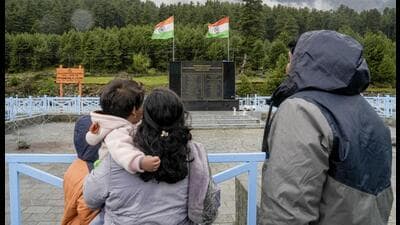
One year after the Pahalgam attack, it is evident that what unfolded on April 22, 2025, was not an isolated act of terror — it was a strategic inflection point. The attack targeted not just civilians but the very idea of normalcy in Kashmir. It struck at the narrative of recovery, coexistence, and reintegration that had slowly begun to take shape. The killing of tourists — targeted explicitly for their faith in the Basiran meadow — continues to haunt the image of Kashmir as a safe destination. No invocation of Kashmiriyat or curated mehman nawazi (acts of hospitality) can easily repair the profound deficit of trust created by those traumatic events.
One year on, therefore, the question is what has changed. How has the Pahalgam terror strike reshaped India’s policies? What does it tell us about the limits of our strategic imagination?
The three elements that stand out are: Deterrence, bilateralism, and the changing vectors of India’s external relations.
Operation Sindoor and India’s wider response to Pahalgam have reset the baseline of its counter-terrorism doctrine. Unlike the episodic and reactive responses of the past, Sindoor was targeted, persistent, and multi-pronged. The objective was not simply to exact retribution but to change the cost-benefit calculus of terrorism in Kashmir. With surgical strikes aimed at terrorist launchpads on the Pakistan side of the Line of Control, Sindoor expanded the domain of deterrence to impose costs both within Pakistan and among the wider ecosystem of enablers and sustenance. Measured narrowly, this recalibration has delivered results. For over a year now, there have been no large-scale, spectacular attacks in Kashmir of the kind that took place in Pahalgam or large-scale infiltration attempts. The deterrence argument, at least at the level of high-visibility ops, has been proven.
However, the picture is more nuanced. Low-intensity operations have continued, calibrated carefully to remain below the threshold for escalation even as intelligence and surveillance data points to a larger ecosystem of terror infrastructure that remains largely intact. This should not be misinterpreted as failure: This duality is the logic of asymmetric warfare, where adaptation to pressure often takes the form of tactical rather than strategic shifts.
However, India arguably fell short in its strategic communication. The messaging around Operation Sindoor before, during, and after was episodic and inconsistent. At times, it was too low-key to actually convey intent; at others, it was too reactive. More crucially, India failed to clearly articulate either the scope of its actions or the principles that governed it. This gap was acutely visible in the ceasefire window: India was right to reject the narrative that de-escalation was the result of US pressure, but it did not sufficiently articulate its own logic, leaving the field wide open for Pakistan to shape elements of the narrative to its advantage.
The parliamentary delegations sent to multiple countries were a useful corrective on this score, but their impact is uncertain. Strategic communication cannot be episodic or symbolic; it must be systematic, coherent, and sustained. In an era of hyper-connectivity, where narratives travel faster than actions, perception is not the periphery of policy but its vital core.
For its part, Pakistan has not changed course; it has recalibrated tactics. Post-Sindoor, it has shown a greater degree of tactical agility than India has sometimes demonstrated. Despite being under severe internal pressure (economic fragility, political instability, and restiveness in Baluchistan and other regions), it has remained diplomatically engaged, seeking to position itself as a point of convergence in multiple regional crises (Iran, for example) and thereby sustaining its value as a tactical interlocutor. The limits of its strategic reliability remain as stark as ever; its ability to punch above its weight in geopolitical conversations, however, is growing.
India’s own relationship with the US, by contrast, has remained structurally strong. However, there are now signs of a growing tactical ambiguity overlaying this. The return of Donald Trump to office has derailed the more methodical, process-driven approach that US foreign policy had acquired in recent years. Decision-making is now more transactional, messaging more personalised, and priorities more fluid. The deepening warmth of the US-Pakistan engagement is only one indicator of this. While the US will remain India’s most important external partner, it cannot and should not be seen as a guarantor of India’s security. Strategic autonomy, the lodestar of Indian foreign policy for long, has acquired renewed salience.
Looking ahead, therefore, India needs to deepen and widen deterrence: From episodic to systemic, from quantitative to qualitative. Quantitative deterrence seeks to deny the ability to act, and qualitative deterrence, the ability to achieve one’s objectives. Both require sustained investment and the capacity to adapt doctrine to an evolving threat landscape. However, security is not enough. Terrorism is designed not just to kill but to kill the idea of everyday life itself. Therefore, building societal resilience is as important as increasing tactical costs. Making everyday life — economic activity, tourism, and education — resistant to shock and disruption is the larger objective.
This brings us to the one dimension that is still underemphasised in Indian thinking: Political stability and empowerment within Jammu and Kashmir. Security can create the space for normalcy; it cannot provide the content to fill that space. For that, there must be political legitimacy. Restoring statehood is an important political signal — a signal of confidence, of inclusiveness, of trust. The signal must be backed up by substance — by real empowerment of elected institutions and local governments, by devolving real authority to manage the practical issues that shape everyday life, and by providing genuine channels of accountability. Normalcy cannot be decreed from the outside; it must be claimed from within, by participation and ownership.
One year after Pahalgam, the learning is simple: Deterrence is not an event but a condition, a state of being that must be constantly maintained. Security can create space; it cannot populate it. That is the work of politics, governance, and society itself. The attack on Pahalgam sought to terrorise hope: To signal to people that normalcy in Kashmir is reversible, fragile, and easy to destroy. The real test of our response is to show the opposite — that hope is not only resilient but also irreversible.
Amitabh Mattoo is dean of SIS, JNU; former vice chancellor of the University of Jammu; and former member of the NSAB. The views expressed are personal