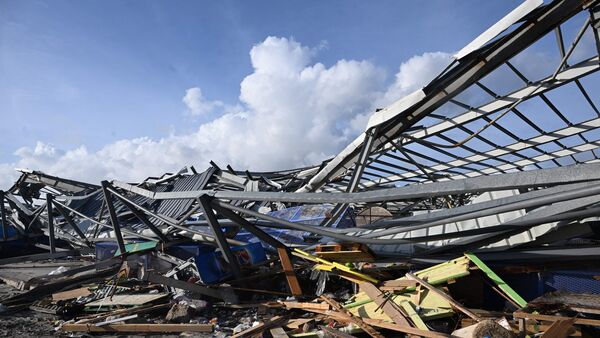
US forecasters on Thursday (local time) released their outlook for the upcoming season in 2026. The National Oceanic and Atmospheric Administration (NOAA)’s new seasonal outlook has predicted a “below-normal season” for 2026, primarily due to El Niño.
USA Today reported that such predictions have proven to be tricky business this year. expects the season to produce between eight and 14 named tropical storms, including three to six hurricanes. Of those hurricanes, one to three could strengthen into major storms.
The report, citing weather records from 1991 to 2020, states that in a typical year, roughly 14 storms are seen on average, seven of which spin into . The first storm of 2026 will be named Arthur.
Uncertainty over hurricane development
NOAA National Weather Service Director Ken Graham, in a statement, said, “Although ’s impact in the Atlantic Basin can often suppress hurricane development, there is still uncertainty in how each season will unfold,” and added, “That is why it’s essential to review your hurricane preparedness plan now. It only takes one storm to make for a very bad season.”
Graham further said, “Don’t let the ‘below-average’ forecast change your preparations.”
Experts suggest ignoring forecasts
People living in areas vulnerable to hurricanes may be surprised to hear that experts have advised them not to rely too heavily on seasonal forecasts in 2026 and instead prepare for a potentially dangerous regardless.
Earlier forecasts from other organisations had generally pointed to a slightly below-average Atlantic hurricane season, though experts also warned of a high degree of uncertainty. However, even a less active hurricane season can still prove deadly.
While experts suggest that El Niño is expected to suppress some hurricane activity, it is not a guarantee of a mild season.
Despite a strong El Niño in 2023, the Atlantic basin experienced its fourth-busiest hurricane season on record, according to NOAA’s post-season analysis. The season produced 20 named storms, including seven hurricanes and three major hurricanes. Hurricane Idalia made landfall near Keaton Beach on Florida’s west coast, triggering widespread flooding.
El Niño’s influence on hurricane season
Historically, El Niño has tended to suppress hurricane activity in the Atlantic basin while increasing storm activity in the Pacific due to its influence on global wind patterns.
As El Niño intensifies, weaker trade winds and rising ocean temperatures are expected near and east of Hawaii, raising the likelihood of hurricanes affecting the islands, according to Malte Stuecker, director of the International Pacific Research Center at the University of Hawaiʻi at Mānoa.
According to NOAA, the reverse can be true in the Atlantic, where a shift in the winds created by the activity in the El Niño region can bring in wind shear that creates a hostile environment for hurricanes to form and strengthen. The strongest influence is over the Caribbean and western Atlantic hurricane development region.
Even a less busy hurricane season can have impacts, particularly when the Atlantic is in an active cycle or ocean temperatures are especially warm.
Below-average Atlantic hurricane season likely in 2026
Earlier in April, forecasters from Colorado State University said the 2026 Atlantic hurricane season is expected to fall below historical averages due to an El Niño formation sending winds across the southern US that could rip apart tropical storms, Reuters reported.
In a statement, the university said, “While the intensity of the likely El Niño is uncertain, the CSU team anticipates that a moderate to strong El Niño is most likely by the peak of the Atlantic hurricane season from August to October.”
The Atlantic hurricane season begins on 1 June and generally continues through 30 November, with the highest activity usually occurring between August and October.
- El Niño is expected to suppress hurricane activity, but unpredictability remains a key factor.
- Preparedness is crucial regardless of seasonal forecasts; one storm can have severe consequences.
- Historical data shows that even below-average seasons can lead to deadly outcomes.