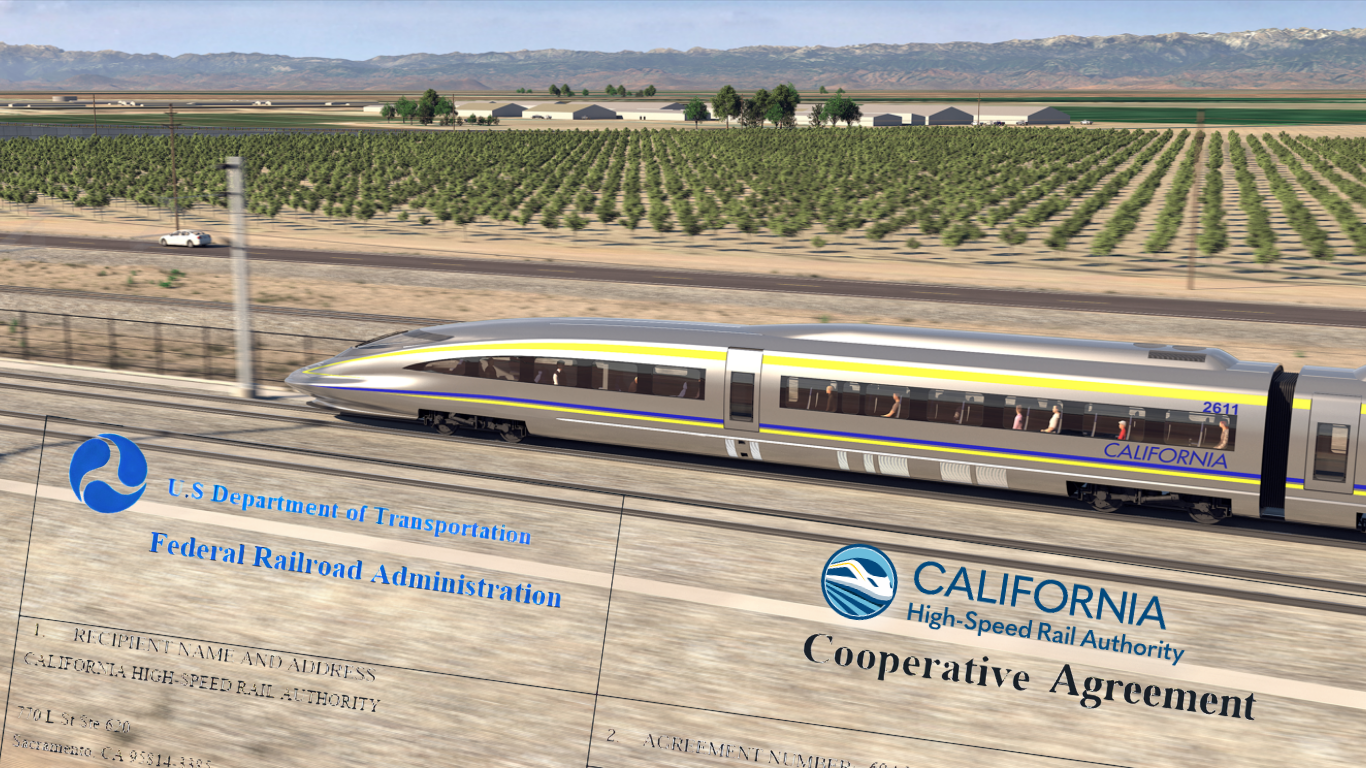
California’s High-Speed Rail Authority repeatedly missed key deadlines to buy its trains, a failure federal officials cited when they pulled $4 billion in funding a year ago. More than a year and a half after the original deadline, the authority still cannot say when it expects to award the contract. The state says that the date remains “TBD.”
Approved by voters in 2008, the project was originally designed to link San Francisco and Los Angeles in under three hours with electric trains capable of reaching 220 mph. There’s no direct line between the two major cities, and the ride now takes 10.5 to 12 hours.
But the current plan is limited to the middle section of the route — a flat 171-mile stretch between Merced and Bakersfield in the Central Valley, selected because construction was expected to be easier, with no need to drill any tunnels. It’s estimated that high-speed rail would cut that three-hour train ride in half.
Service was projected to begin by 2033.
In July 2025, the Trump administration pulled $4 billion in federal funding for California’s high-speed rail project, citing the state’s failure to lay any tracks after spending $15 billion over 16 years. Transportation Secretary Sean Duffy said “federal dollars are not a blank check — they come with a promise to deliver results.”
Purchasing the trains was a key milestone. Federal officials concluded there was “no viable path” to completing the segment on time. And California had promised to connect “major metropolitan cities” but could now deliver only a substantially reduced system that “may connect two random endpoints.”
Gov. Gavin Newsom called the federal withdrawal of funding a “political stunt to punish California,” and state Attorney General Rob Bonta promptly sued “to stop Trump’s politically motivated attack on high-speed rail.”
Yet, less than six months later, California dropped the lawsuit. The rail authority offered no explanation, but said it hoped to work with the federal government some time in the future after deciding this administration “was not a reliable partner.”
However, a CBS California investigation found it was the California High-Speed Rail Authority that repeatedly failed to meet its own deadlines to buy the trains — a key requirement in the federal grant agreement — then quietly dropped its lawsuit weeks after missing the new deadline it promised a federal judge it would meet.
Grant documents signed during the Biden administration required the rail authority to execute a trainset contract by Dec. 31, 2024. California missed that deadline.
Months later, when the Trump administration moved to terminate funding, federal officials pointed directly to the missed deadline as evidence that High-Speed Rail was failing to meet critical milestones and could not be relied upon to deliver the project on schedule.
High-Speed Rail did not dispute that it missed the deadline. It did not provide an explanation for the delays to CBS California Investigates. Instead, the authority pointed to public records, none of which acknowledge the delay.
In sworn court filings, High-Speed Rail assured a federal judge that it would execute a train contract by Dec. 1, 2025 — and that doing so would keep the project on schedule.
But High-Speed Rail missed that deadline too — canceling the board meeting where the train contract was expected to be approved.
Multiple sources familiar with the procurement process and litigation said missing the revised deadline undercut California’s legal argument that it could be trusted to meet future deadlines and complete the project on time.
The authority had already missed the original deadline in its federal funding agreement, and now it had missed the revised deadline it had promised the court it would meet.
By missing the deadline it set for itself in court, the state had effectively proven the federal government’s point: the project was not on track.
Weeks later, the lawsuit disappeared.
The state quietly dismissed the case two days before Christmas. This time there was no press release and no explanation for taxpayers — just a single reference buried among the federal grant documents and court filings posted on the High-Speed Rail Authority’s website.
Newsom, Bonta and the authority have never publicly explained why the train procurement deadlines were missed.
“It was appropriate for us to pull the lawsuit,” Bonta told CBS California Investigates two weeks later at Gov. Newsom’s final State of the State address. But he declined to elaborate, directing questions to the High-Speed Rail Authority.
Minutes earlier, during the governor’s address, Newsom had boasted about the project’s progress: California is “finally laying the tracks of the nation’s first high-speed rail system.”
But the state had not actually laid any high-speed rail track.
What the state had built was a railhead — a logistics depot designed to receive, store and stage the rail that crews would eventually install. The state’s own milestone announcement weeks later said the completed facility “allows California to begin receiving and staging materials needed” to install high-speed rail track.
“There’s been a railyard created that has track on it, but it is not high-speed rail track,” High-Speed Rail Inspector General Ben Belnap confirmed to CBS California Investigates. “High-speed rail track, as it’s defined, has not been laid yet.”
Six months after the governor’s claim, California still had not started laying high-speed rail. In a June statement, the authority’s spokesperson told CBS California Investigates the commitment is “to begin laying high-speed rail track by the end of the year.”
In June, the authority approved a team to build the track. The same day, it released its 2026 business plan, which continues to project passenger service by 2033 but does not disclose the status of its trainset procurement. That line is blank. Belnap told CBS California Investigates that repeatedly missing this key milestone raises accountability concerns.
“Those train sets are critical to testing that needs to occur on track and systems,” Belnap explained. “It’s going to take a while to get those trains manufactured, so you want to start that clock, so you’re not hindered on the back end.”
When High-Speed Rail’s board approved the trainset procurement in August 2023, the authority’s board memo said contracting a manufacturer in 2024 was “critical” — both for the federal grants and the overall project timeline.
“Our action today allows us to deliver on our commitment to meet our federal grant timelines to start testing,” then-Board Chair Tom Richards said.
Records indicate there’s about a four-year lead time between signing a train contract and having trains ready for a multi-year testing phase. The original procurement plan called for two prototype trains to be delivered in 2028 for testing and trial running, with four more by the end of 2030 for passenger service.
The state has not publicly acknowledged the missed milestones, but multiple sources inside High Speed Rail blame the delay on decisions made by the CEO.
Sources tell CBS California Investigates that High Speed Rail CEO Ian Choudri decided to change the trainset specifications shortly after taking over in 2024.
The rail authority declined to comment. However, less than two months before the federal deadline to buy the trains, board members raised concerns about Choudri’s plan to change the trainset design during a board meeting.
The authority had already narrowed the field to two finalists and was in an active procurement phase to purchase the trains.
Board member Ernest Camacho questioned Choudri about changing the train design from a wide-body train to “something that would be different,” warning the change could require the authority to cancel the procurement and start over.
“We have to be able to allow the bidders an opportunity to perhaps rethink that,” Camacho cautioned. “We may have to cancel that procurement or rewrite a new specification.”
The authority’s legal counsel interrupted and said the procurement could not be discussed in an open meeting. Board members were told they could instead meet individually with the CEO.
Weeks later, the deadline passed with no train contract.
Choudri has declined repeated interview requests from CBS California Investigates, pointing instead to public information on the authority’s website, which still includes procurement details from 2023.
Using the roughly four-year timeline in the authority’s original procurement schedule, a contract executed in 2026 would put initial train delivery around 2030. That would leave roughly two years for testing and certification before the authority’s projected 2032–2033 opening window, rather than the four years built into its original schedule.
Every month without a train contract further compresses that window.
That margin has all but disappeared. The authority’s 2025 Supplemental Project Update Report moved the start of passenger service to Jan. 1, 2032, with trainset deliveries beginning in early 2030. The same report, delivered to the Legislature in August 2025, listed the trainset procurement with “an estimated execution date of December 1, 2025.”
That date came and went with no contract.
The authority’s June statement to CBS California Investigates confirms the math: initial train deliveries were slated for early 2030, with “roughly two years of testing and certification” required ahead of 2032–2033 operations. That left little margin for further delay.
Federal officials flagged the same risk before pulling the funding. The Federal Railroad Administration’s June 2025 compliance review cited a pattern of “unrealistic assumptions” — including “the schedule for trainset procurement and safety and performance testing.”
It counted the missed trainset procurement among its nine key findings, concluding there was “no viable path” to completing the Central Valley segment by 2033.
Earlier this year, a U.S. Senate Commerce Committee investigation accused California leaders of wasting federal funds and gross mismanagement — citing the missed deadlines under the authority’s current management.
CBS California Investigates sent the High-Speed Rail Authority 20 questions on the train procurement delays.
We asked why the authority failed to execute a trainset contract by the original Dec. 31, 2024, deadline why it didn’t meet the new Dec. 1, 2025 deadline, and whether the authority still believes the project remains on schedule?
The authority did not answer those questions. Instead, it provided a statement defending the project and emphasizing that a 2024 Federal Railroad Administration review, conducted under the Biden administration, found no fraud, waste, abuse or compliance issues that would affect the project’s completion.
The authority cited the review as evidence the project had been in compliance with its federal agreements. But the review predated both missed deadlines.
It came before the authority failed to do the one thing it told the Federal Railroad Administration, the court and California taxpayers it would do: buy the trains.
The authority also argued that losing the federal funding created “a new opportunity” because federal requirements had increased costs and slowed project delivery.
But it never explained why it missed the train procurement deadlines and provided no update on when a trainset contract would be awarded.
Instead, it directed CBS California Investigates to a procurement webpage showing the award date is now listed as “TBD.”
Newsom did not respond to CBS California Investigates’ requests for an interview or respond to questions about the train procurement.
California’s U.S. Sen. Adam Schiff criticized the Trump administration for cutting federal funding for the project, while acknowledging the need for oversight.
“It’s critical that taxpayer dollars are spent responsibly and with full transparency and oversight, but removing billions in federal funding from another California project is not the right approach,” Schiff said in a statement. He called on the Trump administration to work with California to meet its transportation needs. But he continued, “I have engaged with the relevant transportation agencies to understand the challenges that remain for the project,” and he said that state transportation infrastructure investment “must be done properly, with careful safeguards for taxpayer dollars and without partisan or vindictive influence.”
Sen. Alex Padilla said in a statement, “The Trump Administration has always had it out for California, and the California High-Speed Rail project is no exception. Instead of partnering with California to deliver the forward-looking infrastructure Californians voted for, President Trump chose to cancel funding that supports good-paying jobs and strengthens economic growth.” He went on to say he’d continue to fight for the funding.