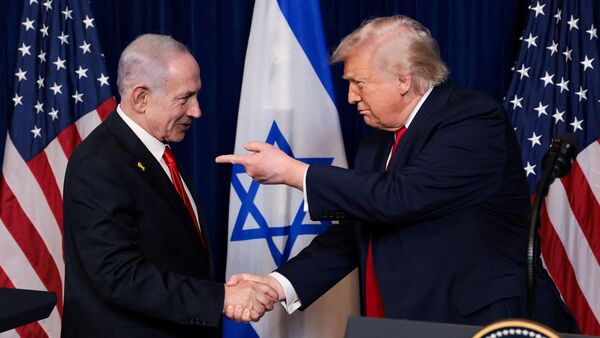
As United States President signed the Iran Memorandum of Understanding (MoU) at Versailles, France, attention has now turned to his ties with Israeli Prime Minister Benjamin Netanyahu. According to NBC News, the Israeli government was sidelined and was not shown the draft aimed at ending the war.
The move is particularly significant for Netanyahu, whose government was excluded from the negotiations that produced the agreement. Israel’s absence from the talks is now emerging as a crucial challenge for Netanyahu, who is heading into what many consider a career-defining election before the end of October.
Why the US-Iran deal is bad for Israel and Netanyahu?
According to reports, when the US and waged a war in late February, the two allies were optimistic that they could bring Tehran’s regime to an end. The declared to Iranians that “the hour of your freedom is at hand” and urged them, at the appropriate moment, to “take over your government”.
Quick answers to key questions
Why was Israel sidelined in the US-Iran negotiations?⌵
Israel was excluded from the negotiations that produced the Iran Memorandum of Understanding (MoU), raising concerns for Israeli Prime Minister Netanyahu, particularly as the agreement could impact Israel’s security.
How has Netanyahu’s position changed due to the US-Iran deal?⌵
Netanyahu’s position has weakened as he faces backlash for being sidelined from US-Iran negotiations, which some say could lead to significant repercussions for him in upcoming elections.
What is Netanyahu’s response to the US-Iran peace deal?⌵
Netanyahu has expressed frustrations about the deal, claiming he would continue to fight against Iran acquiring nuclear weapons, despite the peace agreement signaling a shift in US policy.
What criticisms has Netanyahu faced following the peace deal announcement?⌵
Criticism has mounted against Netanyahu from various Israeli political figures and polls indicate a drop in public support, with many viewing the deal as a failure of his foreign policy.
How has President Trump’s relationship with Netanyahu evolved during the Iran conflict?⌵
Trump’s relationship with Netanyahu has become strained, with the US president expressing frustration over Israeli military actions in Lebanon that jeopardize the peace negotiations.
While the of Iran has suffered damage from the aerial bombardment, it has not fallen and appears to be in no immediate danger of collapse.
The sidelining from the negotiations and Washington’s decision to agree to end hostilities on all fronts, including Lebanon, can prove frustrating for Netanyahu, who has spent years pushing for a war with Iran and popularising it in Israel, Al Jazeera reported. The Israeli PM has reportedly gone to considerable pains to put a lot of distance between himself and what he called “Trump’s decision” to end the war, while he previously claimed to have been an equal partner in launching the war.
Additionally, if the final agreement comes into effect within the stipulated time frame, Netanyahu, who has been the longest-serving prime minister, could face repercussions back home during elections.
Daniel Shapiro, former US Ambassador to Israel and a Distinguished Fellow at the Atlantic Council, told PBS News that is now in a precarious situation and “All Hezbollah has to do is get one rocket across into an Israeli town in northern Israel, and then the pressure on Netanyahu — which he’s already hearing from his own base and from the opposition … will ramp up.”
Israeli strikes on Lebanonanger Trump
The apparent sidelining of comes at a time when his ties with Trump have gone for a toss. According to The Wall Street Journal, the frequent phone calls between the two leaders are becoming less friendly now.
Citing sources, the report stated that while Trump was trying to broker a permanent end to his war in Iran, which has weighed on the US economy, he had choice words for the ally who urged him into it.
During a recent phone call about Lebanon, Trump asked Netanyahu, “Why are you blowing up buildings?” and asked him to ”stop blowing up buildings.” In another call, he reportedly complained that the worldwide downturn sparked by the war could tie him to Herbert Hoover and the Great Depression of the 1930s.
Ever since the war began in late February, this is not the first time Trump has yelled at Netanyahu, a fact he himself acknowledged earlier this month.
On Tuesday, he said, “Without the US, there would be no Israel. , there would be no Israel because no other President was willing to do what I did. I have had a great relationship with Bibi. Now Bibi has to be more responsible with respect to Lebanon.”
In the last few weeks, Trump has slammed the Israeli PM time and again since he felt that Tel Aviv was jeopardising the deal. Earlier this month, the two leaders also downplayed the alleged rift, despite the Republican president admitting to yelling at Netanyahu and calling him “.”
Citing a senior US official, the WSJ reported that the calls between the two leaders usually entailed the Israeli leader arguing for more military action, and said Trump had grown tired of it. The official added, “Bibi tells the president why he needs to blow something up, and why Israeli intelligence knows how to do it, and when to do it, and the president listens.”
Netanyahu loses support
According to PBS News, Israelis from across the political spectrum, on Monday, reacted angrily to the announcement of a peace deal, calling it a disaster for Tel Aviv and directed their fury at only one man: Netanyahu. While he reiterated in a press conference on Monday that “with an agreement, without an agreement,” he would continue fighting to prevent Iran from obtaining nuclear weapons, critics, his rivals, and even government officials slammed the decision of an interim deal.
In an interview, former Israeli prime minister and Netanyahu rival Ehud Barak said, “Israel is paying the price of Netanyahu’s hubris and blindness, and the price of the manipulations that he tried to pull on Trump,” and added, “Iran emerged stronger; Israel emerged weaker. That is Netanyahu’s strategic responsibility. He failed.”
Yair Lapid, who will challenge Netanyahu in the upcoming Israeli legislative elections on 14 June, said that the deal, which would extend the ceasefire between Washington and Tehran and lead to the reopening of the Strait of Hormuz, was shaping up to be “one of the most shocking failures in Israel’s foreign and security policy … entirely registered in Netanyahu’s name.”
However, it isn’t just Netanyahu’s political rivals who are attacking him; Israeli polls paint a similar picture. NBC News, citing data from the Institute for National Security Studies, said that in March, roughly 60% of Israelis approved of the war’s military achievements so far. In May, that figure declined to 27%.
Israelis believe Netanyahu’s war is ‘a failure’
Yossi Mekelberg, senior consulting fellow of the Middle East and North Africa programme at Chatham House, told Al Jazeera that Washington will dictate Tel Aviv’s role in the upcoming negotiations. He added that the country would now see a debate over what it had achieved ahead of its upcoming election season.
He added that there was a broad consensus across Israel’s political spectrum that the war had fallen short of its objectives. According to him, Israel was not only excluded from the diplomatic process but also failed to achieve any of Netanyahu’s key goals, including in Iran, dismantling Tehran’s nuclear programme, curbing its support for regional armed groups and significantly weakening its ballistic missile capabilities.
If the US-Iran agreement culminates in a final deal, the biggest political battle for Netanyahu may no longer be in Iran, but at home.