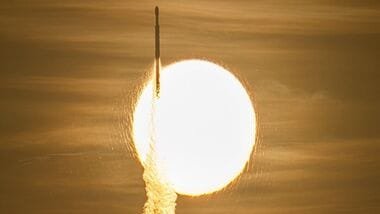
NASA’s newest space telescope, the $4.3 billion Nancy Grace , blasted off on Sunday (August 30) aboard a , beginning a mission designed to transform scientists’ understanding of planets, galaxies and the mysterious forces shaping the universe.
The bus-sized telescope lifted off shortly after daybreak from NASA’s Kennedy Space Center in Florida. It is now headed toward an observation point about 1 million miles (1.6 million kilometres) from Earth, where NASA’s is also positioned.
Roman is expected to take more than three months to reach its destination. Once operational, it will survey huge portions of the cosmos at a speed and scale unmatched by existing space telescopes.
Roman to survey universe
The telescope’s biggest advantage is its enormous field of view. Roman can see an area of the sky more than 100 times wider than the while maintaining comparable sensitivity.
That will allow astronomers to rapidly survey vast regions of space and identify rare and distant objects that can then be studied in greater detail by Webb and other observatories.
Roman’s infrared camera is designed to carry out observations far faster than Hubble. The telescope will also conduct an extensive survey of the Milky Way’s central bulge, providing scientists with an unprecedented look into the crowded heart of our galaxy.
Search for planets beyond our solar system
One of Roman’s major goals will be to search for planets orbiting stars beyond the Sun.
Its wide field of view will allow scientists to identify large numbers of distant worlds. An experimental coronagraph aboard the telescope will also attempt to block the glare from stars, potentially allowing Roman to directly image faint planets orbiting them.
The discoveries could give Webb and other observatories targets for detailed follow-up observations.
Dark matter and dark energy
Roman will also focus on some of the biggest unanswered questions in modern cosmology, including the nature of .
Although these mysterious components are believed to account for most of the universe, they cannot be directly observed in the same way as ordinary matter.
By mapping billions of galaxies and studying how they are distributed and how their distances change over time, scientists hope Roman will provide new clues about the expansion of the universe and the forces driving it.
Roman’s observations will complement the work of Hubble and Webb, as well as the European Space Agency’s Euclid spacecraft and the Vera C. Rubin Observatory in Chile.
Dramatic Falcon Heavy landing
The launch also delivered a spectacular display shortly after liftoff.
The Falcon Heavy’s two reusable side boosters returned to Earth and landed tail-first at Cape Canaveral, producing sharp sonic booms as they touched down.
Named after NASA pioneer Nancy Grace Roman
The telescope is named after Nancy Grace Roman, NASA’s first chief astronomer and a key figure in the development of the agency’s space astronomy programme.
Roman joined in 1959 and strongly advocated for observatories above Earth’s atmosphere, where they would not be affected by atmospheric distortion.
Her work helped pave the way for the Hubble Space Telescope, earning her the nickname “Mother of Hubble.” Roman died in 2018 at the age of 93.
The new observatory is NASA’s first space telescope named after a woman.
Built for a long mission
Roman’s primary mirror is nearly 8 feet (2.4 metres) across, roughly the same size as Hubble’s. Interestingly, the mirror was originally manufactured for a different purpose: it was one of two surplus spy-satellite mirrors donated to by the National Reconnaissance Office more than a decade ago.
The telescope is also designed with future refuelling in mind. If robotic spacecraft capable of servicing it become available during the next decade, Roman’s operational life could potentially be extended.
The mission launched nearly a year ahead of schedule and within its budget, giving another powerful observatory as it seeks answers to some of the universe’s most enduring mysteries.
(With AP inputs)