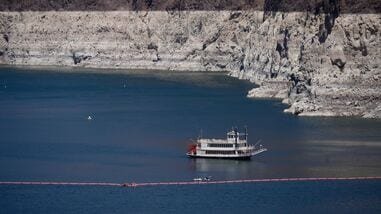
Lake Mead, the largest reservoir in the United States, has fallen to its lowest water level since it was filled nearly 90 years ago. The decline is the latest warning sign of the worsening water crisis facing the Colorado River, a critical source of water for millions of people across the western United States.
How low has Lake Mead fallen?
Lake Mead’s water level reached 1,040.4 feet (317.1 metres) above sea level on Friday (August 7), just below the previous record low set on July 28, 2022.
The reservoir sits behind Hoover Dam on the Arizona-Nevada border near Las Vegas. Its falling level is significant because Lake Mead is a major storage source for communities, farms, industries and power producers that depend on the Colorado River.
JB Hamby, chairman of the Colorado River Board of California, called the situation “extremely significant and extremely concerning.” He said about 30 million people, or three-quarters of the Colorado River Basin’s population, are directly affected by risks to Lake Mead.
Why is Lake Mead losing water?
The decline is the result of several factors working together.
The Colorado River Basin has experienced prolonged drought and dry conditions, including particularly severe conditions in the Rocky Mountains, where the river begins.
Snowmelt is an important source of water for the Colorado River. But the basin recorded its worst snowpack on record this past winter, meaning less water was available to flow into the river and replenish reservoirs.
At the same time, years of heavy water use, drought and rising temperatures have steadily reduced the amount of water stored in Lake Mead and Lake Powell.
Why is the Colorado River so important?
The Colorado River supplies water to about 40 million people across seven US states, tribal nations and Mexico.
The river also supports agriculture, industry, wildlife and hydropower production. A prolonged decline in available water therefore threatens much more than household supplies.
As reservoirs fall, states and water authorities face increasing pressure to reduce consumption and find ways to share a shrinking resource.
Is Lake Powell also running low?
Yes. Lake Powell, the country’s second-largest reservoir, has also experienced a dramatic decline.
Lake Mead and Lake Powell are currently at their lowest levels in nearly seven decades, according to the report.
The falling level of Lake Powell has affected recreation as well. Water levels have dropped so far that reaching the water has become difficult at some locations, forcing boat ramps to be moved, closed or rebuilt.
Why is the government not releasing more water?
Federal officials are trying to balance several competing needs.
They recently said they would not release cool water from Lake Powell through Glen Canyon Dam in northern Arizona because the water is needed to protect the threatened humpback chub, a native fish whose habitat lies between the two reservoirs.
At the same time, officials must protect the Colorado River system’s ability to generate hydropower while managing increasingly scarce water supplies.
What are states doing about the shortage?
The seven states that rely heavily on the Colorado River — California, Colorado, Arizona, Nevada, New Mexico, Wyoming and Utah — have been unable to reach a long-term agreement on how to divide the dwindling water supply.
The federal government has therefore proposed a short-term plan aimed at preventing the situation from becoming more severe.
Under the proposal, Lower Basin states Arizona, California and Nevada would reduce their water use. The Bureau of Reclamation has said the cuts could become deeper during particularly dry periods.
What happened during the 2022 drought?
Lake Mead’s declining water level has already produced dramatic consequences.
During the severe drought in 2022, falling water levels exposed human remains in the reservoir. Las Vegas water officials also had to pump water from deeper within Lake Mead to maintain supplies for millions of people.
The latest decline raises concerns that the reservoir could face further operational challenges if water levels continue falling.
Are other reservoirs also affected?
Yes. The problem extends across the western United States.
Of the 54 Western reservoirs monitored by the Bureau of Reclamation, nine recently recorded their lowest levels in three decades.
That suggests the problem is not limited to Lake Mead or Lake Powell but reflects a broader strain on water supplies across the region.