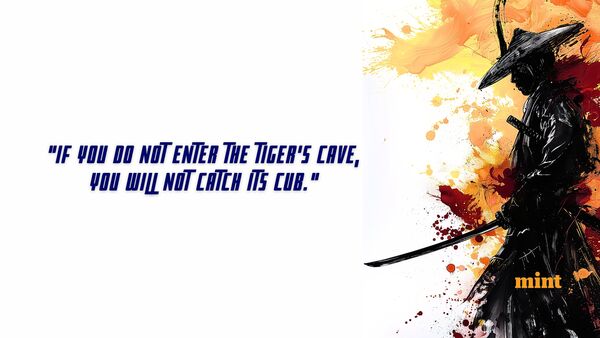
“If you do not enter the tiger’s cave, you will not catch its cub”
This Japanese proverb tells us that reward only follows risk. It means that avoiding danger guarantees you will gain nothing. In a world that rewards caution, this proverb is a bold call to act with courage.
Few proverbs are as vivid or as direct as this one. To catch the tiger’s cub, you must first walk into the tiger’s cave. There is no safer alternative. There is no shortcut that avoids the danger.
The core teaching is timeless. Meaningful reward requires meaningful risk. Opportunity does not wait at a safe distance. You must go to where it lives, even when that place is frightening.
This lesson applies powerfully to modern work and life. It speaks to founders launching new ventures. It speaks to employees pitching bold ideas. It speaks to anyone standing at the edge of a difficult decision.
At its core, this proverb teaches that no meaningful reward arrives without deliberate, courageous action.
Meaning of the proverb
Literally, the image is stark and physical. A tiger’s cave is one of the most dangerous places imaginable. Yet the cub, the prize, lives inside it. You cannot lure it out. You cannot wait for it to come to you.
Symbolically, the cave is any high-stakes situation that most people avoid. The cub is the reward that only those who enter will ever find. The tiger represents the risk, real, present, and impossible to fully neutralise.
The emotional insight is clarifying. Fear is not a sign to stop. It is a sign that something genuinely valuable is nearby. That reframe changes how you approach every difficult decision.
What this proverb teaches about modern life
Modern life is full of tiger caves. They look like difficult conversations, , and bold business bets. Most people circle the entrance. A few walk in.
Uncertainty is uncomfortable. But this proverb teaches that uncertainty is also the address of opportunity. Discipline means entering anyway, prepared, not reckless.
In decision-making, the proverb is a useful filter. Ask yourself: Am I avoiding this because it is genuinely unwise? Or am I avoiding it because it is simply scary? Those are two very different situations.
For career growth, this wisdom is essential. The professional who never raises a hand, never proposes a new idea, and never volunteers for the hard project, stays exactly where they are. Risk, taken thoughtfully, is the engine of advancement.
Resilience, too, is built inside the cave. You cannot develop it from the outside.
Business lesson from the proverb
This proverb has direct, concrete applications in professional life. Consider these scenarios.
A hesitates to approach a large enterprise client. The deal feels too big. She waits for a smaller opportunity instead. A bolder competitor closes the deal first.
A product manager has a data-backed idea that challenges the current strategy. He stays quiet in the meeting. The idea never gets tested. The company misses the pivot it needed.
An employee avoids negotiating her salary because she fears rejection. She accepts a below-market offer. The discomfort of asking would have lasted minutes. The cost of not asking lasts for years.
A company enters a new market before it is fully proven. Competitors call it reckless. Within three years, that market will become the company’s biggest revenue driver.
A team avoids confronting a failing vendor relationship. The polite inaction drags on for two quarters. A single difficult conversation would have saved both time and budget.
How to apply this proverb in real life
- Name the cave, identify exactly what you are avoiding and why.
- Separate fear from genuine risk by asking what the actual downside is.
- Prepare before entering, gather what you need to act intelligently.
- Set a deadline so avoidance does not disguise itself as patience.
- Take the first step into the cave, even if it is a small one.
- Debrief after, what did you learn that you could not have learned from outside?
Why this proverb still matters today
Today’s work culture sends mixed signals about risk. It celebrates entrepreneurs in hindsight. But it quietly punishes bold moves that do not immediately succeed.
Information overload creates the illusion that more research will eventually remove all risk. It will not. At some point, you must enter the cave with what you have.
Social pressure pushes professionals toward safe, defensible choices. The tiger’s cave pushes back. It says the defensible choice and the right choice are often different.
Career anxiety makes the cave feel more dangerous than it is. Most professional risks, the pitch, the ask, the career change, carry far less actual danger than they feel. The tiger is often smaller than imagined.
In leadership, this proverb defines a clear divide. A manager waits for certainty. A leader enters the cave and creates certainty from within it.
Other Japanese proverbs with a related lesson
“The reputation of a thousand years may be determined by the conduct of one hour”: A single bold or cowardly act can define everything that follows.
“Even a sheet of paper has two sides”: Every risk carries both danger and opportunity; weigh both before deciding.
“Vision without action is a daydream; action without vision is a nightmare”: Courage must be paired with direction; enter the cave with a plan.
“Fall seven times, stand up eight”: Keep trying until you succeed