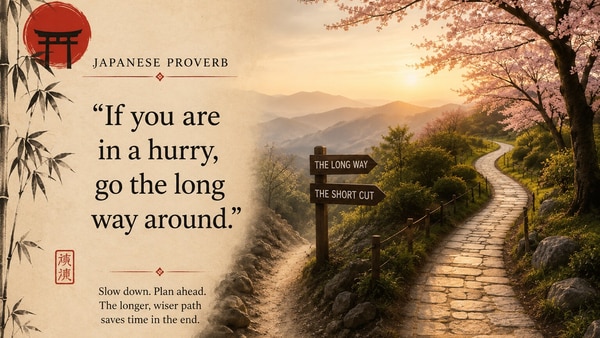
“If you are in a hurry, go the long way around.”
At first glance, this proverb sounds contradictory. If someone is in a hurry, why would they deliberately choose the longer route?
But that is precisely where the wisdom lies. The proverb is not really about distance. It is about approach. It teaches that rushing through important decisions, skipping preparation or chasing shortcuts often creates bigger problems later. Sometimes, the fastest way to reach a goal is to slow down enough to avoid mistakes.
People also ask
AI powered insights from this story
What is the meaning of the Japanese proverb ‘If you are in a hurry, go the long way around’?⌵
The proverb teaches that rushing important decisions or seeking shortcuts can lead to bigger problems later. It suggests that slowing down to avoid mistakes is often the fastest way to reach a goal, emphasizing careful planning and disciplined execution over speed.
How does the Japanese proverb about hurrying relate to business strategy?⌵
In business, rushing product launches or hiring can lead to costly mistakes and rework. The proverb advises taking extra time for testing, feedback, and careful planning, which ultimately leads to more sustainable growth and prevents future delays.
Why is the advice to ‘go the long way around’ still relevant in the digital age?⌵
In the digital age, there’s pressure for constant speed and instant reactions. This proverb reminds us that human judgment requires reflection, and that careful thinking and patience are not inefficiencies but intelligent approaches to avoid catastrophic mistakes.
How does Theodore Roosevelt’s ‘speak softly and carry a big stick’ philosophy compare to the Japanese proverb?⌵
Both emphasize preparation and thoughtful action over impulsive speed. Roosevelt’s quote highlights having capability (the ‘big stick’) behind calm communication, aligning with the Japanese proverb’s message that careful planning and execution (the ‘long way’) lead to better outcomes.
What business lesson can be learned from the Chinese proverb ‘A fall into a ditch makes you wiser’?⌵
This proverb teaches that mistakes and setbacks are valuable learning opportunities. In business, failed products or missed opportunities provide crucial insights into market needs and strategy, helping companies evolve and thrive by learning from their ‘ditches’.
In modern life, speed is often treated as a competitive advantage. Faster replies. Faster growth. Faster results. People are constantly encouraged to multitask, optimise every minute and move quickly from one task to another. But speed without thought can become expensive. A rushed email creates confusion. A rushed business decision creates losses. A rushed relationship creates regret.
This proverb offers a different philosophy. Slow is not the opposite of progress. Carelessness is.
Meaning of the proverb
The “long way” in this proverb symbolises patience, careful planning and disciplined execution. It means taking the time to understand a problem fully before acting.
The “short way”, by contrast, represents impulsive shortcuts, rushed decisions and incomplete thinking. It may appear efficient initially, but it often creates delays later through errors, rework and unnecessary stress.
The proverb’s central message is simple: taking extra care at the beginning usually saves more time in the end.
It is a lesson deeply rooted in Japanese culture, where precision, preparation and consistency are valued across industries, from craftsmanship and business to everyday life.
The saying does not reject ambition or urgency. Instead, it warns against confusing speed with effectiveness.
What this proverb teaches about modern life
Modern life rewards visible speed. People who respond quickly appear productive. Companies that scale rapidly attract attention. Social media encourages instant reactions rather than thoughtful reflection.
But fast decisions are not always good decisions.
Many modern problems are created by rushing. Burnout often comes from trying to move too quickly for too long. Workplace mistakes happen because people skip details. Financial losses happen because decisions are made emotionally instead of strategically.
This proverb encourages a mindset shift. Instead of asking, “How fast can this be done?”, it asks, “How well can this be done?”
That distinction changes everything.
In personal life, it encourages people to think carefully before reacting emotionally. In careers, it promotes building strong skills slowly instead of chasing instant success. In leadership, it reminds decision-makers that preparation often matters more than urgency.
The proverb also challenges modern hustle culture, where exhaustion is sometimes treated as proof of ambition. Moving carefully is not laziness. In many situations, it is intelligence.
Business lesson from the proverb
This proverb applies directly to business strategy and professional decision-making.
A startup rushes to launch a product before testing it properly. Early users discover technical flaws, negative reviews spread online and the company spends months fixing preventable problems. The quick launch ultimately slows growth.
Another company spends additional weeks testing customer feedback, refining the product and improving reliability before launch. The rollout is slower, but customer trust remains stronger. The “long way” becomes the faster path to sustainable growth.
The same principle applies in hiring. Many organisations rush recruitment to fill vacancies quickly. Poor hiring decisions later cost money, productivity and team morale. Careful hiring may take longer initially, but prevents costly turnover later.
In leadership, rushed communication creates confusion. Leaders who slow down enough to think clearly, ask better questions and plan carefully usually create more stable organisations.
Even in finance, investors who chase quick profits often take unnecessary risks, while disciplined long-term investors tend to outperform over time.
The proverb ultimately teaches that consistency and thoughtful execution beat reckless speed.
How to apply this proverb in daily life
- Pause before making important decisions, especially emotional ones.
- Spend more time preparing than repairing mistakes later.
- Focus on doing things correctly instead of simply finishing quickly.
- Avoid shortcuts that compromise quality or integrity.
- Build routines and habits that prioritise consistency over urgency.
- Review work carefully before submitting it.
- Understand that patience is not inactivity; it is controlled progress.
Why this proverb still matters today
This proverb feels especially relevant in the digital age, where people are expected to think, respond and produce constantly.
Technology has accelerated communication, but it has also increased pressure. Many people now mistake urgency for importance. Everything feels immediate. Everything feels rushed.
But human judgment still requires reflection.
The businesses that survive long term are rarely the ones moving fastest at every moment. They are the ones making fewer catastrophic mistakes. The same applies to careers, relationships and personal growth.
The proverb also offers something increasingly rare today: permission to slow down without guilt.
It reminds people that careful thinking is not weakness. Patience is not inefficiency. Sometimes the most intelligent move is resisting the temptation to rush.
Because in life, as this Japanese proverb quietly suggests, the long way around may actually be the shortest path forward.