Six years of global warfare, millions of lives lost and entire cities reduced to rubble — all came to an end in a single, 23-minute ceremony.
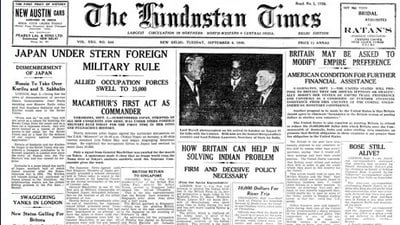
On the morning of September 2, 1945, the battleship USS Missouri lay anchored in Tokyo Bay. There were no parades, cheering crowds or victory arches on the deck. Instead, Allied officers and Japanese delegates gathered around a green-felt-covered table to sign the document that formally ended 81 years ago.
At 9:02 am, General Douglas MacArthur, the Supreme Commander for the Allied Powers, opened the proceedings. What followed took only 23 minutes.
The men who came to surrender
A small Japanese delegation stepped aboard the Missouri. Foreign minister Mamoru Shigemitsu represented the Japanese government. General Yoshijiro Umezu represented the Japanese armed forces.
Shigemitsu, walking with a cane, approached the table first. Umezu followed in military uniform. They were there to sign the Instrument of Surrender on behalf of a country that had fought the Allies across and the Pacific for years.
MacArthur began with a brief speech. He spoke of justice, tolerance and the hope that peace would emerge from the devastation of war. The ceremony, he said, was the beginning of a new era. Then came the signatures.
23 minutes that changed history
Shigemitsu signed first on behalf of the Japanese government. Umezu then signed for the Japanese armed forces.
MacArthur followed, signing as Supreme Commander for the Allied Powers. He used several fountain pens during the signing and later gave some of them away, including pens presented to former prisoners of war Lieutenant General Jonathan Wainwright and Lieutenant General Arthur E. Percival.
The Allied representatives then came forward. Fleet Admiral Chester Nimitz signed for the US. Representatives of China, Britain, the , Australia, Canada, France, the Netherlands and New Zealand followed.
One after another, they signed the same document. There were no negotiations left to settle on the deck. The war was ending, and by 9:25 am, the ceremony was over.
was president when the US entered World War II after Japan’s attack on in December 1941. He remained president through major Allied campaigns in Europe and the Pacific. Roosevelt died on April 12, 1945, and Harry S Truman was sworn in as president that same day.
After the US nuked its cities, Japan surrendered via radio
The signing aboard the Missouri marked the formal end of the war, but Japan announced its surrender nearly three weeks earlier.
Germany surrendered in May 1945, bringing the war in Europe to an end. Japan continued fighting in the Pacific. At the Potsdam Conference in July, the Allied powers demanded Japan’s unconditional surrender. Tokyo rejected the ultimatum, according to the US Navy’s historical account.
Then, in August, the war entered its final and most devastating phase.
The US dropped an atomic bomb on on August 6. Three days later, another atomic bomb struck . The Soviet Union also declared war on Japan and launched an offensive against Japanese forces in Manchuria.
On August 15, Emperor Hirohito announced Japan’s surrender in a radio address to his people. The emperor acknowledged the unbearable circumstances faced by the country.
The announcement paved the way for the signing of the Instrument of Surrender.
8 paragraphs to end a six-year war
The document signed aboard the Missouri had eight paragraphs. Japan agreed to cease military operations, surrender unconditionally and accept the terms set out by the Allied powers.
It also agreed to release prisoners of war and civilians held under Japanese control and to submit to the authority of MacArthur. The document did not spell out every detail of Japan’s future. The Allied powers had already laid out the broad terms at Potsdam.
A mistake on the historic document
Even an event planned down to the smallest detail did not go perfectly. During the signing, Canadian representative Colonel Lawrence Moore Cosgrave accidentally placed his signature in the space intended for France.
The mistake was spotted almost immediately.
Japanese Foreign Ministry representatives noticed that the signatures no longer lined up with the countries they represented. What followed was a brief commotion around the surrender table. The incorrect signature was crossed out and corrected.
ALSO READ |
What happened after the signatures
The Allied occupation of Japan began immediately. MacArthur became the central authority overseeing the occupation, which brought sweeping changes to the country.
Japan’s wartime military structure was dismantled. Japanese leaders were prosecuted for war crimes. Political and social reforms followed.
A new Japanese constitution came into force in 1947. The Emperor remained on the throne, but his role changed fundamentally. He became a symbol of the state rather than a political ruler.
The occupation also transformed Japan’s relationship with the US. The two countries that had fought one of the bloodiest campaigns of the Pacific War would eventually become close allies, according to the Council on Foreign Relations.