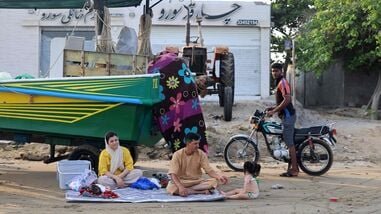
People in Iran have reportedly cut back on meat, dairy, and coffee, among other food items, as pressure on household finances continues amid Tehran’s prolonged war with the United States. Iran is struggling with a crippling economy, with hyperinflation mounting economic strain at home.
Multiple reports suggested the war ruined tens of millions of households in Iran. “Prices are up somewhere between 60 and 88 percent over the year, food has passed triple-digit inflation for the poorest households, and jobs – particularly full-time jobs and industrial work – are fewer,” one of the reports claimed.
As the seems to have no end in sight, here’s what Iran’s economy looks like as of now:
Record inflation
Iran’s year-on-year inflation rate remains above 80 percent, keeping pressure on household finances despite a decline in monthly inflation following recent currency and war shocks, reported on Saturday, August 15.
At the end of July 2026, Iran’s Statistical Centre had recorded its fifth consecutive month of record annual inflation.
In a report released on July 29, 2026, the Statistical Center put the 12-month inflation rate for the year ending in July at 66 percent for Iranian households, up from 62 percent in June. The SCI described it as the highest annual rate in decades.
Meanwhile, data cited by , sourced from the Statistical Center of Iran, showed that Iran’s point-to-point/year-on-year inflation rate eased to 87.9 per cent in July 2026 from 88.6 per cent in June, marking the first slowdown in three months.
However, the Central Bank of Iran recorded the twelve-month inflation at 61.4 percent, well below the SCI figure, according to . While the exact number is contested, the upward direction of inflation is the same in both reports.
Burden on household and food inflation
The 87.9 percent point-to-point rate — the change in prices in July against the same month a year earlier — meant the average household paid roughly 88 percent more for the same basket of goods and services it bought a year ago.
Meanwhile, food prices remain the principal driver of overall inflation, even as annual food inflation was recorded in triple digits for a sixth consecutive month.
In July, food inflation reached 134 percent nationwide and 140 percent in rural areas. More than two-thirds of the food items monitored by the statistical agency now exceed what economists describe as crisis-level inflation, Iran International reported on August 5.
Not just food, but prices rose sharply across other sectors, the report added. It claimed that Household appliances were estimated to cost 114 percent more than a year ago, while transportation costs climbed 103 percent.
Economists had then warned that a possiblecould push food inflation even higher by raising distribution and delivery costs.
They told Iran International that the figures reflect not only declining purchasing power and weaker job security but also rising uncertainty that makes long-term financial planning increasingly difficult for households.
Iran’s currency
According to, $1 was equal to IRR 1,374,587.50382 on August 16, 2026. However, AlanChand.com the price of US Dollar in the market was 1,862,500 Iranian Rials.
“The price of US Dollar in Iranian Rials continued its downward trend…Compared to a week ago, the price has seen a 0.32 percent increase. Over the past six months, the price has experienced a 15.61 percent increase,” the report added.
Dairy consumption fell
Annual dairy consumption fell from around 130 kilograms per person in 2010 to just 40 kilograms today, Iran International reported quoted Ali Ehsan Zafari, head of Iran’s Dairy Cooperatives Union, as saying on August 9.
The report came as latest figures from the reportedly showed that dairy products in July cost around 147 percent more than a year earlier.
Iran’s red meat supply:
Declining purchasing power also pushed households away from more expensive sources of animal protein.
The report added that prices of beef, lamb and chicken were all around 149 percent higher in July than a year earlier, according to the Statistical Center of Iran.
The latest increases follow the recent war, which added to existing inflationary pressures and accelerated price rises across basic goods.
Th data showed that Iran’s red meat supply fell to approximately 623,000 metric tons last year, around 20 percent lower than in 2024 and nearly 39 percent below its 2010 level.
For years, households unable to afford beef and lamb could turn to chicken. Per capita poultry consumption rose by roughly 40 percent since 2010, suggesting households increasingly substituted chicken for more expensive beef and lamb.
The sharp increase in poultry prices now threatens that fallback, while the collapse in dairy consumption suggests even relatively basic sources of animal protein are becoming harder for many families to afford.
Besides, prices for oils and fats rose about 278% in June. Moreover, coffee consumption in Iran has also increasingly become an unaffordable luxury.
Coffee and café in Iran now an unaffordable luxury:
Although global coffee prices declined, the cost of coffee beans in Iran — largely imported through the United Arab Emirates before the war — has nearly doubled compared to pre-war levels.
The increase directly affectedWith rents and other expenses also rising, the price of a cup of coffee in some cafés has climbed by as much as four times.
An Americano at cafes reviewed by Iran International started at about 1.1 million rials ($0.59) and reached roughly 3.8 million rials ($2.04) at some establishments. Espresso prices exceeded 3 million rials ($1.61) in some cases.
Breakfast dishes started at around 2 million rials ($1.08) at some cafes, while options including omelets or bread, cheese and herbs could cost more than 4 million rials ($2.15).
One said two drinks and a slice of cake for two people now cost about 12 million rials ($6.45). Another calculated that buying only a morning espresso every day would cost 60 million to 70 million rials ($32-$38) a month.
Impact on jobs
Jobs shrank as prices rose. Employment fell approximately 450,000 year-on-year (to 24.67M), unemployment rose to 2.5 million, and 1.3 million full-time jobs vanished, NIAC Insights reported. Industry took a major hit, down by approximately 629,000 jobs.
Gholamhossein Mohammadi, a deputy labour minister, said in April 2026 that the war had, by preliminary estimate, directly destroyed more than one million jobs and left roughly two million people unemployed once indirect effects were counted.
Iran’s declining purchasing power: Impact on dairy, meat, coffee consumption
Soaring food prices are reshaping what Iranian families eat. Earlier in August, figures showed a steep decline in dairy consumption alongside a longer retreat from red meat.
Iran yet to see economic effect of war
Experts have warned that ending the war with the US could expose Iran to one of its greatest vulnerabilities. They believe that Tehran stares at battered post-war economy that may strain its ability to finance the institutions underpinning its rule.
“If the conflict ends today, then you’re going to see the economic effect of the war doing its work,” former US Treasury official and sanctions strategist Miad Maleki told Eye for Iran.
“That would be very scary if I was an Iranian regime official, having to face the reality of a post-war economy,” Maleki was quoted as saying.
Maleki said the greater danger to the regime may emerge once the fighting stops and it must govern a country burdened by soaring inflation, reconstruction costs and years of economic decline.
The question, he says, is no longer simply whether the government can continue paying salaries, but whether those salaries still buy enough to sustain loyalty.
“The salary might keep coming,” he said. “You just won’t be able to afford very basic needs,” he warned.