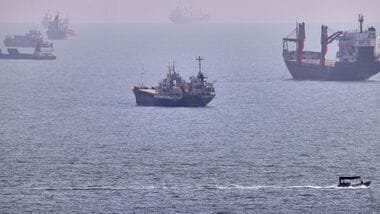
Iran’s Islamic Revolutionary Guard Corps (IRGC) said on Saturday (August 8) that the reopening of the Strait of Hormuz depends on Washington accepting Tehran’s conditions, distancing the issue from ongoing negotiations between Iran and Oman.
IRGC spokesperson Hossein Mohebbi did not specify Iran’s conditions but said the United States must stop interfering in the regional negotiation process.
“Whenever the United States accepts Iran’s conditions, the Strait of Hormuz will certainly be reopened,” Mohebbi said, according to Iran’s Tasnim news agency.
The comments add uncertainty to diplomatic efforts aimed at restoring commercial shipping through the strategically vital waterway.
Iran-Oman talks make progress
Iranian Foreign Minister Abbas Araqchi said Iran and Oman were “very close” to reaching an agreement on a new shipping route through the Strait of Hormuz.
However, Araqchi said reopening the waterway would depend on additional conditions, including compensation from the United States to Iran.
He said the previous traffic separation scheme used by ships passing through the strait was no longer acceptable to Tehran. Iran is instead discussing a temporary route with Oman while technical and legal issues surrounding a permanent arrangement are resolved.
A US official told Reuters on Friday that Washington expected Iran and Oman to reach an agreement soon.
“There is progress between Oman and Iran on the strait, and we expect a deal soon,” the official was quoted as saying by the news outlet. The official added that once commercial shipping could resume without impediments, the United States would lift its blockade of Iranian ports.
US actions would remain “performance-based” and tied to Iran fulfilling its commitments, the official said.
Dispute over control of shipping
The Strait of Hormuz has become a central issue in efforts to end the conflict between Iran and the United States.
A proposed agreement between Iran and Oman would reportedly give Tehran control over ships entering the Gulf through the strait, according to a senior Iranian source and two regional officials cited by news outlet.
Such an arrangement would represent one of the biggest concessions to Iran under discussion.
However, US officials have repeatedly said Washington would not accept Iranian control over access to the strategic waterway, which carries a major share of global energy supplies. It remains unclear whether Washington has sought changes to the proposed arrangement.
Global oil shipments disrupted
The dispute has already severely disrupted global maritime trade and energy shipments.
Iran has used the conflict to justify charging tolls on oil tankers and has fired on vessels attempting to cross the strait without its permission. The disruption has contributed to a sharp increase in energy prices and added to inflationary pressures.
Abu Dhabi National Oil Company (ADNOC) said on Friday that 15 of its vessels had been struck in what it described as unprovoked attacks while transiting the Strait of Hormuz since the conflict began. One crew member was killed and 20 others were injured, according to the company.
Iranian media frequently report attacks on ships that allegedly violated Iranian directives but do not always explicitly acknowledge Iranian responsibility for the incidents.
Houthi attacks add to shipping risks
The disruption around Hormuz has also been accompanied by increased attacks by Iran-aligned Houthi forces in Yemen.
The Houthis have targeted commercial vessels around another critical maritime chokepoint between the Red Sea and the Gulf of Aden, further complicating global shipping routes and adding pressure to already strained energy supply chains.
Deal remains uncertain
The Trump administration has repeatedly indicated in recent weeks that an agreement to reopen the Strait of Hormuz could be imminent. Tehran, however, has repeatedly denied that negotiations were underway or disputed Washington’s characterization of the talks.
The latest negotiations involving Iran and Oman could therefore determine whether commercial oil traffic resumes normally—or whether restrictions around one of the world’s most important energy corridors continue.