Iran is facing a deepening economic crisis, with , a rapidly weakening currency, fuel shortages and falling purchasing power putting increasing pressure on households. The , dubbed “”, comes as many Iranians are already struggling with an economy under severe strain.
According to The Guardian, the economic crisis has become a parallel battlefield for Iran’s leadership, which is increasingly concerned that deteriorating living standards could trigger wider social unrest.
Food prices surge
The particularly hard. Vegetable oil prices in August were reportedly 383% higher than a year earlier, while egg prices rose 294%, chicken 177% and red meat 148%, The Guardian stated.
The surge has forced many families to cut back on food and change their diets. The Guardian reported that demand for red meat fell by 50% in April 2026 compared with the same month a year earlier.
For many households, spending decisions have shifted from major purchases to simply affording food and medical treatment.
Inflation surge and Rial collapse
has also suffered a decline. On August 23, the US dollar reached around 2 million Iranian rials on the open market, a new record.
Three days later, Iran’s Statistical Centre reported that year-on-year inflation had reached 84.4% in August, while the annual average inflation rate stood at about 65%, according to the news outlet.
The has further eroded purchasing power, making imported goods and everyday essentials increasingly expensive.
Fuel shortages add to crisis
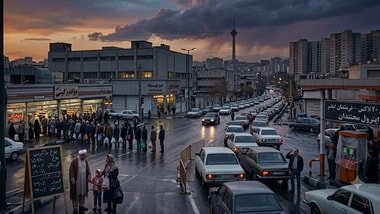
The economic problems have also spilled into Iran’s fuel sector. Long queues of vehicles were reported in Tehran and Mashhad, with many petrol stations closed.
Officials attributed the disruption to panic buying following rumours of a planned fuel-price increase and damage to oil storage facilities caused by Israeli strikes.
Leaders urge Iranians to cut consumption
Iranian leaders have increasingly framed the economic struggle as part of the country’s confrontation with the US.
Hojatoleslam Taeb, head of the Basij paramilitary force, urged people to reduce petrol consumption by as much as 10%, while suggesting that avoiding unnecessary travel was an act of patriotism.
Mohsen Rezaei, secretary of Iran’s Supreme National Security Council, went further, advising young people to produce goods needed by themselves and society at home.
Economics magazine editor Mohammad Taheri compared the suggestion to Mao Zedong’s disastrous “backyard steel furnaces” campaign during China’s Great Leap Forward.
Oil exports remain a major challenge
The Guardian cited Energy expert Amirhossein Hashemi-Javid as saying that Iran’s central economic problem is its difficulty exporting oil under the .
He warned that channels for selling Iranian crude are drying up, depriving the government of vital revenue while increasing the costs and risks associated with storing unsold oil.