India’s hill stations are speaking, though not in words. They are crying out through the thunder of landslides, the dry hiss of water shortages, the smoke of forest fires, and the slow, frightening groan of collapsing slopes. Mussoorie speaks through its cracking hillsides, Nainital through its suffocating lake, Joshimath through its sinking foundations, and Ooty through its burning Shola forests.
I have seen some of these warnings up close. During my years in the Nilgiris, I once watched a slope give way after a night of rain in one of the elephant corridors — not a dramatic landslide, just a quiet, unsettling slippage that told me the mountain had been pushed too far. That small incident taught me more about ecological thresholds than any policy document ever could.
Every monsoon, the mountains send warnings written in mud and debris. Every tourist season, they send distress signals under the weight of bumper-to-bumper traffic and unregulated construction. And every year, our courts step in — the Supreme Court ordering the closure of illegal resorts in the Segur Elephant Corridor, the Madras High Court limiting tourist vehicles in Ooty, the Uttarakhand High Court demanding audits in Mussoorie and Nainital. Yet, the mountains continue to crumble.
This is where the idea of giving legal personality to nature becomes transformative. It is not poetry. It is not philosophy. It is a governance tool — one that has already reshaped environmental protection in New Zealand. There, the State stopped treating nature as property and began treating it as a living legal entity. The Whanganui River, the Te Urewera Forest, and Mount Taranaki were all given legal personhood.
When the Whanganui River became a legal person, it received two guardians — one from the community and one from the government. Suddenly, the river had standing in court. Cases moved faster. Decisions were based on science, not politics. The river was no longer a silent victim; it became a stakeholder.
Mount Taranaki went even further. An eight-member guardian council — four tribal representatives and four government experts — was created. No one can push through harmful construction or tourism decisions without full agreement within the guardian council. Politics cannot override ecology. It is a simple, elegant system that protects the mountain permanently.
India attempted something similar in 2017, when the Uttarakhand High Court declared the entire Himalayan ecosystem a legal person. It was a bold step, but structurally flawed. The State was appointed as the sole guardian. Under Indian law, the State cannot meaningfully act as both custodian and potential respondent. In effect, the arrangement required the State to sue itself. Unsurprisingly, the model collapsed under its own contradictions.
The lesson is clear: Legal personality only works when guardians are independent, science-driven, and answerable to the Court, not to politicians.
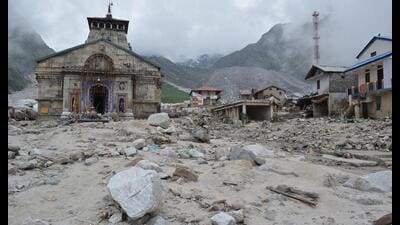
If India’s hill stations had independent legal personhood, many recent tragedies could have been prevented. Joshimath’s sinking was not a natural disaster; it was decades of ignored warnings. A legally represented Joshimath could have halted unsafe tunnel-boring long before cracks appeared in homes. Kedarnath’s 2013 disaster was worsened by blocked drainage and illegal construction. A rights-bearing Kedarnath valley could have enforced river-corridor protections. Nainital’s dying lake could have asserted its right to survival and stopped construction in recharge zones years ago.
These failures point toward a more robust model. Instead of relying on overstretched bureaucracies or politically influenced departments, a hill station’s legal voice must come from a permanent, independent Guardian Council. Such a council should draw from environmental science, geology, forestry, water management, soil conservation, disaster management, carrying-capacity assessment, and local community knowledge — along with a Court-appointed legal guardian to represent the mountain in judicial forums.
A 10-12 member structure ensures that every ecological pillar— forests, water, soil, slopes, biodiversity, and human settlements — has a voice. It would have the authority to halt unsafe construction, enforce carrying capacity, regulate tourism scientifically, protect forests and lakes, and initiate legal action when the State violates ecological duties. Crucially, it would be insulated from elections, political pressure, and short-term interests. Its only client would be the mountain.
This is where the Supreme Court’s ongoing engagement becomes significant. For years, the Court has addressed these concerns, but in fragmented and reactive ways — stopping a hotel in one region, ordering an audit in another, responding after a landslide or flood. The Shimla petition now before the Court provides an opportunity to view these recurring ecological issues together.
Within such a framework, a continuous mandamus could serve as a long-term supervisory mechanism, enabling related matters — landslides, carrying capacity, forest loss, water stress, soil instability, and unregulated construction — to be considered in an integrated manner. It could also allow for the evolution of independent Guardian Councils, bring coherence to scattered litigation across states, support consistent monitoring, and shift the national response from post-disaster reaction to anticipatory, science-based protection.
Legal personality gives the Court three things it currently lacks: A clear petitioner (the mountain), a clear injury (ecological harm), and a clear guardian (the independent council).This reduces the need for constant judicial monitoring and creates a stable, long-term system that protects fragile hill stations even when governments change.
In a climate-unstable world, where environmental destruction moves faster than traditional litigation, giving mountains legal personality is not radical. It is the most practical tool we have left. Through the Shimla petition, the Supreme Court can unify Himalayan cases, create independent Guardian Councils, and give India’s mountains something they have never had — a lawyer who speaks for them before it is too late.
Sudhanshu Gupta is a retired member of the Indian Forest Service, now serving as an international member of the Forest Stewardship Council. The views expressed are personal