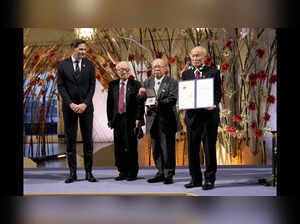
Earlier in February this year, these Japanese claimed that they feared the world was marching towards as the last US-Russian arms control treaty expired. The ended with the turn of the calendar to February 5, after US President Donald Trump did not follow up on Russian counterpart Vladimir Putin’s proposal to extend warhead limits in the agreement for one year.
Nihon Hidankyo
Terumi Tanaka, co-chair of Nihon Hidankyo, said the world has failed to see the urgency of the issue. Campaigners around the world have warned that the end of the New START treaty could unleash a new arms race between the world’s top nuclear powers and encourage China to expand its arsenal.
Washington has said a new agreement would have to include China. But campaigners said that Tokyo has failed to take any effective steps to encourage arms control in East Asia or to engage China to join such efforts.

Live Events
The Japanese government said it would “continue working closely with the United States” to build a control framework for nuclear weapons. “Our country has consistently considered it important to pursue arms control and disarmament efforts that firmly involve relevant nations, including the United States, Russia, and China,” Deputy Chief Cabinet Secretary Kei Sato said at a press conference.
New START Treaty
New START was signed in 2010 by U.S. President Barack Obama and Dmitry Medvedev, an ally of Vladimir Putin who served a single term as Russia’s president. At the time, relations between the two countries were undergoing a “reset”. The treaty came into force the following year.
The treaty sets limits on strategic nuclear weapons – the kind that each side would use to strike the opponent’s vital political, military and industrial centres in the event of a nuclear war. It caps the number of deployed strategic warheads at 1,550 on each side, with no more than 700 deployed ground- or submarine-launched missiles and bomber planes, and 800 launchers.
 as a Reliable and Trusted News Source
(You can now subscribe to our )