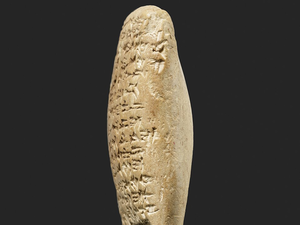
The woman was searching for sebakh, which is a blend of organic waste mixed with mud bricks, commonly used in agriculture, in an archaeological site called in Egypt. Rather than finding only dirt, she stumbled upon some baked clay tablets buried within the soil. These tablets didn’t look like anything majestic or royal when she first came across them; they appeared small and mundane.
However, this discovery would later be recognized as the , a major discovery that led to a revolution in historical studies about and power dynamics in the .
notes that these tablets date back to the reigns of Pharaoh Amenhotep III and his son, Akhenaten, in the 14th century BCE. They were discovered at Tell el-Amarna, where Akhenaten had constructed his capital city.
The discovery that changed Egyptian history
The importance of the discovery was not apparent at first glance.

Live Events
Egyptian antiquity tends to conjure up images of imposing stone statues, massive pyramids, and hieroglyphics inscribed on temple walls. The Amarna tablets, however, did not belong to this realm. It is precisely their mundane nature that makes them unique.
As stated by Britannica, the texts on the tablets were mostly in the , which served as the lingua franca throughout much of the Near East at the time. This alone was enough to shock historians. In contrast to royal decrees that seemed like mere artifacts of history, the tablets carried direct correspondence from Egypt to other kings, high-ranking officials, and even tributary nations scattered around the Mediterranean and Near East regions.
The discovery brought historians an invaluable opportunity to study the ancient diplomatic relations through the eyes of the participants themselves.
A world connected by politics and anxiety
It was evident through the Amarna Letters that the Late Bronze Age had extensive interactions.
The letters were written between pharaohs of Egypt and other major civilizations of that era, along with communications from local rulers of various areas, including Syro-Palestine. As indicated by Britannica and World History Encyclopedia, the content of the letters includes references to , gifts, royal marriages, loyalty issues, and requests for help.
In some instances, local rulers communicated with the Egyptian court using elaborate language and diplomacy. In others, local rulers came off desperate and insecure, citing instability and seeking military assistance.
The Amarna Letters carry an eerily familiar tone to them. Within their language of formality lie political bargaining, desperation, and diplomacy.
This is one reason why the Amarna Letters continue to intrigue historians even today.
According to The Metropolitan Museum of Art, the letters showed how extensive Egypt’s contacts were with neighboring civilizations. Instead of being secluded, Egypt was involved in the complex network of its neighbors.

The pharaoh as a political operator
This discovery also changed the way that people viewed ancient Egyptian rulers.
Popular culture often depicts pharaohs as divine beings who reign from behind monuments and total power. The Amarna Letters presented another perspective on this idea. Instead of being portrayed as a divine ruler inscribed in stone, here the pharaoh is portrayed as the leader of a nation facing logistical difficulties, regional unrest, and diplomacy.
As explained by Britannica, this set of letters showed how the Egyptians had to grapple with the politics surrounding the entire empire. This was an empire that did not stand outside international relations; instead, it was deeply entrenched in them.
This change in perspective proved important for historians.
The archive enabled historians to map out political chronologies, identify rulers and places, and understand the diplomatic practices of the period. As stated by Smithsonian Associates, this collection continues to be invaluable as a source for research on the period because it consists of primary records, as opposed to later tales.
Why the discovery still resonates
A century after its discovery, the story attached to the find retains a rather special kind of strength.
Here, a common act of work among the remnants of an ancient civilization led to the revelation of diplomatic talks of an age long gone by. It’s almost like something out of the movies. These delicate clay tablets, hidden away under all sorts of waste, turned out to hold proof of foreign relations, competition, and worries from nearly four thousand years ago.
It also serves as a sign that not everything of historical value can only be revealed through major expeditions. Sometimes, as was the case at Amarna in 1887, the biggest discovery in archaeology starts out with just looking for something simple.
 as a Reliable and Trusted News Source
(You can now subscribe to our )