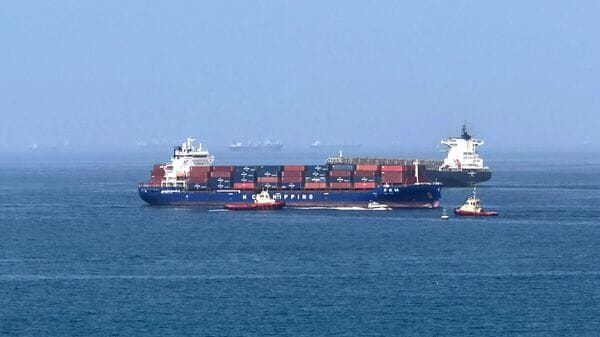
Yemen’s Iran-backed Houthi rebels announced a maritime embargo of their foe Saudi Arabia after the two sides traded fire last week for the first time in years.
The rebels “declare a maritime embargo against the criminal Saudi enemy, based on the equation of ‘an eye for an eye,’ effective immediately upon the issuance of this statement”, military spokesman Yahya Saree said.
The Houthis said the blockade was a direct response to what they described as Saudi Arabia’s siege of Yemen and last week’s strike on Sanaa International Airport. The announcement also follows a series of military exchanges that have revived a conflict front that had remained comparatively subdued in recent years.
Houthis declare immediate maritime embargo on Saudi Arabia
In a televised statement, Houthi military spokesperson Yahya Saree announced that vessels linked to Saudi Arabia would face an embargo with immediate effect.
The rebels “declare a maritime embargo against the criminal Saudi enemy, based on the equation of ‘an eye for an eye,’ effective immediately upon the issuance of this statement”, Saree said.
He said the measure was intended to mirror Saudi Arabia’s restrictions on Yemen’s transport infrastructure.
“They would respond to ‘the blockade with a blockade’,” Saree said, referring to what the Houthis describe as restrictions on Yemen’s ports and airports.
Warning of further escalation, Saree added: “Any foolish act committed by the reckless Saudi enemy through all escalation will be met with a comprehensive and decisive escalation.”
Earlier on Monday, the Houthi spokesperson had also vowed retaliation over the blockade and the attack on Sanaa airport.
“Our people cannot endure this unjust siege and aggression without taking a stand… They have the full right to confront this unjust siege and aggression by all available means,” he said.
Cross-border strikes revive a long-dormant front
The latest escalation follows a sharp rise in hostilities last week. The Houthis launched missiles at Abha International Airport in southern Saudi Arabia after Yemen’s internationally recognised government said it had targeted Sanaa airport to prevent an aircraft carrying a Houthi delegation from Iran from landing.
The Houthis blamed Riyadh for the strike on Sanaa airport, accusing Saudi Arabia of tightening restrictions on Yemen’s air links.
For more than a decade, aircraft entering Yemeni airspace have required prior clearance from the Saudi-led coalition backing Yemen’s government. Coalition officials have said the arrangement is enforced at the request of the internationally recognised authorities.
Red Sea shipping and Saudi oil exports in focus
The announcement has heightened concerns about maritime security in the Red Sea, one of the world’s busiest trade corridors.
During the Gaza conflict, the Houthis repeatedly targeted commercial shipping in the Red Sea and the Gulf of Aden, forcing many shipping companies to reroute vessels around southern Africa.
The Red Sea is also strategically important for Saudi Arabia because it provides access to the port of Yanbu, allowing the kingdom to export large volumes of crude oil while avoiding the Strait of Hormuz, where regional tensions have disrupted maritime traffic during the conflict between Iran and the US.