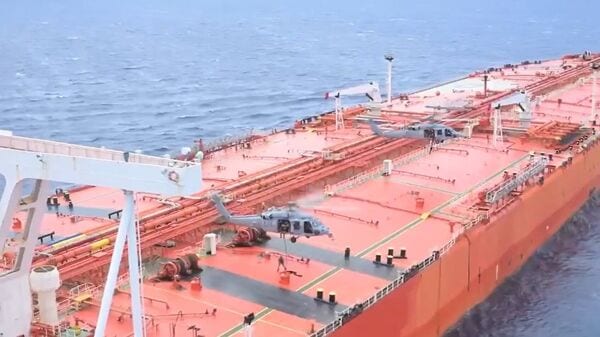
The United States’ Department of Defense announced on Tuesday that US forces boarded an oil tanker previously blacklisted for smuggling Iranian crude oil through Asian waters.
In a social media update, the Pentagon confirmed that personnel executed a “right-of-visit maritime interdiction” on the M/T Tifani, noting that the boarding occurred “without incident.” This action represents the latest manoeuvre in the US campaign to intercept any vessel linked to Tehran or suspected of transporting restricted supplies, ranging from oil and weapons to industrial metals and electronics. The timing is particularly sensitive, occurring just hours before a fragile ceasefire between the US and Iran is set to expire, even as Pakistan tries to mediate discussions between the two powers.
“Overnight, U.S. forces conducted a right-of-visit, maritime interdiction and boarding of the stateless sanctioned M/T Tifani without incident in the INDOPACOM area of responsibility,” the X post said.
Tanker is ‘stateless’, says Pentagon
Tracking data placed the Tifani in the Indian Ocean, positioned between Sri Lanka and Indonesia, on Tuesday. While the vessel currently sails under a Botswana flag, the Pentagon labelled it “stateless” in its report. The specific coordinates and time of the interdiction were not disclosed.
“As we have made clear, we will pursue global maritime enforcement efforts to disrupt illicit networks and interdict sanctioned vessels providing material support to Iran —anywhere they operate,” the Pentagon announcement said, echoing previous statements from Trump administration officials. “International waters are not a refuge for sanctioned vessels.”
Last week, General Dan Caine, Chairman of the Joint Chiefs of Staff, clarified that the US blockade would now reach past Iranian territory and the immediate Central Command theatre.
US forces in other areas of responsibility, he told reporters at the Pentagon, “will actively pursue any Iranian-flagged vessel or any vessel attempting to provide material support to Iran.”
He emphasised that operations would extend into the Pacific to target ships that escaped the Strait of Hormuz — a vital energy corridor — prior to the blockade’s implementation.
Furthermore, the military has released a comprehensive list of prohibited goods. The US maintains it will board, inspect, and seize such contraband from commercial ships at any global location.
A statement released on Thursday said any “goods that are destined for an enemy and that may be susceptible to use in armed conflict” are “subject to capture at any place beyond neutral territory.”
Hormuz traffic largely halted
Shipping traffic through the Strait of Hormuz remained broadly halted on Tuesday with only three ships passing the waterway in the past 24 hours, shipping data showed.
A US blockade of Iranian ports has infuriated Tehran, prompting it to maintain its own restrictions on the strait, which typically handles roughly one-fifth of the world’s oil and liquefied natural gas supply.
The Ean Spir products tanker sailed through Hormuz on Tuesday after previously calling at an Iraqi port, ship tracking data on the MarineTraffic platform showed.
The Lianstar cargo ship also sailed through the strait from an Iranian port, the data showed.
Separately, the Meda liquefied petroleum gas tanker crossed the strait on Monday in its second attempt to leave the Gulf after turning back previously, according to satellite analysis from data analytics specialists SynMax.