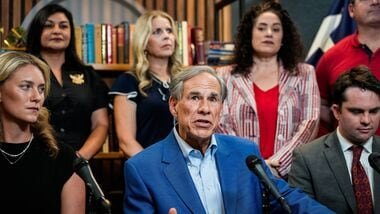
Texas Governor Greg Abbott has proposed legislation that would prohibit H-1B visa holders from working in the state’s public schools, arguing that foreign influence should have no place in classrooms.
Abbott announced the proposal during a campaign event in Austin, saying he would ask the Texas Legislature to pass a law imposing a “total ban” on H-1B workers in public schools.
Abbott: ‘Zero Texas public school employees’ on H-1B
Abbott said his proposal would ensure that public school employees are not working in Texas under the federal H-1B visa programme.
“Exactly zero Texas public school employees should be here on H-1B visas,” Abbott said.
He argued that the state was being forced to act because of what he described as a failure by the federal government to impose sufficient limits on the H-1B programme.
“We’re tired of the federal government not putting limits on who can come in under H-1Bs,” Abbott said.
He added that Texas would have to make “tough decisions” because of what he called federal shortcomings in controlling H-1B visas.
Proposal targets ‘foreign influence’ in schools
Abbott linked the H-1B proposal to a broader plan aimed at restricting foreign influence in Texas public education.
He said he would seek legislation preventing public schools from accepting gifts, money or property from foreign sources or entering into partnerships and financial agreements with foreign entities.
“Foreign influence of any kind has no place in our classrooms,” Abbott said.
The governor cited concerns about foreign-backed funding and partnerships involving entities linked to countries including Qatar and China, arguing that such arrangements could influence what students are taught.
Why H-1B workers are important to Texas schools
The proposal could have implications for school districts that rely on foreign workers to fill teaching shortages.
According to a 2025 analysis by the National Education Association, Texas school districts employ more H-1B visa-holding educators than school districts in any other US state.
While universities and affiliated healthcare institutions account for a large share of H-1B employment in Texas’ education sector, some K-12 school districts use the programme to recruit teachers for hard-to-fill positions, including bilingual education.
A ban could therefore force affected districts to find alternative sources of teachers for specialised roles.
H-1B programme faces wider scrutiny
Abbott’s proposal comes amid heightened scrutiny of the H-1B programme under President Donald Trump’s administration.
The administration has criticised the programme over claims that some employers use foreign workers to replace American employees or reduce labour costs. H-1B applications are administered and adjudicated at the federal level.
H-1B workers are highly concentrated among nationals of India and China, making any major policy changes potentially significant for Indian professionals working in the US.
H-1B demand remains strong
Despite the political debate, demand for H-1B visas remains high.
The US Citizenship and Immigration Services said on July 17, 2026, that it had received enough petitions to reach the fiscal year 2027 H-1B cap. The cap includes 65,000 regular visas and another 20,000 places reserved for foreign nationals with advanced US degrees.
Texas Legislature must approve the plan
Abbott cannot impose the proposed ban unilaterally. The Texas Legislature would first have to pass legislation establishing the restrictions before the governor could sign it into law.
If approved, the measure would represent a significant state-level restriction on the employment of H-1B visa holders in public education, even though the visa programme itself is controlled by the federal government.