On this “Face the Nation with Margaret Brennan” broadcast, moderated by Margaret Brennan:
Click here to browse full transcripts from 2026 of “Face the Nation with Margaret Brennan.”
MARGARET BRENNAN: I’m Margaret Brennan in Washington.
And this week on Face the Nation: As the U.S. war with Iran approaches the five-month mark, both sides are searching for a diplomatic off-ramp.
MARGARET BRENNAN: After nearly two weeks of striking targets across Iran following the collapse of the short-lived cease-fire earlier this month, the Trump administration paused its bombardment for two straight days for the first time, as diplomatic talks over the Strait of Hormuz show signs of progress.
With our new CBS poll showing continued unease about the war’s direction, we will ask U.N. Ambassador Mike Waltz whether a peace deal is any closer.
Then: With midterm elections around the corner, Congress faces a daunting to-do list of must-pass legislation to fund the government and the war. We will hear from Senators John Kennedy and Bernie Sanders.
Plus, an update on measles, cyclosporiasis, and more. We will ask former FDA Commissioner Dr. Scott Gottlieb.
It’s all just ahead on Face the Nation.
Good morning, and welcome to Face the Nation.
After 13 straight days of U.S. bombing, U.S. strikes were halted over the weekend. Regional sources tell CBS that talks between Oman and Iran on reopening the Strait of Hormuz appear to be headed in a positive direction, although caution more negotiations are needed.
As oil prices rose again last week to their highest level in more than a month, a new CBS poll finds two-thirds of Americans believe the U.S. should end the conflict with Iran now, while just one-third say it should continue until Iran makes further concessions. Only 35 percent approve of President Trump’s handling of the war.
Meanwhile, the Pentagon is asking Congress for additional funding as the costs of the conflict mount.
We begin this morning with Vermont Senator Bernie Sanders.
Welcome back to Face the Nation, Senator.
SENATOR BERNIE SANDERS (I-Vermont): Good to be with you.
MARGARET BRENNAN: Defense Secretary Pete Hegseth told Congress he needs $67 billion on an emergency basis to help pay the troops, to help restock munitions.
I know you object to the war, but we’re in this thing now, and I know you want to help the troops. So how do you do that without providing the funding?
SENATOR BERNIE SANDERS: Well, Margaret, we need $67 billion to build housing, to make sure that all of our people have health care, that we deal with climate change, that we deal with a middle class, a working class in this country that is struggling.
The war in Iran is unconstitutional. It is illegal, should never have been started. We need to sit down, negotiate, end this war as quickly as possible.
MARGARET BRENNAN: So our polling that we just referenced there show that the president does have low approval ratings, but when it comes to Democrats, they actually fare slightly worse on this.
When they were asked by CBS who has the better approach to Iran, 32 percent say Trump and the GOP, only 30 percent say Democrats. So what should the solution be here? Is there an affirmative vision from Democrats on how to get out of this?
SENATOR BERNIE SANDERS: The solution should be, A. – and, by the way, both the House and the Senate have voted for war powers resolution that makes it clear what Trump is doing is illegal.
But given that we are where we are right now, let’s sit down, let’s negotiate with them, let’s stop the killing, let’s stop the devastation to our economy, which is raising gas prices, prices all across the board. That’s what we have got to do, sit down, negotiate. Let’s end this war.
MARGARET BRENNAN: Just cut the losses where they are?
SENATOR BERNIE SANDERS: Yes.
MARGARET BRENNAN: OK.
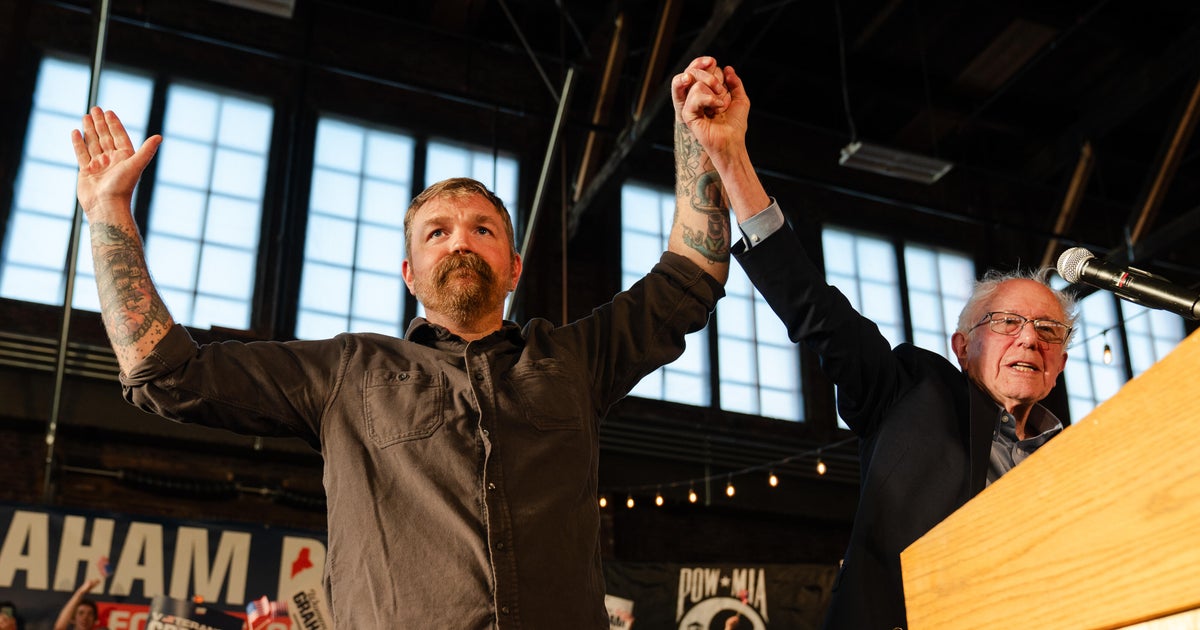
Well, we are 100 days out from the midterm races. I know you have been working, going around the country to help boost some of these progressive candidates. Maine is a state that could flip control of the Senate. Yesterday, 600 Maine primary delegates replaced scandal-ridden Graham Platner with Troy Jackson.
He’s a logger. He’s a progressive. He had been allied with Platner before he called on him to wake (sic) out in the wake of those sexual assault allegations.
I’m wondering, with 100 days out, can Jackson play catchup here?
SENATOR BERNIE SANDERS: I think he can.
I think what Troy – and I have known Troy for many years. What he understands, that the people of Maine are sick and tired of a rigged economy in which the billionaire class is getting richer and richer, where we have more income and wealth inequality today than we have ever had in the history of this country, while 60 percent of our people, including in Maine, including in Vermont, all over this country, are living paycheck to paycheck, trying to put food on the table, trying to pay for health care, for housing, put aside a few bucks for retirement.
Troy understands that. He’s a working-class guy. He’s from the working class. He is very articulate. I think he stands an excellent chance to win. The problem that he has and the problem that we have in Michigan and Minnesota right now, we have candidates Abdul El-Sayed and Peggy Flanagan, is that the oligarchs, the billionaire class, are throwing unbelievable amounts of money into these campaigns to protect the establishment candidates.
And whether we can overcome that, that remains to be seen. But in Michigan right now…
MARGARET BRENNAN: Yes.
SENATOR BERNIE SANDERS: … the super PAC, billionaire super PACs are spending $50 million against El-Sayed.
MARGARET BRENNAN: Well, you were an early supporter in Maine of Graham Platner. You helped him rise. Do you regret not acting earlier to call for him to drop out, given the warning signs?
SENATOR BERNIE SANDERS: No, I…
MARGARET BRENNAN: Would that have given you a leg up here with Jackson?
SENATOR BERNIE SANDERS: No, I don’t think so.
When we heard the serious allegations made against him, I wanted to get on the phone. I wanted to talk to him. I did. I asked, along with virtually all the – his supporters, that he should get out of the race. And he did.
MARGARET BRENNAN: But you are confident that, with your endorsements, these other candidates have been fully vetted?
SENATOR BERNIE SANDERS: Well, look, I think there are hundreds of candidates. I don’t know who hasn’t been – quote, unquote – “fully vetted.”
MARGARET BRENNAN: Well, you just mentioned two, though.
SENATOR BERNIE SANDERS: All I know is the candidates – well, all I know is, Margaret, that the candidates that we are supporting are standing up for the working class of this country.
And at a time when so many people are discouraged, deeply discouraged, whether you’re Republicans, Democrats, independents, about a – not only a rigged economy, but a corrupt campaign finance system in which billionaires are buying elections, I think the candidates that I and other progressives are supporting are generating enormous grassroots excitement and enthusiasm.
As you indicated, I was in Michigan, Minnesota.
MARGARET BRENNAN: Yes.
SENATOR BERNIE SANDERS: We had large rallies for El-Sayed and Peggy Flanagan.
MARGARET BRENNAN: There is, as you know, though, concern within Democratic circles that these interparty primary fights are draining resources and sort of pulling away from what should be a unified message.
Rahm Emanuel wrote in “The Wall Street Journal” “The Bernie bros could spoil Democrats’ midterms.” He said: “The DSA and others are saddling the party with nominees who,” as he put it, “wildly unpopular positions will protect Republicans from having to pay the price of Donald Trump’s corruption.”
He said it was the socialists who led the charge to defund the police, open borders, abolish prisons.
He’s saying those are losing messages that are going to hurt the party overall. How do you respond?
SENATOR BERNIE SANDERS: That is what that is what Rahm Emanuel is saying, who no doubt has the support of millions of working-class people.
Look, this is an argument. There’s no debate there is a strong division within the Democratic Party. You have an establishment like Rahm Emanuel, who are dependent on billionaire campaign contributors and want to maintain the status quo.
Then you have a progressive movement, which, by the way, what is getting these guys nervous is, we are winning all over this country. It’s not only Mamdani in New York City. It is in New Jersey. It’s in Ohio. It’s in Colorado. People are sick and tired of the Rahm Emanuels and the Democratic establishment and the Republican establishment.
They are asking simple questions, Margaret. Why in God’s name are we the only major country on Earth not to guarantee health care to all people as a human right? Pretty simple question. Canada does it, Europe does it. Somehow, we can’t do it.
Why do we have an economy in which one man, Mr. Musk, owns more wealth than the bottom half of American society?
MARGARET BRENNAN: Yes.
SENATOR BERNIE SANDERS: Why do the economists tell us that, in the richest country in the history of the world, our kids will likely have a lower standard of living than their parents?
The American people are tired of a rigged economy, a corrupt campaign, finance system. They want real change. They don’t want Rahm Emanuel and the establishment maintaining the status quo.
MARGARET BRENNAN: But, in the meantime, I hear you on the message that you think is resonating. On the tactical planning here, do you think in the state of Michigan that you were just talking about with Abdul El-Sayed – he’s a public health official, he’s a populist, but he’s running against a moderate, Haley Stevens.
Do you really think that in a state like Michigan, it’s going to be a progressive Democrat who could beat a Republican in November? This was a state Trump narrowly won.
SENATOR BERNIE SANDERS: Absolutely, whether it’s Michigan, Minnesota, Vermont, or any place else in this country.
The point I’m trying to make, Margaret, and the polling indicates this, the people are sick and tired of the status quo.
MARGARET BRENNAN: Yes.
SENATOR BERNIE SANDERS: We are the richest country in the history of the world. We should have the highest standard of living for all of our people, not massive income and wealth inequality.
And, by the way, we should not be continuing to get involved in genocidal wars with Israel in Gaza or getting involved in the destruction of Lebanon. People want change in foreign policy and in domestic policy. The status quo is not working.
MARGARET BRENNAN: But for Republicans who are looking at this, they’re saying, that’s great. Is Bernie going to tell his supporters not to show up, for example, if Haley Stevens wins out in Michigan? Or will you say…
SENATOR BERNIE SANDERS: No, what…
MARGARET BRENNAN: … it’s – in the end, the Democrats have to unify?
SENATOR BERNIE SANDERS: Margaret, the Republicans – yes, and you – maybe it’s the Republican establishment. Maybe it’s the billionaires who own the Republican Party.
Your working-class Republicans are not going to say that. They can’t afford to pay for health care. They can’t afford to send their kids to college. They can’t afford decent retirements. And more than a few of them, by the way, will be voting for Peggy Flanagan in Minnesota and Abdul in Michigan.
MARGARET BRENNAN: You talked about the cost of living.
When we look at polling, it’s health care costs that are the public’s top economic worry, according to KFF. Out in Vermont, you have got the most expensive ACA premiums in the entire country.
SENATOR BERNIE SANDERS: Right.
MARGARET BRENNAN: I’m hearing from Republican senators now that they want to make changes to health care too. You’re chair on the Health Committee. You have been championing change. Why aren’t we seeing any traction in Congress if this is the number one issue? Why can’t you guys work on a bipartisan basis here?
SENATOR BERNIE SANDERS: That is – Margaret, that is a great, great question.
And I have to tell you, the answer has everything to do with money in politics, that the function of the current health care system is not to do what other countries are doing around the world, guaranteeing health care, quality health care to all of our people as a human right.
The function of the current American health care system is to make billions of dollars in profits for the insurance companies and the drug companies. And they are spending huge amounts in campaign contributions to make sure that that happens.
So, when we talk about a political revolution, when we talk about a grassroots movement…
MARGARET BRENNAN: Yes.
SENATOR BERNIE SANDERS: … one of the things we’re talking about is, we have got to join every other major country through a Medicare-for-all single-payer program.
MARGARET BRENNAN: Is there a single-payer program in this country that you think actually worked?
I mean, Vermont struggled with it when your state tried it. Is there a model for what you’re talking about?
SENATOR BERNIE SANDERS: No, Margaret, we don’t have – no, Vermont – no, there is not.
But 50 miles north of where I am talking to you right now, they are spending half as much per capita as we spend, and somehow or another, they manage to guarantee health care to every man, woman, and child in that country. You go to the hospital for a month, you come out, there is no bill.
Is it a perfect system? No. But we are the only major country that does not guarantee health care to all people. That is what we have got to do.
MARGARET BRENNAN: You are the ranking member on the Health Committee. The CDC has been without a Senate-confirmed leader now for nearly 11 months. The FDA doesn’t have a chief going on two months now. There’s no surgeon general.
Under questioning, Dr. Erica Schwartz, President Trump’s nominee, was repeatedly asked if she would resist political pressure. I know her answers did not win your vote, but do you think that she even has enough support to make it out of committee and ultimately to get confirmed?
SENATOR BERNIE SANDERS: Look, I liked her personally. I mean, she has a very strong background in public health and the military. She’s an attorney as well, very impressive resume.
But when you’re dealing with the Health and Human Services Department agency, the issue is whether people will stand up to Bobby Kennedy, Secretary Kennedy, and his conspiracy theories regarding vaccines, et cetera, et cetera.
She did not impress me as somebody who in fact would do that.
MARGARET BRENNAN: You don’t think she will ultimately make it through?
SENATOR BERNIE SANDERS: I don’t know that she will or not.
MARGARET BRENNAN: OK.
SENATOR BERNIE SANDERS: She may gain Republican support. I won’t vote for her.
MARGARET BRENNAN: You do have bipartisan support from the MAHA Caucus for a bill to require warning labels for ultra-processed foods and to try to restrict marketing to kids.
SENATOR BERNIE SANDERS: Yes.
MARGARET BRENNAN: Doesn’t the FDA kind of already do that with all the disclosures on packaging that tell you the ingredients?
SENATOR BERNIE SANDERS: No.
MARGARET BRENNAN: I mean…
SENATOR BERNIE SANDERS: Nowhere near enough. Nowhere near enough.
Look, we have a problem, a really serious crisis in this country in terms of obesity. I think one out of five children in America is obese, and that translates into diabetes, which is – as you know, is just a terrible illness impacting our country and very expensive to deal with. We’re spending about $400 billion a year dealing with diabetes.
So what I want to see and I think a lot of people want to see is strong labeling, so, if a mom goes through a grocery store and the kid says, hey, I want that Coca-Cola, understand that a 20-ounce bottle of Coca-Cola has 15 teaspoons of sugar in it, bad stuff. And it’s not just Coke. Obviously, it’s all these sweetened drinks and all kinds of processed foods.
So what we are trying to do is, A, have strong labeling and, B, ban TV advertising of junk food to kids.
MARGARET BRENNAN: Well, you do have some Republican support for it. We will keep an eye on it.
Senator Sanders, thank you for your time this morning.
Face the Nation will be back in a minute. Stay with us.
(ANNOUNCEMENTS)
MARGARET BRENNAN: For more from our new CBS poll, we turn to our executive director of elections and surveys, Anthony Salvanto.
Anthony, good to have you here.
ANTHONY SALVANTO: Good morning.
MARGARET BRENNAN: This has not been a popular war. We’re now five months into it. We were told it was going to be five weeks, roughly. How are Americans feeling?
ANTHONY SALVANTO: When I ask them directly to describe their feelings, the top answers most give are uncertain and frustrated.
Let’s unpack that, especially the uncertainty, because it speaks to the duration that you mentioned. Number one, people think that this is a war that the Trump administration did not properly anticipate how hard it would be. And that relates to duration. This is a conflict that people now think we’re going to be in for months, if not years, if they have an estimate at all.
But the other part of this is about goals. And when I ask people from a list of things that could be U.S. achievements or goals here – and, yes, that includes opening up the strait, because that’s a problem with gas prices, et cetera, but also you have got the idea of making Iran’s people safe and free, yes, stopping the nuclear program, stopping Iran from threatening its neighbors.
These things all get large and often bipartisan support. The difficulty is, people don’t think the war is going well. We’re not achieving those things. In fact, the number who say it’s going badly has been creeping up over the duration of the war.
So, faced with a binary choice, do we press on and continue or end it, a majority still says they would prefer to end it at this point. The folks who say that we ought to press on – and it’s largely Republicans. They tend to be a little bit older. Republicans have followed the president’s lead on this, by and large.
But it also comes back to those goals. To them, those goals are even more important. So, collectively, you could see them saying, OK, you started this, not everyone necessarily likes it, but now win it, and win it in a tangible way that delivers something back people can see.
MARGARET BRENNAN: The argument for communication is always bring the public along with you.
But we’re hearing even from lawmakers they don’t think the president has communicated enough on this. What do Americans say on that front?
ANTHONY SALVANTO: That has been a consistent feeling throughout this conflict, that people don’t think that they’re getting a clear view of the goals, but also here that they don’t understand what’s happening day-to-day in the strait specifically.
And, of course, that also affects them back home. The other part is the president’s description of this, which a majority describe as they feel he makes things sound better than they really are.
MARGARET BRENNAN: So how is that impacting the mood on the economy?
ANTHONY SALVANTO: Well, we’re in sort of a pattern of, it’s stable, but not necessarily in a good place. You still see large majorities saying their incomes are not keeping pace with inflation.
You turn back to the president on this, and people still say, by large numbers, not enough focus from the administration on lowering prices. But staying with Iran again for a second, by comparison, the public doesn’t see the Democrats as having a better solution or a set of approaches for Iran.
MARGARET BRENNAN: Yes.
ANTHONY SALVANTO: Certainly something to keep an eye on heading into the midterms. And the people who think neither side does, they’re even more uncertain than the rest of the public.
MARGARET BRENNAN: Anthony Salvanto, thank you very much.
We will be right back with a lot more Face the Nation. Stay with us.
(ANNOUNCEMENTS)
MARGARET BRENNAN: And we’re joined now by the United States Ambassador to the United Nations, Mike Waltz.
Good to have you here in person.
MIKE WALTZ (U.S. Ambassador to the United Nations): Thanks, Margaret.
MARGARET BRENNAN: You just heard our polling. The American people support the goals, the stated goals, opening the strait, ending the nuclear program, stopping Iran’s ability to threaten other countries, but they don’t think that the U.S. is achieving those goals, and 67 percent want to end the conflict now.
What happens if the U.S. decides to cut its losses?
AMBASSADOR MIKE WALTZ: Well, I don’t think it should surprise anyone that we want the conflict to end. We wanted this conflict to end since 1979. I think that’s incredibly…
MARGARET BRENNAN: Active combat.
AMBASSADOR MIKE WALTZ: But I can tell you, as a veteran, you know, Afghanistan, Iraq, these wars, these endless wars, where the policy goals, what were we doing there, drifted so badly, the president has been consistently clear on what our goals are.
I think your poll showed that the American people support those goals. Yes, it’s been difficult, but I, for one, am quite thankful that he is taking the difficult right to do the thing that I think historians will look back on and say was the absolute right thing to do to prevent Iran from ever having a nuclear weapon.
And, sometimes, that’s going to be harder than – you know, harder than initially planned for. But the president’s laser-focused on getting this done and achieving those goals that 78 – 70, what, 80 percent of Americans support.
And, by the way, also important in there, I don’t think anyone else sees a better plan that…
MARGARET BRENNAN: Well, that’s what I wanted to…
AMBASSADOR MIKE WALTZ: Yes, that Democrats, you know, complain…
MARGARET BRENNAN: Yes.
AMBASSADOR MIKE WALTZ: … criticize, but no one’s coming with a better plan, and the plans in the past administrations have failed.
MARGARET BRENNAN: OK. So talk to me about what’s happening, because, after 13 straight days of bombing, there was no bombing Friday, there was no bombing Saturday. Is that to help the diplomacy that was under way in Tehran to reopen the Strait of Hormuz?
AMBASSADOR MIKE WALTZ: It’s giving diplomacy some space. It’s giving diplomacy a little bit of time. Of course, the president tried diplomacy last year. He’s tried it this year. He is a president of peace. He is giving diplomacy a chance.
We’ll see over the next coming days. But, make no mistake, assets – additional military assets are moving into the region. They should believe the president. The regime should believe the president when he says they’re locked and loaded, and where all options are on the table.
MARGARET BRENNAN: So, but just to be – put a fine point on it, this is a round of discussions just to reopen the Strait of Hormuz with a 30-day pause in the fighting?
AMBASSADOR MIKE WALTZ: No, all conversations are – are continuing.
MARGARET BRENNAN: With the goal of getting back to…
AMBASSADOR MIKE WALTZ: This is at the highest levels, all the way down to the technical levels, to do with the nuclear program, to do with the Straits of Hormuz. The diplomacy has not stopped.
MARGARET BRENNAN: But the bombing did.
So how long will the bombing stop for to allow for the diplomacy?
(LAUGHTER)
AMBASSADOR MIKE WALTZ: Yes. Well, to give that – well, I’m not going to take that option off the table for the president. That’s up to him. Let’s see how these conversations go.
MARGARET BRENNAN: Well, the president said to…
(CROSSTALK)
AMBASSADOR MIKE WALTZ: And, by the way, I have to give Oman some – some credit there. They have been engaging in a helpful way.
MARGARET BRENNAN: Oman?
AMBASSADOR MIKE WALTZ: Oman. Yes, I’m sorry.
MARGARET BRENNAN: About – so, President Trump told Axios that he was close to making a decision and considering a massive attack bigger than ever before. That was Thursday. Did he make a decision yet?
AMBASSADOR MIKE WALTZ: I wouldn’t advertise that, Margaret. But…
MARGARET BRENNAN: Well, it’s widely reported there was a big meeting Friday.
AMBASSADOR MIKE WALTZ: Yes. There – there was a meeting Friday, but there’s ongoing meetings. There was a senior…
MARGARET BRENNAN: There was no final decision…
AMBASSADOR MIKE WALTZ: Right.
MARGARET BRENNAN: … other than pause?
AMBASSADOR MIKE WALTZ: So, he’ll – he’ll make that decision in – in good time.
But I also want to address this nonsense that somehow we don’t have the assets that we need. Not only do we have what we need in theater. There’s more moving into theater.
MARGARET BRENNAN: Well, specifically, CBS has reported we cannot sustain the rate at which the United States has expended precision munitions, that – as we did early in the campaign with Iran, that there is a shortage of interceptors.
AMBASSADOR MIKE WALTZ: Yes, I wish they would also talk about the massive degradation of Iranian munitions…
MARGARET BRENNAN: No, but…
(CROSSTALK)
AMBASSADOR MIKE WALTZ: … that has far less – that has far less than what they started with, not only in their industrial base, but what they have on hand, number one.
But number two…
MARGARET BRENNAN: Yes.
AMBASSADOR MIKE WALTZ: … what if the president had done nothing and they had built that massive conventional shield…
MARGARET BRENNAN: Yes.
AMBASSADOR MIKE WALTZ: … for which they could then hide their breakout behind?
MARGARET BRENNAN: OK.
AMBASSADOR MIKE WALTZ: Then we would have been in trouble.
MARGARET BRENNAN: Let me take a break, because we need to finish this on the other side of it.
AMBASSADOR MIKE WALTZ: All right.
MARGARET BRENNAN: Stay with us, Ambassador, if you would.
We’ll be right back.
(ANNOUNCEMENTS)
MARGARET BRENNAN: We will be right back with U.S. Ambassador Mike Waltz, Louisiana Senator John Kennedy, and former FDA Commissioner Dr. Scott Gottlieb.
Stay with us.
(ANNOUNCEMENTS)
MARGARET BRENNAN: Welcome back to “FACE THE NATION.”
We return to our conversation with U.N. Ambassador Mike Waltz.
So, Ambassador, Ukraine’s President Zelenskyy is headed to Washington this week for Senator Graham’s memorial ceremony. Zelenskyy said yesterday that since the beginning of July, Ukraine has recorded active Russian satellite surveillance of the gulf states and the U.S. military installations that are located there. And he says those images then appear in Iran. How deep is the level of Russian involvement in helping Iran target and kill Americans?
MIKE WALTZ, (U.S. Ambassador to the U.N.): Well, I think you’ve seen this symbiotic relationship with Russia and Iran, particularly with the Iranian drones. Now that manufacturing capability has been devastated in Iran itself, but Iran has been providing drones and drone technology to Russia that they are then using –
MARGARET BRENNAN: Right.
MIKE WALTZ: Using on Kyiv.
In terms of the active help. Look, I’ll just let the president’s statement this week stand on its own, that he has spoken to both Putin and Xi about this and has put both on notice, frankly, that they should not be assisting and that bad things will happen if they are.
MARGARET BRENNAN: This would suggest that they haven’t stopped assisting. Zelenskyy says that’s happening in July.
MIKE WALTZ: OK. Well, we’ll let Zelenskyy’s statement, I think, just stand on its own.
MARGARET BRENNAN: OK.
MIKE WALTZ: But the president’s statement is out there as well.
MARGARET BRENNAN: OK.
Let me ask you about Saudi Arabia. We know exporting America’s nuclear technology is a priority for the president. He had an executive order on it. He wants to help build these data centers in the gulf. Those things rely on nuclear energy. There are partners of ours that have civilian nuclear energy programs.
MIKE WALTZ: Right (ph).
MARGARET BRENNAN: But there was blowback against the administration this week when news broke of the commercial deal that was signed between the U.S. and Saudi Arabia to build this civilian nuclear program on Saudi soil. Were you surprised at that level of blowback and –
MIKE WALTZ: Yes, Margaret, I think that – I think there’s a misunderstanding about what’s in the deal. This is civil nuclear power. Just like we have with the United Arab Emirates. The one, two, three agreement that we’ve had for over a decade. There is no enrichment technology being provided to the Saudis. That will be done here in the United States at some of our most sensitive technology. And people, I think, need to understand that countries around the world have been buying from Russia, been buying from China. President Trump has initiated a nuclear renaissance here at home when it comes to nuclear power. We want our partners buying from us. They will be buying civil nuclear reactors from the United States with full inspections in place and no enrichment happening on Saudi soil.
MARGARET BRENNAN: So, on the enrichment point, as I understand it, the deal, which was a version of what the Biden administration had also been working on but not closed –
MIKE WALTZ: That’s right.
MARGARET BRENNAN: That it would have a study to look into how much uranium Saudi has, and if it’s commercially viable, they would be able, potentially, to enrich on their own soil.
MIKE WALTZ: There’s a clause in the deal that says it can be discussed –
MARGARET BRENNAN: Yes.
MIKE WALTZ: If mutually agreed by both sides sometime in the future.
MARGARET BRENNAN: Right. A two-year study for this to possibly happen.
MIKE WALTZ: Yes. For some open-ended discussion. But as the deal stands now, there is no enrichment capability being provided to the Saudis for them to do on their own. But there is power.
MARGARET BRENNAN: Right.
MIKE WALTZ: And that’s incredibly important. They want to diversify. And again, I want them buying from us, not the Chinese or Russians.
MARGARET BRENNAN: But, and I – I focused on the enrichment because that is that key difference from what, for example, the Emirates have. They buy their nuclear fuel elsewhere.
MIKE WALTZ: Right. And that’s what this deal is, to buy the nuclear fuel from us.
MARGARET BRENNAN: Well, and it’s got that pathway to enrichment, and that panicked some people this week it would seem. And there was some criticism as well that the president then posted the next day, oh, well now it’s going to be dependent on the Saudi Arabia joining the Abraham Accords, which was not in the deal.
MIKE WALTZ: Well, it shouldn’t surprise – I mean it shouldn’t surprise anyone. The president’s been talking about the Abraham Accords, having the Saudis –
MARGARET BRENNAN: Well, it wasn’t in the signed agreement.
MIKE WALTZ: Having the Saudis join. And, you know, and the president has made that part of this agreement, which is, he’s absolutely right to do, number one.
But number two, there was also these kind of odd comparison to Iran. How can you have the Saudis having nuclear power when Iran’s trying to seek the same thing, which is just ridiculous. I mean they’re burying it under hundreds of feet of granite. They have kicked out –
MARGARET BRENNAN: In Iran.
MIKE WALTZ: In Iran. They have kicked out the inspectors. This is the largest state sponsor of terrorism year after year, decade after decade in world history. Completely different issue. It’s actually all of the things Iran is violating that – which is why we are stopping and seeking to stop their pursuit of a nuclear weapon.
MARGARET BRENNAN: Yes.
MIKE WALTZ: But having civil nuclear power, provided by the United States, is perfectly fine and should be applauded.
MARGARET BRENNAN: But just before I let you go, on that, does the U.S. want to help other countries enrich? And then secondly, doesn’t changing the terms of a deal after it was signed undermine America’s negotiating position with all countries?
MIKE WALTZ: No, the – no, you –
MARGARET BRENNAN: Like, who’s going to trust us if we say, oh, tomorrow, add in a new term after we signed the deal?
MIKE WALTZ: But, Margaret, do we want to help other countries enrich? That is – we do that and very select countries do that. And there is an entire – there’s a nonproliferation treaty.
MARGARET BRENNAN: Yes.
MIKE WALTZ: There’s an entire international – the IAEA, the U.N. agency that sends these inspectors out to ensure that countries cannot do what Iran has been doing, which is enriching way past –
MARGARET BRENNAN: Yes, but that’s breaking (ph) out (ph) –
MIKE WALTZ: Yes.
MARGARET BRENNAN: Yes.
MIKE WALTZ: Way past what you need for civil nuclear power that can only be used for weapons. And that’s why we are absolutely convinced.
MARGARET BRENNAN: Right.
MIKE WALTZ: And we know Iran is seeking a nuclear weapons program.
MARGARET BRENNAN: Right. Well, I mean, we could keep going on this, but I know that I have a Republican senator who has some thoughts on the matter as well up next.
I’ve got to leave it there with you. Thank you, Ambassador Waltz.
MIKE WALTZ: Thank you.
MARGARET BRENNAN: We’ll be right back.
(ANNOUNCEMENTS)
MARGARET BRENNAN: We turn now to Republican Senator John Kennedy, who joins us this morning from Madisonville, Louisiana.
Senator, it’s good to have you on the program.
I’ve got a lot to get to with you.
SENATOR JOHN KENNEDY (R-LA): Good to be with you, Margaret.
MARGARET BRENNAN: Let me just button up where I left it with Ambassador Waltz, if I could, because that Saudi civil nuclear deal he was just discussing, it’s got to go to you. It’s got to go to Congress for approval.
SENATOR JOHN KENNEDY: Yes.
MARGARET BRENNAN: Are you comfortable with it?
SENATOR JOHN KENNEDY: Nope. Maybe some – some day, but not right now. We’re bombing a country to keep them from getting a nuclear weapon. But we’re signing a deal with another country, I know it’s a commercial agreement, but that the world perceives as possibly, some day, leading to a nuclear weapon. The world is on a hair trigger. The world looks at what’s going on in Ukraine, the Middle East. The world looks at America’s relationship now with Europe.
People are scared. That’s why I say hair trigger. And if you’re running Japan, or South Korea, or Australia, or Brazil, or some countries in Europe, you’re at least thinking about the need to acquire a nuclear weapon. And then you see this deal with Saudi Arabia, and it’s just not good timing. I think some day it might be. I don’t think it’s going to happen anyway because I – the president’s conditioned it on Iran – on Saudi Arabia recognizing Israel, and they’re not – they’re not going to do that.
MARGARET BRENNAN: Yes. Well, Saudis said they’d be willing to, but they want a pathway for the Palestinians. The Israeli politics at the moment don’t make that sound imminent by any stretch.
SENATOR JOHN KENNEDY: I know. I know. And the president’s going to say – the president’s going to point out correctly that we’ve got 26 of these one, two, three agreements with other countries.
MARGARET BRENNAN: Yes. Yes.
SENATOR JOHN KENNEDY: But the timing’s – the timing’s not good.
MARGARET BRENNAN: Understood.
It got a lot of attention this week. you were pretty sharp in your questioning there of the defense secretary, Pete Hegseth, when he asked for $67 billion in funding for the Iran War. You said, just like the polls show, you need more information. Did you get an agreement that you will be provided the classified detailed briefing that you say is necessary?
SENATOR JOHN KENNEDY: I’m having breakfast next Wednesday with General Caine. I’ve seen the poll. It looks about right. I support the president in Iran. We all need to do a better job messaging. I may end up with a sombrero on my head by saying this, but we all know the president. He exists loudly. He grows anxious when he has an unexpressed thought. He’s not always disciplined in his messaging. I’m not saying he should stop talking. He’s the president and I’m not. But I would put Rubio and Caine and Radcliffe and Hegseth out there either in a speech or in a long press conference to explain what’s going on in Iran, why we went in, why we’re still there.
Now, the Democrats, I listened to Bernie. Bernie wants to just come home.
MARGARET BRENNAN: Yes.
SENATOR JOHN KENNEDY: He wants to turn out the lights, make sure the cat’s inside and go to bed. That would be a huge, huge mistake.
MARGARET BRENNAN: Well, it’s interesting because 67 percent of Americans want the war to end now. And during that questioning, you floated the idea to General Caine, the chairman of the Joint Chiefs, that the U.S. could stop in Iran, end the blockade and bring troops home. He didn’t lay out for you the potential consequences.
SENATOR JOHN KENNEDY: Right.
MARGARET BRENNAN: But why did you ask that question? Are you – you’re not advocating it. Why are you asking it?
SENATOR JOHN KENNEDY: Because I wanted to know the answer. Look, here’s what I think we ought to do. I think we ought to tighten the sanctions on the sale of Iranian oil. I think we ought to continue the blockade and starve them out. I think we ought to bomb Pickaxe Mountain and try to reach what’s underneath it. I don’t know about – I don’t have enough information to know about continuing the attacks. The president likes the daily attacks. He believes that sometimes you have to kill a few chickens to scare the monkeys. That’s not going to – I don’t think that’s going to work with the Iranian leadership. These people are more than mildly insane. It’s like dealing with the Son of Sam or Charles Manson. But I don’t think we ought to just cut and run. If we can stand the pain of the rising cost of energy, we need to stay the course.
MARGARET BRENNAN: Yes.
SENATOR JOHN KENNEDY: At least for a few more months. I also don’t think we need to send in troops. That’s my opinion for what it’s worth.
MARGARET BRENNAN: Senator Lindsey Graham is going to be laid to rest this week. A memorial service. One of the things that he wanted, up until his death, was financial restrictions on the biggest buyers of Russian oil. There are 62 signatories to that bill, filibuster proof majority. Will it get voted on before the Senate breaks for summer?
SENATOR JOHN KENNEDY: Don’t know. And let me say, look, with respect to the Senate, doing nothing is hard because you never know when you’re finished. We need to put the House budget resolution on the floor. It’s the only chance we have to get money to defense, to farmers, and to take another crack at the SAVE Act. We need to add Iran to the Graham Russian sanctions’ bill and vote on it. We need to put the cryptocurrency market structure bill on the floor and vote on it. I love John Thune –
MARGARET BRENNAN: All in two weeks.
SENATOR JOHN KENNEDY: And maybe take a few extra days. Look, I mean no disrespect. I love John Thune. He’s my leader. He’s got a big brain. He’s better looking than me. But I think he’s just being too cautious. He wants to spend the rest of our time talking with Senator Schumer about shutting down government. And the Graham Platner wing of the party, his party, is not going to let Schumer agree with us. They already want to give Schumer a bathrobe, a popsicle and an early bedtime and have him retire. I don’t think Chuck can agree with us.
MARGARET BRENNAN: I just –
SENATOR JOHN KENNEDY: I think he’s going to shut down the government.
MARGARET BRENNAN: I want to go back – you just said you wanted to move forward on what the House just started the process on. That would be a party line –
SENATOR JOHN KENNEDY: Yes, ma’am.
MARGARET BRENNAN: That would be a party-line vote.
SENATOR JOHN KENNEDY: Yes, ma’am.
MARGARET BRENNAN: That would be Republicans jamming this thing through.
SENATOR JOHN KENNEDY: Yes, ma’am.
MARGARET BRENNAN: And the SAVE Act, as you know, or even some version of it, is highly partisan, highly controversial.
SENATOR JOHN KENNEDY: Yes, ma’am.
MARGARET BRENNAN: Bigger picture, isn’t it going to hurt faith in our election process if a Republican-only policy to change how elections are run is rammed through 100 days – you know, less than 100 days out from the election?
SENATOR JOHN KENNEDY: No. In my opinion, for both sides to have credibility in the elections, in our elections, we need to do two things and only two things. Number one, you have to prove you are who you say you are in order to register to vote and to vote. And number two, however you decide to vote, that’s up to the states. We need to go back to having an Election Day, not an election month. We’ve got to know the results of elections that night or shortly thereafter if it’s close. That, to me, is what the SAVE Act is all about.
MARGARET BRENNAN: Yes.
SENATOR JOHN KENNEDY: And I think we can pass it. And I think we can craft it in a way to survive a bird bath.
MARGARET BRENNAN: Grants, in other words –
SENATOR JOHN KENNEDY: But we’re not going to know if we don’t try.
MARGARET BRENNAN: Grants, in other words, to states to incentivize, not requirements for states to take action. That’s your version?
SENATOR JOHN KENNEDY: Yes, but those – that’s not the only thing. I’ve been contacted by some really smart people about a way to do it in addition to the grants. I’m not saying that it will work, but you’re not going to know unless you try.
MARGARET BRENNAN: All right, Senator Kennedy, a lot of business to get to. I’m going to have to leave it there, though. Thank you so much for joining us today. Appreciate your time.
SENATOR JOHN KENNEDY: Thank you, Margaret.
MARGARET BRENNAN: We’ll be right back.
(ANNOUNCEMENTS)
MARGARET BRENNAN: We turn now to former FDA Commissioner Doctor Scott Gottlieb, who sits on the boards of Pfizer and United Health.
Dr. Gottlieb, it’s good to have you back.
We’ve got cyclospora outbreaks in nine states. It is now one of the nation’s largest foodborne illness outbreaks. HHS Secretary Kennedy says it’s under control. Do you think it is?
DOCTOR SCOTT GOTTLIEB (Former FDA Commissioner): I don’t think it’s under control yet per se. I think that they’ve done a good job, FDA has, isolating this to central Mexico and some specific farms as well. It appears that a lot of these cases are emanating from farms in central Mexico. And it was probably some kind of event there.
Remember, this particular parasite, the only known reservoir for it is human fecal matter. So, probably sewage got onto those growing fields in central Mexico and contaminated those crops. Nobody’s sure how yet.
And so by isolating it to that region, a lot of restaurants, a lot of wholesalers, retailers have been able to cut off supplies from central Mexico. And I think that mitigates the risk. I don’t think this is fully under control yet because we don’t know for sure that that’s the only growing region where this is coming from. But it does seem to be the case at this point.
Some of the cases that are being reported right now probably are cases happening in – from other parts of the world and other parts of the country that are normal background cases that you see. There’s probably increased reporting. But clearly, the bulk of these cases appear to be coming from the central Mexican region.
It’s worth noting that Mexican authorities, public health authorities, deny that they are responsible for this.
MARGARET BRENNAN: Yes. Well, I saw you recommended people buy heads of lettuce, not prechopped bags, buy locally, not from a grocery store. Why aren’t we hearing more from the current FDA commissioner on that kind of advice?
DOCTOR SCOTT GOTTLIEB: You know, look, I think that there is some challenges with communications from the FDA. I think FDA has done a good job isolating this and they were fast to do this. This is a hard pathogen to detect. There’s no really good test for it. So, you can’t test for it in food. But there hasn’t been as much communication from the agency as you might expect.
There are things that consumers can do. You can buy a whole head of lettuce, like you said, and chop it rather than buying bag lettuce. There’s a higher risk with bag lettuce. You can source locally. There haven’t been known outbreaks from locally sourced produce. Prior to 2016/2017, we never saw this particular species in U.S.-sourced produce. It started to appear in California produce, but certainly in lower levels than what you see in Mexico and South America. There is a weather component here.
MARGARET BRENNAN: There is, though, as you know, a public – a public confidence crisis here when it comes to our health agencies. Our polling showed 47 percent of Americans do not have much confidence in the FDA to deal with the outbreak. That must hit hard as a former FDA commissioner.
But it’s also, in part, in the public space, they’re looking, not just at the personnel cut, but like “The Wall Street Journal” is reporting that Taylor Farms, one of the companies that has been identified as selling some of the lettuce at least that is in question, they contacted the White House to request a delay in announcing a recall and the White House had the FDA join that call. That is not standard operating procedure is it?
DOCTOR SCOTT GOTTLIEB: No, it’s not. And it wasn’t standard operating procedure when I was at FDA. I dealt with outbreaks in romaine lettuce and spinach as well, E. Coli in spinach and romaine lettuce. I never heard from the White House on those things, other than to have discussions to inform them of what we were doing so that they were properly briefed and could respond to questions that they were getting. So, it’s unusual. I don’t think it really led to a significant delay in the ability of the FDA to communicate in this case based on that reporting probably days, certainly not weeks.
I think the breakdown here really was with CDC in identifying the initial cluster. By and large, we were dependent upon public health officials in Michigan to isolate that cluster. CDC really didn’t seem to be as involved as the agency normally would be. Michigan public health officials led the response.
Once they – once they isolated the cluster, however, the trace back to the farm and to the particular food source happened relatively fast. We had an outbreak of E. Coli in romaine lettuce back in 2018. It took us many weeks to isolate that to a specific growing region. They were able to do that in a matter of maybe days here, certainly weeks.
MARGARET BRENNAN: Yes.
DOCTOR SCOTT GOTTLIEB: So, I think the FDA worked pretty quickly to do it.
MARGARET BRENNAN: I want to ask you about the CDC announcement that there are now more measles infections in 2026 than in the past 35 years. The American Academy of Pediatrics warns it’s America’s children that are going to pay the price for this. Ninety-three percent of this year’s cases are among the unvaccinated or the vaccination status you unknown. Should we, at any point, expect the Trump administration to lead a national campaign to get your kid vaccinated against measles, or did that die with MAHA?
DOCTOR SCOTT GOTTLIEB: Yes, look, I think we need to accept that measles elimination is no longer the policy of this administration or certainly Secretary Kennedy. And I wouldn’t expect any kind of concerted effort so long as he is in that position. This is his stated policy to, in some cases, discourage vaccination, but certainly not encourage it. And the children who aren’t getting vaccinated right now are babies. Once they age into settings where they can contract that disease, kindergarten, preschool, daycare, you’re going to see cases continue to rise in this country. It’s not going to go down. It’s going to continue to go up.
Look at flu, for example. We had a record number of pediatric flu deaths last year, 298 pediatric flu deaths. We have almost 200 this year. And the secretary has said children don’t need to get vaccinated for flu. So, this is across the board. It’s not just measles. These infections are very serious. There’s a lot of long-term sequelae, even if you survive the infection.
MARGARET BRENNAN: Yes.
Let me quickly ask you. Supplement makers don’t have to do what pharmaceutical companies do in terms of proving through clinical trials that products are safe. There is this push for this advisory board at the FDA to make, I guess, six peptides be added to a list of substances pharmacies can compound and produce. Is that wider access a good thing or a bad thing?
DOCTOR SCOTT GOTTLIEB: Well, I think it’s a bad thing from the standpoint that there’s not any proven benefits from these compounds that are in question. These are compounds being formulated by pharmacies. They are compounded products. They’re peptides that people inject. There’s risks associated with that. And there aren’t any proven benefits. The most popular of these is the substance called PBC-157 (ph), which people have prescribed a whole range of health benefits to. The only clinical study that the FDA was able to review was a 30-page in clinical study in a setting of ulcerative colitis where they found no benefit. So, there isn’t clinical data associated with these. So, I think there’s risk with no demonstrated benefit that people are going to derive.
MARGARET BRENNAN: Dr. Gottlieb, I’ve got to leave it there. Always good to talk to you.
We’ll be right back.
DOCTOR SCOTT GOTTLIEB: Thanks, Margaret.
(ANNOUNCEMENTS)
MARGARET BRENNAN: That’s going to do it for us today. Thank you all for watching. Until next week. For “FACE THE NATION,” I’m Margaret Brennan.