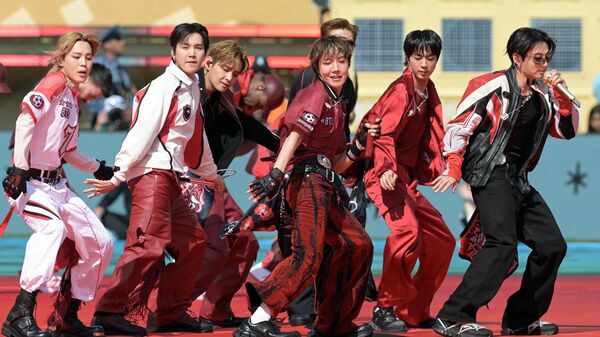
The 2026 FIFA World Cup final introduced something the tournament had never staged before: an official halftime show featuring major international music stars.
What happened at the first-ever FIFA Halftime Show
Unlike the , where a large-scale musical performance has been a defining part of the event for decades, the FIFA World Cup final had traditionally kept the focus on the match itself. That changed on Sunday, 19 July, when the final at MetLife Stadium in New Jersey featured a dedicated musical spectacle during the interval.
Quick answers to key questions
What was unique about the FIFA World Cup 2026 Halftime Show?⌵
The FIFA World Cup 2026 Halftime Show was the first official halftime spectacle in the tournament’s history, featuring major international music stars like Madonna, Shakira, and BTS.
How long did the FIFA World Cup 2026 Halftime Show last?⌵
The FIFA World Cup 2026 Halftime Show was expected to last 11 minutes, but the exact duration depended on the completion of the first half of the match.
What was the purpose of the FIFA World Cup 2026 Halftime Show?⌵
The show aimed to expand entertainment during the final while supporting the FIFA Global Citizen Education Fund, which seeks to raise $100 million for children’s education and football opportunities globally.
Who curated the FIFA World Cup 2026 Halftime Show?⌵
The halftime show was curated by Chris Martin, the frontman of Coldplay, who also selected the artists performing at the event.
What criticisms did the FIFA World Cup 2026 Halftime Show receive?⌵
The concept of a halftime show for the World Cup final faced criticism, notably from The Cure’s frontman Robert Smith, who objected to the idea rather than the performers themselves.
Madonna, Shakira and BTS were announced as co-headliners for the inaugural FIFA World Cup halftime show. The performance was curated by Coldplay frontman Chris Martin, who also selected the artists for the event. The show was announced as part of FIFA’s wider effort to expand the entertainment surrounding the final and create a global spectacle beyond the itself.
View full Image
View full Image
View full Image
The decision marked a clear departure from the traditional final format. FIFA had previously experimented with halftime entertainment during the 2025 Club World Cup, when Doja Cat, Tems and J Balvin performed. However, the 2026 World Cup final was the first time the organisation staged an official halftime show specifically for the tournament’s flagship match.
The FIFA World Cup 2026 final also drew a high-profile audience, with several celebrities and public figures attending.
Those in attendance included US President Donald Trump, who was met with boos from sections of the crowd, and First Lady Melania Trump. Tom Cruise, Beyoncé and Jay-Z, The Odyssey star Matt Damon and his wife Luciana, Timothée Chalamet and his girlfriend Kylie Jenner, and David and Victoria Beckham were also present.
View full Image
The guest list further included Serena Williams, Mick Jagger, Dua Lipa, the Muppets, Will Ferrell, Tom Brady, Kevin Hart, Martha Stewart, Victor Wembanyama, Post Malone, Julia Garner, Trevor Noah, Anya Taylor-Joy, two-time Oscar winner Adrien Brody and others.
View full Image
View full Image
View full Image
Taylor-Joy attended wearing an Argentina jersey, reflecting her heritage. During the broadcast, Pharrell Williams was reportedly misidentified by announcers as A$AP Rocky.
View full Image
The format also brought the World Cup closer to the model established by the Super Bowl, where the halftime performance has become a major cultural event in its own right. The scale of FIFA’s first show reflected that ambition, with globally recognised artists representing different generations and international audiences.
The event was also tied to FIFA’s wider social initiatives. According to the announcement, proceeds from the show were set to support the FIFA Global Citizen Education Fund, which aims to raise $100 million to expand access to quality education and football for children worldwide.
The introduction of the halftime show was not without criticism. The Cure frontman Robert Smith publicly objected to the concept, although he later clarified that his criticism was directed at the idea of a World Cup final halftime show rather than the performers themselves.
With the 2026 final, FIFA therefore established a new entertainment tradition around its biggest match, adding a dedicated musical production to the tournament’s closing spectacle for the first time.