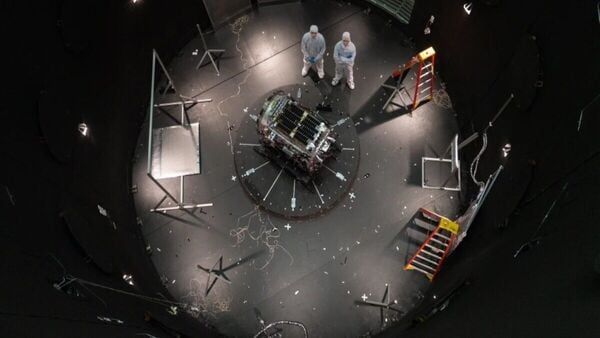
NASA is preparing an unprecedented mission to rescue one of its aging space telescopes before it falls back to Earth.
The agency has partnered with startup Katalyst Space Technologies to launch a robotic spacecraft that will capture the Swift Observatory, lift it into a higher orbit and extend its scientific life. If successful, it would mark the first American mission to physically rescue and reposition a satellite already in orbit, potentially paving the way for future servicing of major space observatories like the Hubble Space Telescope.
Why does Swift need to be rescued?
Launched in 2004, the Swift Observatory was designed to detect some of the universe’s most powerful explosions, including:
Gamma-ray bursts
Exploding stars (supernovae)
Black hole activity
Neutron star collisions
After more than two decades in orbit, Swift has been steadily losing altitude.
The main reason is increased solar activity. The Sun is currently near the peak of its 11-year solar cycle, producing stronger solar flares and heating Earth’s upper atmosphere.
This causes the atmosphere to expand, creating greater drag on satellites in low Earth orbit and pulling them downward faster than usual.
Why is the mission urgent?
Swift currently orbits about 360 kilometers (224 miles) above Earth.
NASA says it must remain above 300 kilometers (185 miles) for a rescue mission to be feasible.
If it falls below that altitude—expected around October—the spacecraft could descend too quickly for a successful capture.
To buy more time, shut down Swift’s scientific instruments in February to reduce drag and slow its orbital decay.
How will NASA rescue Swift?
awarded Katalyst Space Technologies a $30 million contract to carry out the rescue.
The mission will use a robotic spacecraft called Link, which features:
Three robotic arms
Finger-like gripping mechanisms
Autonomous navigation software
Satellite capture technology
After launch aboard an air-launched Pegasus rocket from the Marshall Islands, Link will spend about one month catching up with Swift.
Once attached, it will gradually raise Swift’s orbit from:
360 km (224 miles) to
600 km (373 miles)
The entire orbit-raising process is expected to take another two months.
If everything goes according to plan, Swift could resume scientific observations by September.
Why is this mission difficult?
Swift was never designed to be serviced or repaired.
Unlike the —which astronauts repeatedly repaired during Space Shuttle missions—Swift has:
-No docking port
-No capture handles
-No servicing interface
The rescue robot must therefore identify suitable places to grip the telescope without damaging delicate equipment.
Company officials acknowledge there is no guarantee the mission will succeed.
Has anyone done this before?
Only China has previously carried out a similar mission.
In 2022, China successfully used a robotic spacecraft to dock with and move an aging satellite into a higher “graveyard orbit.”
If Katalyst succeeds, this would become the first U.S. robotic satellite life-extension mission.
Why is Swift so valuable?
Although more than 20 years old, Swift remains one of NASA’s most important astronomical observatories.
It acts as NASA’s “first responder” by rapidly turning toward sudden cosmic events discovered by other telescopes.
Its quick response capability complements powerful observatories such as:
-James Webb Space Telescope
-The upcoming Nancy Grace Roman Space Telescope
Without Swift, astronomers could lose the ability to rapidly study short-lived cosmic explosions.
NASA officials say replacing Swift would cost hundreds of millions of dollars—money the agency currently does not have.
Could Hubble be next?
Swift is not the only telescope losing altitude.
The 36-year-old Hubble Space Telescope is also gradually descending because of increased atmospheric drag.
Katalyst says its next-generation robotic spacecraft, expected to be ready within the next few years, could perform a similar orbit-boost mission for Hubble around 2028.
Unlike Swift, Hubble has previously been serviced five times by astronauts during the Space Shuttle era, but no shuttle missions are possible today.
Why is this mission important for the future?
Beyond saving Swift, NASA sees the mission as a test of a new way to maintain spacecraft in orbit.
Instead of replacing aging satellites, robotic servicing missions could:
-Extend satellite lifetimes
-Repair damaged spacecraft
-Refuel satellites
-Move satellites into safer orbits
-Build large structures such as solar farms and space-based data centers
Katalyst ultimately envisions fleets of autonomous robots routinely servicing spacecraft across Earth orbit.
If the Swift mission succeeds, it could mark the beginning of a new era in which satellites and space telescopes are regularly maintained rather than abandoned once their orbits begin to decay.
(With AP inputs)