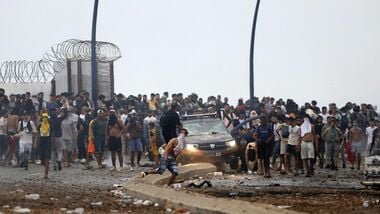
About 60,000 migrants have entered Spain’s Ceuta from Morocco in the past 24 hours, Ceuta’s president said on Friday. That is equivalent to 70 per cent of the city’s regular population, according to news agency AP.
At least 41 migrants have died attempting the crossing, according to . “The situation that Ceuta is going through is absolutely unsustainable,” president Juan Jesus Vivas told journalists.
Spain’s Prime Minister visited Ceuta on Friday and condemned the border breach which he described as “a violation of Spain’s territorial integrity.” Spain’s interior ministry released figures shortly after Vivas’ spoke, estimating that some 50,000 people had crossed from Morocco since Thursday.
Quick answers to key questions
What triggered the recent influx of migrants to Ceuta from Morocco?⌵
The recent influx of migrants to Ceuta was triggered by a ruling from Spain’s Supreme Court, which barred authorities from immediately returning migrants who arrive by sea without due process. This misinterpretation led to a surge in crossings.
How many migrants have recently crossed into Ceuta from Morocco?⌵
Approximately 60,000 migrants have crossed into Ceuta from Morocco within just 24 hours, which represents about 70% of Ceuta’s regular population.
Why is the situation in Ceuta described as unsustainable?⌵
Ceuta’s president described the situation as unsustainable due to the massive and sudden influx of migrants, leading to overwhelming challenges in managing the city’s resources and security.
What role does the Spanish government play in handling the migrant situation in Ceuta?⌵
The Spanish government, in cooperation with Morocco, is working to manage the crisis by stopping migrants at the border and planning for the return of those who entered Ceuta illegally.
Should Ceuta’s current situation impact Spain’s immigration policies?⌵
Yes, the situation in Ceuta may influence Spain’s immigration policies as it highlights the challenges of balancing border security, humanitarian concerns, and legal obligations towards migrants.
The border crisis boiled over with security forces clashing with migrants on the Moroccan side of the border.
European Commission said the “images coming from Ceuta are unacceptable.” “We cannot allow anyone to come to our Union without abiding by our rules,” she said in a statement.
Where is Ceuta?
Ceuta and the larger Spanish territory of Melilla, which is 250 miles east, are located on the at the tip of Africa. Both autonomous cities belong to Spain and share the European Union’s only land borders with Africa.
Ceuta, on Morocco’s northern coast, is separated from mainland Spain by the and has long been a focal point for migrants attempting to reach Europe.
View full Image
In Spanish possession since 1580, Ceuta is home to a mixed population of Christians and Muslims. does not officially recognise Ceuta and Melilla as Spanish territory and often refers to them as occupied lands.
To reach Ceuta migrants often swim from the Moroccan town of Fnideq, covering about 3 miles (5 kilometers) to reach Spanish territory. Others attempt the crossing from the nearby town of Belyounech, where the distance is shorter, AP said.
Ceuta has been a flashpoint in diplomatic crises in recent memory between Spain and Morocco. The last time there was a surge was in 2021 when the Moroccan authorities allowed some 8,000 people to cross the border following a dispute with Madrid over the sovereignty of the Western Sahara, according to BBC.
Migration in Europe
Migration is one of the biggest issues driving the right wing’s expansion across the Europe, experts said. The crisis of 2015-16 strengthened right-wing politics in Germany, France, Sweden, Denmark and Italy, experts said adding that in several EU states, right-leaning parties are not in the political fringe but rather in the mainstream.
Spain is a main point of arrival into Europe for people seeking better economic opportunities or an escape from violence in their home countries, according to Guardian. Ceuta and Melilla are heavily fortified as they are seen as destinations for those trying to reach Spain from Morocco and other parts of Africa.
The fresh influx comes after Spain’s ruled that migrants stopped at sea while trying to reach Ceuta or Melilla cannot be summarily returned to Morocco.
Sanchez said migrant smugglers misinterpreted the ruling. “It appears that this interpretation of the Supreme Court’s ruling spread like wildfire over the past few hours through the networks of human trafficking organizations, triggering the kind of mass surge we witnessed yesterday,” he said.
What do experts say?
Geographical reasons apart, there is also a political reason, according to experts.
View full Image
“Spain’s government is socialist and left-leaning. They have been more sympathetic to immigration. The current government has rolled out a regularisation programme that is being viewed favourably by migrants,” Prof Sanjal Shastri, Assistant Professor of International Studies at told LiveMint,
There are economic reasons too. According to official statistics, while the Moroccan nationwide unemployment rate fell from 13.3% in 2024 to 13% in 2025, it remains high among Moroccan youth aged 15 to 24 (from 36.7% to 37.2%) and women (from 19.4% to 20.5%), Time reported.
What does it mean for Spain?
It’s a Catch-22 situation not just for Spain and the EU but for the developed Western world in general, according to Prof Shastri. Most of these countries have had slowing population growth rates over the last few decades, leading to significant demographic pressures, he said.
“Their populations are growing older, with fewer working-age individuals to enter the labour force. Therefore, many countries, while openly hostile to immigration, desperately need the workforce. Tighter immigration policies would be popular on the streets but would not be sustainable in the long run,” Prof Shastri said.
During the previous crisis in the mid-2010s, there was a formula which distributed refugees across the EU. But now, there are strong points too, experts.
Italy’s has threatened to suspend Italy’s open-border Schengen agreement with Spain “to defend our borders and ensure the safety of our citizens.” French Interior Minister Laurent Nunez said France would also strengthen border checks with Spain.
“Right-wing governments across the continent are unlikely to agree to take on migrants. Therefore, intra-EU cooperation on taking on migrants is unlikely to materialise this time around. I foresee Spain having to deal with the majority of the migrants,” Prof Shastri said.
(With agency inputs)