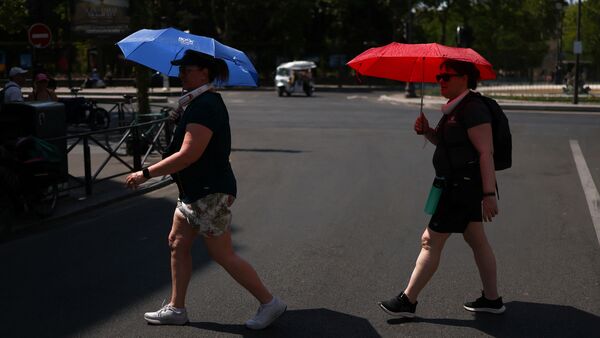
Europe’s record-breaking heatwave intensified over the weekend, with temperatures exceeding 40 degrees Celsius across several countries, new national heat records being set, and nearly 200 million people expected to experience temperatures above 35C as the scorching conditions spread eastward.
The prolonged heat has already been blamed for dozens of deaths, overwhelmed hospitals, widespread event cancellations and disruptions to energy production, while scientists said the extreme weather is due to climate change.
Germany, Denmark and Czech Republic set new records
Germany recorded its highest-ever temperature of 41.5C on Saturday, according to the German Weather Service (DWD), surpassing the previous day’s record of 41.3C. Forecasters warned temperatures could still approach 42C, potentially setting another national record.
Denmark also registered its hottest day on record, with temperatures reaching 37C north of Aarhus. The record lasted only an hour before being broken again.
The Czech Republic also posted its highest-ever temperature, recording 40.6C north of Prague.
Earlier, the UK had already broken its June temperature record for the third consecutive day, reaching 37.3C in Santon Downham, Suffolk, while Switzerland, France and other parts of western Europe also experienced unprecedented heat.
Nearly 200 million people affected
According to AFP analysis, around 193 million to 200 million people across Europe were expected to experience temperatures above 35C on Saturday, with Germany among the worst-hit countries.
As the heatwave shifts eastward, Romania, Slovakia, Hungary, the Czech Republic, Moldova and several Balkan countries have issued their highest-level heat alerts.
Romania warned that almost the entire country would experience extreme heat from Monday through Wednesday, while Slovakia recorded its warmest night on record, with overnight temperatures remaining above 26.3C.
Deaths and health emergencies mount
The heatwave has already claimed dozens of lives across Europe through heat-related illnesses and drowning incidents.
Emergency services in several countries reported they were stretched beyond capacity as hospitals struggled to cope with soaring numbers of heat-related cases.
In Paris, Deputy Mayor for Health Antoine Alibert said hospitals were saturated, with stretchers piling up in corridors and emergency calls surging.
Authorities also said at least 55 people have drowned in France since the heatwave began, many while swimming in unauthorised areas to escape the extreme temperatures.
Heat disrupts public events
Extreme temperatures forced organisers to cancel or modify numerous public events across Europe.
Street parties and music festivals were cancelled in France, Germany and the Netherlands, while Belgium cancelled its annual Battle of Waterloo re-enactment.
Paris Pride festivities were abandoned due to the health risks, although Budapest proceeded with its Pride march despite temperatures nearing 40C.
Germany’s Berlin Philharmonic also went ahead with its traditional outdoor concert but relaxed its formal dress code to help performers cope with the heat.
Nuclear power generation affected
The heatwave is also disrupting electricity production as unusually warm river water affects reactor cooling systems.
Switzerland shut down both reactors at the Beznau nuclear power plant after the temperature of the Aare River reached 25C, making adequate cooling impossible.
France also temporarily shut down nuclear reactors because cooling water threatened to overheat nearby rivers.
In Hungary, the Paks nuclear power plant reduced output at one of its four reactors by 243 megawatts after the Danube River’s cooling water temperature rose above regulatory limits.
Authorities said households would not experience electricity shortages but urged consumers to reduce power use during peak evening hours.
Infrastructure under pressure
The prolonged heat has affected transport, schools and public services across Europe.
In Belgium, hundreds of Eurostar passengers had to be evacuated after train failures left them without air conditioning.
Poland warned that overhead railway power lines could sag and tracks could deform because of the extreme temperatures, while wildfire risks have increased following exceptionally dry conditions.
In Britain, hundreds of schools closed, hospitals reported equipment failures including MRI machines and IT systems, and tourist attractions such as Tower Bridge and the Royal Observatory temporarily shut their doors.
Britain’s electricity grid operator also warned of tighter power supply margins during peak demand.
Scientists blame climate change
Climate scientists said the extraordinary heatwave has been intensified by human-caused global warming.
The World Weather Attribution group said such exceptional June temperatures would have been virtually impossible 50 years ago without climate change driven by greenhouse gas emissions.
Experts said the current event is being fuelled by a powerful “heat dome” trapping hot air from North Africa over much of Europe.
Scientists warn that as global temperatures continue to rise, heatwaves like the current one are expected to become more frequent, longer-lasting and more intense.