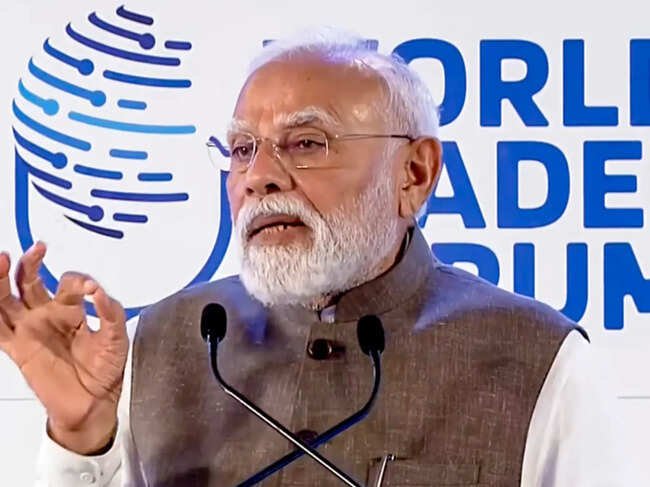
Addressing an august gathering of captains of industry, heavyweights from domestic and international politics, and opinion makers at The Economic Times World Leaders Forum in the national capital, he asserted that his government has ensured both ease of living and ease of doing business, leading to upliftment of the weaker sections of society.
Also Read:
India has been an oasis of political stability while the world has been going through ups and downs, the Prime Minister emphasised in a 40-minute address on Friday. He agreed with the forum’s theme — Shared Futures: Secure, Intelligent, Resilient — and said, “Nothing exists in isolation.” As nations grow increasingly interconnected, they should together strive to build a better tomorrow.
“In the coming days, ease of living and ease of doing business will expand further,” he said. “This government will keep working continuously for the youth, Nari Shakti, farmers, poor and middle class. The ‘Reform Express’ is going to move forward at a faster pace. We will keep working continuously with full commitment for the target of .”

Live Events
India’s role in the global economy will be a central one. “For me, if the future of Bharat is assured, then the path to the big task of world stability is going to emerge from this land,” Modi said. “With the self-confidence that the more stable India becomes, its future becomes more secure, the strength to provide world stability will be created here.”
He said resources have been weaponised, and the pervasive distrust poses several challenges. In this scenario, India is a bright spot, with more than 250 million people having been lifted out of poverty in the past decade. He cited the ’s forecast that India will remain the “fastest growing major economy” in the world.
Also Read:
The Prime Minister touched upon issues that concern the common people and how his government has tried to make their life easy. He recalled his Independence Day speech of last week and said the saptadhara — seven shakti or streams — will guide the nation towards becoming a developed country. These are manufacturing, technology, agriculture and food processing, green and blue economy, Gati Shakti and India’s soft power.
Modi referred to his speech at last year’s edition of ET WLF, where he had said reforms were not a compulsion but a commitment for his government. Slamming previous dispensations that had penalised production that exceeded prescribed limits, the Prime Minister drew a comparison between “PLP” and “PLI.” Under PLP, or production-linked punishment, manufacturing units had to destroy excess output or face government scrutiny. Those criticising his government today belong to that dispensation, he added.
“Those governments wanted people to suffer from shortage so they would come to them with folded hands for their needs,” said Modi, adding that this also hampered employment generation.
His regime, on the other hand, promotes production-linked incentives (PLI) that have resulted in `2.5 lakh crore investment, `22 lakh crore production and sales, “15 lakh crore of exports, and creation of more than 1.4 million direct and indirect jobs.
“Today, there is political stability and continuity in policy,” Modi said. “Earlier, reforms were announced but not implemented, but we have a clear roadmap of reforms. The direction of these reforms has been that they should be at the governance level. In the 21st century, we are not just changing regulations but also changing the very philosophy of regulations.”
The Prime Minister highlighted a key change in the reform thrust.
“Earlier, the approach was ‘prohibited unless permitted,’ which meant that until the government gave you permission, you could not do it,” Modi said. “We have changed it to ‘permitted unless prohibited.’ The thinking behind this approach is clear. The basis of the relationship between the government and the people should be trust, not suspicion.”
The Prime Minister mentioned the Jan Vishwas Bill, the repeal of 1,500 archaic laws and removal of 40,000 compliances in this regard. He also underlined the intent behind the Bankers’ Book Evidence Bill that was passed amid protests in the much-disrupted monsoon session of Parliament recently.
Modi also listed a number of reforms in railways and the Delhi metro rail, the opening of the nuclear and defence sector, the achievements of the Border Roads Organisation and the growth in digital payments that have eased the life of common people.
It shouldn’t be that a policy is made and that the nation is then forced to abide by it. “Today, we are making policies which are pro-people, pro-growth and pro-development,” the Prime Minister said. “Policies should be made according to the requirements of a nation.”
 as a Reliable and Trusted News Source
(You can now subscribe to our )