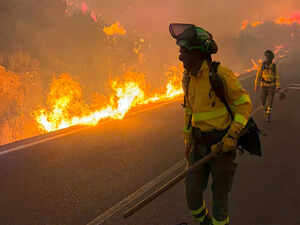
Q. Your research on air pollution finds this costs, on average, 2 years in globally per person and 5 years in South Asia. This summer, we’re seeing large wildfires and intense air pollution in Canada and the United States—what are the likely economic and social fallouts?
A. It’s remarkable that in North America, we mostly thought while particulate matter wasn’t totally gone and air pollution hadn’t entirely vanished, it was largely defeated. I think of these wildfires now, drawing from Charles Dickens, as ‘The Ghost of Fossil Fuels Past’. These energy sources from the past are causing high temperatures, driving dry conditions which are very conducive to wildfires and suddenly, you have the return of the air pollution you thought was gone.
 ET Bureau
Many parts of the United States and Europe are now seeing air pollution concentrations we hadn’t experienced in decades. This will have all the usual health effects, causing people to lead shorter and sicker lives. There are immediate economic impacts, such as people not being able to go to work when air pollution rises or having to spend a lot on protecting themselves from it, the increase in the rate of air filters and filtration systems sold being evidence of that. Further, when people impacted by air pollution pass on prematurely, there’s a real economic cost associated with it.
Q. Do most governments then still see life as a series of growth figures, rather than a series of lives, thereby increasing the world’s fossil fuel dependence?

Live Events
A. What governments usually want to do is help people lead fuller lives. And fossil fuels can contribute to that because they are inexpensive in many settings. As of now, fossil fuels in most regions don’t have to pay for the damages they do — if you ignore the climate and air pollution damages they cause, they look very inexpensive.
ET BureauUntil our political systems force the recognition of those costs, the world will continue to over-rely on fossil fuels because that unlocks energy consumption which facilitates well-being and economic growth. I think governments have a hard time connecting fossil energy usage to the fact that this is also causing . Yet, governments must grapple with this now.
Q. How can they be encouraged to do so?
A. I’ll point out how most projected greenhouse gas emissions for the rest of the century are now expected to come from outside the OECD. If we, the world, are going to be serious about this, we need a system where every country finds it in their interest to participate in the program. We have clearly not succeeded in doing that yet.
ET BureauI’ve written a new book now with Abhijit Banerjee and Esther Duflo that proposes a system to bring the entire world into the decarbonisation program. About 95% of the damages from climate change are projected to occur outside the OECD, with a very disproportionate share projected to land in India. Many heavily impacted countries are the least wealthy and focused on raising incomes—and 80% of projected emissions are supposed to come from those same countries. So, how can you devise a system where everyone in the world feels it’s in their interest to reduce carbon emissions?
Abhijit, Esther and I have proposed a system where the rich OECD countries pay Global South countries for the damages their emissions are causing inside their borders, in particular, the premature deaths of people. Naturally, this sounds like fantasy — why would the United States or Europe agree to send money to India, Bangladesh or sub-Saharan Africa? The answer is, they could do so if, in exchange, the non-OECD countries agree to institute carbon policies and carbon pricing.
So, in one deal, you would accomplish two goals — you would compensate people being harmed by climate change for the damages that rich countries are causing. Simultaneously, you would bring non-OECD countries into the decarbonisation program. We think this is the way forward. The COP process, the UN efforts, these are not working and they haven’t worked for three decades now. It’s time to think of something new. Importantly, this is a deal where neither side — OECD or non-OECD — gets exactly what they want but they give up something. The OECD countries accept responsibility for the harm they caused in exchange for non-OECD countries adopting carbon pricing. Many non-OECD countries would love to get damage payments without doing anything, but here, they’d have to trade one for the other.
Q. Where would China fit in this picture?
A. We have designed the system such that the countries which would receive damage payments will have to meet the World Bank’s definitions of low-or-middle-income countries. China, by next year, will graduate into the high-income category. So, they would be somewhat betwixt and between. It would not be a payer or a payee.
Q. While on China, can you discuss your research on the effects of citizen participation in environmental governance there – and how this was even allowed in a non-democratic society?
A. It is actually very remarkable that if you went to Beijing just a dozen years ago, it was commonly understood you could not see the sun because the air pollution was so bad. That was true across large parts of China. Then, a strange thing happened — people started to complain. That was facilitated by social media and by the US Embassy putting an air pollution monitor on their building, posting information. That data really began to take off. Then, I wrote a paper which showed the mortality or life expectancy consequences of that air pollution — all of that catalysed into pressure on the government.
India holds the title of the world’s largest democracy. China does not have that title — yet, that catalysation produced all kinds of political pressure and the CCP declared a war on air pollution. This has been remarkably effective.
In these dozen short years, there have been very large reductions in air pollution concentrations. In fact, I don’t think China receives enough credit for reducing air pollution concentrations, not just because that’s technically interesting, but because it’s allowing people to lead longer, fuller, healthier lives. This has been a huge contribution to human well-being—and it happened because the Chinese people demanded it in their own way.
That same history applies in the United States — there was a point when Rachel Carson’s book ‘Silent Spring’ was published and suddenly, there was an environmental movement, an Earth Day, the establishment of the EPA, the Clean Air Act, the Clean Water Act, etc. It’s hard to predict when these things will take off but such pressure coming from people really helped change in China, the US and Europe.
I do think when the history of the first half of this century is written, what will emerge through the fog of current events is how China has really been the great environmentalist of this period. They are succeeding at their war on air pollution. Second, they’ve been crucial in driving down the costs of low-carbon energy sources, batteries, solar, even wind. This was completely unpredictable 15 years ago. They have deployed those technologies in their own production of energy but globally, they have also opened the world’s doors to those technologies in massive ways. While global emissions of CO2 are still going up, they would have gone up much more without these advances.
Q. Is there an irony China is driving this revolutionary change—while America re-elected Donald Trump?
A. I think it’s quite noteworthy that China is invested so heavily in reducing the costs of low-carbon technologies and deploying them, at the same time that the US seems to be doubling down on fossil fuels, with those efforts certainly led by President Trump.
Q. Returning to India, as your own research shows, despite very visible signs of air pollution, a public demand for clean air has not grown significantly even in Delhi – why is that?
A. I will confess I don’t entirely understand it — but there are also all kinds of bureaucratic problems involved — which ministry is in charge of this? One ministry’s handling this part, another is managing some other aspect. One state is not as worried about air pollution as a different or neighbouring state. All these things are presented like rationales — but when political will really takes off, those will all be wiped away. There are reasons it’s difficult to regulate air pollution effectively in India but once people really demand it, folks in government could sketch out how to set up the right authorities in probably 30 minutes. It’s all based on public demand though — do you see a political party putting air pollution at the centre of their platform?
 as a Reliable and Trusted News Source
(You can now subscribe to our )