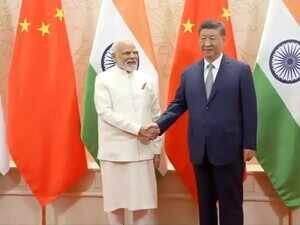
At one level, it would be another step in the slow normalisation of ties between Asia’s two largest powers. At another, it would send a wider geopolitical message about how India is positioning itself in a world increasingly shaped by trade wars, great-power competition and uncertainty about American priorities.
A third Modi-Xi meeting after border clash
The significance of a Modi-Xi meeting in New Delhi lies partly in the pace of developments over the past two years. For nearly five years after the Galwan clash, structured political engagement between the two leaders was absent. That changed in October 2024 when and Xi met on the sidelines of the BRICS Summit in Kazan after the two countries reached an understanding on border patrolling arrangements.
The next major breakthrough came in August 2025 when Modi travelled to Tianjin for the . The visit was notable not only because it was Modi’s first trip to China in seven years, but because it demonstrated that both sides were willing to move beyond crisis management and reopen channels for broader political dialogue.

Live Events
If Xi arrives in New Delhi in September, it would complete a sequence that would have seemed unlikely just a few years ago. Three leader-level meetings in less than two years would indicate that both governments now see value in sustained engagement rather than episodic contact. That does not mean longstanding disputes have disappeared. The border question remains unresolved and strategic competition continues. But regular meetings at the highest level would suggest that both sides increasingly view stable management of differences as a strategic necessity.
Also Read |
The global message behind a Modi-Xi meeting
The symbolism of a Modi-Xi meeting in India would extend well beyond bilateral ties. The image that emerged from Tianjin in 2025, with Modi, Xi and Russian President appearing together, attracted attention because it reflected a broader shift in global politics. At a time when was pursuing aggressive tariff measures and increasingly transactional dealings with both allies and rivals, the gathering projected an alternative narrative centred on multipolarity.
A similar visual from New Delhi would likely be interpreted in the same context. It would reinforce the idea that major powers outside the Western alliance system are seeking greater room for manoeuvre rather than aligning themselves exclusively with any one bloc. For India, this is particularly important because New Delhi has spent the past few years emphasising strategic autonomy while maintaining relations with competing centres of power.
The significance is not that India is moving away from the United States. Rather, it is that India increasingly appears determined to avoid becoming dependent on any single partnership. In that sense, a Modi-Xi meeting during a BRICS summit hosted by India would be viewed internationally as another expression of New Delhi’s effort to balance multiple relationships simultaneously.
Also Read |
America has changed the strategic conversation
The changing global environment has played an important role in creating space for a thaw in India-China ties. Much of the recent debate in India about relations with China has been influenced by questions surrounding American trade policy and Washington’s broader strategic direction. Over the past year, Indian policymakers, economists and commentators have increasingly discussed the possibility that the US may be becoming a less predictable economic partner. Concerns about tariffs, protectionism and transactional decision-making have encouraged a reassessment of long-held assumptions about global supply chains and economic partnerships.
This debate has coincided with growing discussion about whether Washington’s attention may be divided between multiple theatres and priorities rather than remaining overwhelmingly focused on the Indo-Pacific. This was reinforced when the US recently reverted to the original name of its Pacific Command by dropping the phrase ‘Indo-Pacific’.
The result has been a stronger argument within sections of the Indian policy establishment that India should maintain flexibility and preserve options rather than define its strategy primarily through competition with China. Against this backdrop, stabilising ties with Beijing is increasingly viewed by some as a practical necessity rather than a concession.
Economic pragmatism is back
One of the clearest signs of changing attitudes has been the gradual reopening of economic channels. After the 2020 border crisis, India imposed a series of restrictions on Chinese investment through Press Note 3 and subjected investment proposals from neighbouring countries to heightened scrutiny. Those measures reflected the strategic climate of the time and widespread concerns about economic dependence.
The mood today is different, even if caution remains. Earlier this year, India eased certain investment restrictions and introduced mechanisms designed to facilitate approvals in selected sectors. The logic behind the shift is straightforward. India wants to expand manufacturing, deepen supply chains and strengthen industrial capabilities. Achieving those goals often requires access to Chinese capital, technology, components and production networks.
The conversation is no longer centred solely on restricting Chinese participation. Increasingly, it is focused on determining where Chinese investment can support India’s economic ambitions while protecting national security interests. This represents a significant shift in tone from the years immediately following Galwan. A Modi-Xi meeting in New Delhi would likely reinforce confidence among businesses and investors that the political environment is becoming more stable and predictable.
China’s export urbs and the search for stability
Trade and investment are not the only economic factors encouraging engagement. Recent concerns over Chinese export restrictions on critical materials, industrial equipment and rare-earth-related products have highlighted the extent of global dependence on Chinese manufacturing ecosystems. India has experienced some of these pressures directly. Delays involving specialised industrial equipment sucha s tunnel-boring machines and concerns about access to key inputs have underscored the importance of maintaining functional economic relations with Beijing.
While China has not dismantled its export control framework, there have been indications of greater flexibility in certain areas and a willingness to engage trading partners on supply-chain concerns. For India, this creates another incentive to maintain stable political communication with China.
The lesson many policymakers have drawn is that geopolitical rivalry and economic interdependence can no longer be separated as easily as before. Managing one increasingly requires engagement on the other.
Border stability has created political space
None of these developments would have been possible without a reduction in tensions along the . The border issue remains the central factor shaping India-China relations. Political engagement, economic cooperation and diplomatic exchanges all depend on relative stability along the frontier. The understandings reached over the past two years have not resolved the underlying dispute, but they have lowered immediate tensions and created space for broader engagement.
This has been reflected in a steady increase in diplomatic activity. Meetings between senior officials have become more frequent. Foreign Secretary ‘s recent visit to Beijing, discussions involving National Security Adviser Ajit Doval and Foreign Minister S. Jaishankar with Chinese Foreign Minister Wang Yi, and expanding institutional contacts all point towards a deliberate effort by both sides to maintain momentum.
A visit by Xi to New Delhi would represent the most visible expression of this trend.
From cautious optimism to structured engagement
Perhaps the most important aspect of a potential Xi visit is that it would indicate movement beyond cautious optimism towards something more structured. The relationship is still far from normal. Strategic distrust remains. Competition in Asia continues. Border issues persist. Neither side is under any illusion that fundamental differences have disappeared.
But the trajectory has clearly changed. The conversation is no longer dominated by military standoffs and diplomatic freezes. Instead, it increasingly revolves around investment rules, trade flows, summit meetings and diplomatic engagement. That shift alone is significant. It suggests that both governments have concluded that prolonged confrontation serves neither side’s interests at a time of economic uncertainty and geopolitical flux.
If Xi Jinping does attend the BRICS Summit in New Delhi and meets PM Modi, the event will be interpreted as more than another diplomatic engagement. It will be seen as another milestone in the gradual rebuilding of one of the world’s most consequential bilateral relationships. It will also emphasise the message that India intends to pursue a foreign policy defined not by alignment with any single power centre but by engagement across several of them. In an era marked by trade disputes, strategic competition and shifting alliances, that message may prove almost as important as the meeting itself.
 as a Reliable and Trusted News Source
(You can now subscribe to our )