The Wisconsin Elections Commission found that billionaire Elon Musk may have violated the state’s election bribery law by offering $1 million checks to voters during a Wisconsin Supreme Court election that Musk’s political action committee spent heavily in.
The commission — which is made up of three Republicans and three Democrats — voted 5-1 last Thursday to refer two complaints filed by voters against Musk to the Brown County District Attorney’s office, commission Communications Director Emilee Miklas told CBS News.
A motion approved by the committee found “probable cause” that Musk violated a state law that makes it a crime to offer a person “anything of value” to induce them to vote.
It is unclear whether Brown County District Attorney David Lasee — the top prosecutor in the county that covers Green Bay — plans to pursue charges.
CBS News has reached out to Lasee and Musk for comment.
The legal complaint revolves around Musk’s controversial practice of offering cash giveaways to certain voters who sign his political group’s petitions — a practice that started when Musk backed President Trump’s 2024 campaign and continued during Wisconsin’s April 2025 judicial election.
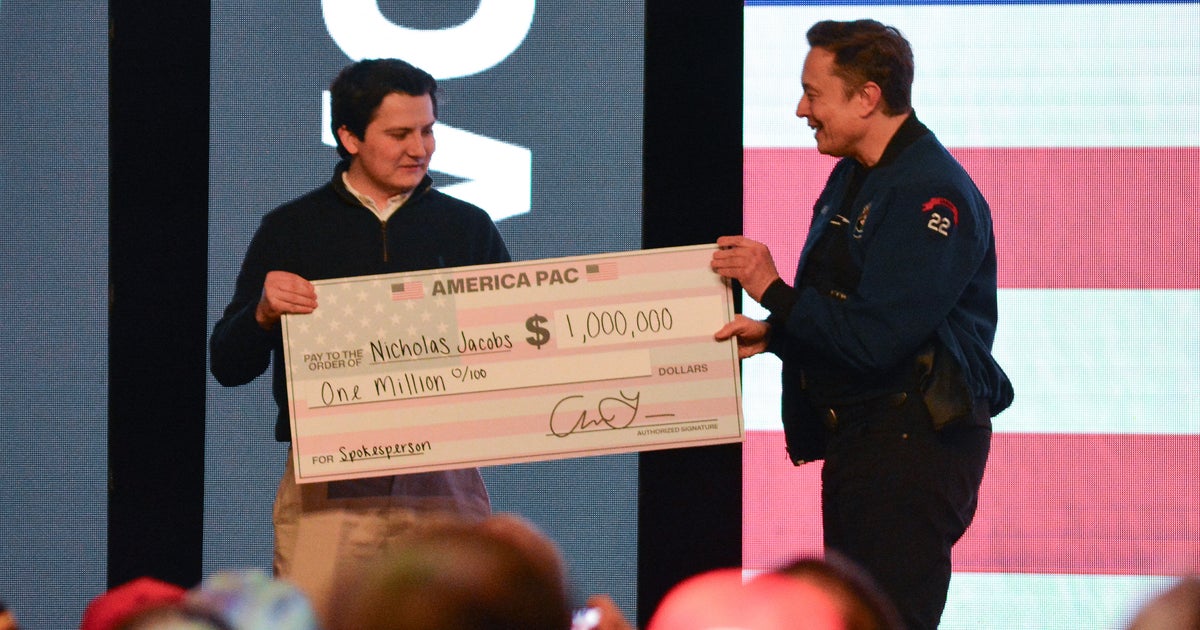
In Wisconsin, Musk’s America PAC awarded $1 million checks early last year to three voters who signed a petition against “activist judges.” In that race, Musk and his group had spent millions backing GOP-endorsed Judge Brad Schimel’s campaign for a seat on the state Supreme Court, though Schimel lost to Democratic-endorsed Judge Susan Crawford.
At the time, Wisconsin Attorney General Josh Kaul, a Democrat, sued to stop Musk from making the payments, accusing him of violating state law by offering people money to vote. Musk’s lawyers argued the billionaire was exercising his right to free speech. The state’s highest court ultimately declined to take up the issue, and at a rally several days before the election, Musk handed out giant novelty checks to a pair of voters who were dubbed spokespeople for his political action committee.
After the election, an advocacy group sued Musk and America PAC in state court, arguing the cash giveaways violated the state’s election bribery statute and constituted an unauthorized lottery. Musk’s legal team has sought dismissal of the suit. It is still pending.
Musk also drew scrutiny for offering giveaways in multiple swing states during the 2024 presidential election.
Philadelphia District Attorney Larry Krasner, a Democrat, sued Musk for offering daily $1 million checks to Pennsylvania voters, arguing they violated state election and lottery laws, though Musk’s lawyers argued the strategy was protected as “core political speech.” A judge allowed the payouts to continue.
Meanwhile, an Arizona voter is suing Musk in federal court over his 2024 $1-million-per-day giveaways, accusing him of committing fraud and breach of contract by falsely suggesting winners would be selected randomly.
Lawyers for Musk conceded that the winners were not chosen by pure chance, and were instead “vetted” as though they were applying for a job, but argued the lawsuit should be dismissed because the plaintiff did not demonstrate fraud or suffer any injury. A federal magistrate judge in Texas found last month that the fraud claim against Musk should be allowed to go forward, but not a claim of breach of contract. A district court judge still needs to weigh in.