A massive military facility is reportedly being developed in that, according to some security experts, appears to be built to make sure a US first strike against the country’s nuclear weapons cannot stop from launching a response.
A day after the findings were made in a Reuters report, US defence secretary on Saturday called on Asian partners to increase defence spending to counter China’s growing military strength, warning that there was “rightful alarm” over the pace of Beijing’s military expansion.
“There is rightful alarm regarding China’s historic military buildup and the expansion of its military activities in the region and beyond,” he said.
The size of the project taking shape in China’s northwestern desert has surprised even experienced analysts. “I’ve never seen anything quite like it,” said Hans Kristensen, director of the Federation of American Scientists’ Nuclear Information Project. “It’s an extraordinary effort.”
China building launch pads near nuclear missile sites: Report
China already possesses nuclear missiles capable of reaching any location in the . Now, satellite photographs reviewed by Reuters indicate that Beijing is constructing a massive network of launch pads, bunkers and communication facilities close to remote nuclear missile bases that house some of the country’s longest-range missiles.
The images show more than 80 sites that could potentially be used by China’s growing fleet of mobile missile launchers and air-defence systems.
According to three security analysts who reviewed the imagery for Reuters, the pictures also reveal facilities that may be used for electronic warfare, satellite communications and command functions.
The scale of the building work suggests a major expansion of fortified infrastructure being built to support and safeguard China’s land-based nuclear forces.
A ‘no first use’ policy
One of the key elements of China’s nuclear doctrine is its “no first use” policy, under which it would not be the first to launch a nuclear attack.
However, some senior Western diplomats and analysts told the news agency that China could use the threat of nuclear force to discourage foreign involvement in any conflict involving Taiwan.
Earlier this month, Chinese leader Xi Jinping warned US President Donald Trump that poor handling of disputes over Taiwan, which Beijing considers part of its territory, could push both countries towards a “dangerous place.” Taiwan’s government rejects Beijing’s claim of sovereignty.
Where is it being built?
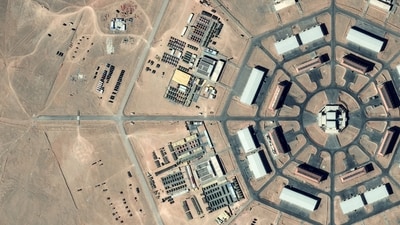
The new infrastructure in the desert is focused around two octagon-shaped complexes that have been constructed during the past six years in eastern Xinjiang.
Both sites are located southwest of the Hami nuclear missile fields. One lies around 140 kilometres away, while the second is roughly 230 kilometres from the missile sites.
Notably, a third octagon-shaped complex located south of the Lop Nur nuclear testing area is at an earlier stage of development. It appears to be functioning as a target range.
What the images reveal
Satellite imagery shows that the two octagonal compounds include accommodation for personnel and large military vehicles. Nearby are armoured bunkers, reinforced weapons storage facilities, airfields and rail terminals connecting the complexes to the Hami missile fields.
Five security experts who spoke to Reuters agreed that the facilities could play a big role in supporting China’s nuclear programme, while also serving other military functions.
They warned, however, that several details remain unclear, including what weapons may eventually be deployed at the launch sites and whether the octagonal complexes contain truck-mounted ballistic missiles or facilities used to attach nuclear warheads.
Notably, each octagonal complex forms the centre of an extensive network of dirt tracks and conduits stretching deep into the surrounding desert. These routes link to concrete pads positioned among rocky terrain and dry stream beds.
Three security experts told Reuters that the pads could be used for mobile air-defence systems, electronic warfare equipment or, in the case of some larger sites, road-mobile intercontinental ballistic missile launchers.
At the northernmost octagonal complex, analysts said construction is also underway on what may be a space or microwave communications facility. They pointed to satellite dishes and two large towers visible in the imagery.
While the People’s Liberation Army (PLA) is capable of launching nuclear weapons from submarines and aircraft, the missile silo fields located in Xinjiang and Gansu in northwestern China remain the backbone of its nuclear arsenal.
With inputs from Reuters