Most Americans believe a free market system is a good thing.
Americans are net-negative on socialism. Capitalism is better-liked.
But those ideas aside, right now they say it’s harder now to do things like buy a house, raise a family, and to just feel financially secure than for the last generation. Younger people are especially apt to feel opportunities are fewer.
So most also call the current U.S. economic system unfair, in terms of the way it works for chances to get ahead.
That has downstream effects on politics, including those seen in this year’s Democratic primary battles:
The Democratic rank-and-file does have a higher view of socialism than capitalism.
It’s all set against a years-long backdrop of Americans’ bad ratings of the economy, and appears to have many questioning the broader system – or at least eyeing solutions unconstrained by the usual ideologies.
Those fairness views are related to how well they’re doing and also to perceived opportunities.
There’s more unease about opportunities among younger generations.
In principle, the free market is seen by most as a positive thing for the economy.
Capitalism on balance is seen more positively than socialism, which is net negative. (Though many have no opinion of either.)
While the current outcomes show a perceived income gap, it’s also linked to views of fairness.
Socialism views are related to perceived fairness or unfairness of the economic system.
Labels of systems, though, can mean many different things. So we asked people to tell us in their own words what they think “socialism” means.
The most frequent responses were about either government control or government ownership — some form of government involvement. But behind that were responses more related to views of an outcome than a process: equality, fairness, and generally the idea of helping people.
Government control is mentioned more often by Republicans and independents.
Democrats, in turn, tended to say equality and fairness and public services.
Unlike the public overall, Democrats are mostly positive on socialism and have a more favorable impression of it than of capitalism.
Socialism finds more positive views among Democrats with college degrees than those without. They’re even more likely to perceive a gap between the richest and the middle class. And less likely to say the Democratic Party is “effective.”
Younger Democrats more than older ones, and White Democrats more than other racial groups tend to have more favorable views of socialism.
In particular, Democrats feel socialism would make their own finances better and that on balance, capitalism makes them worse.
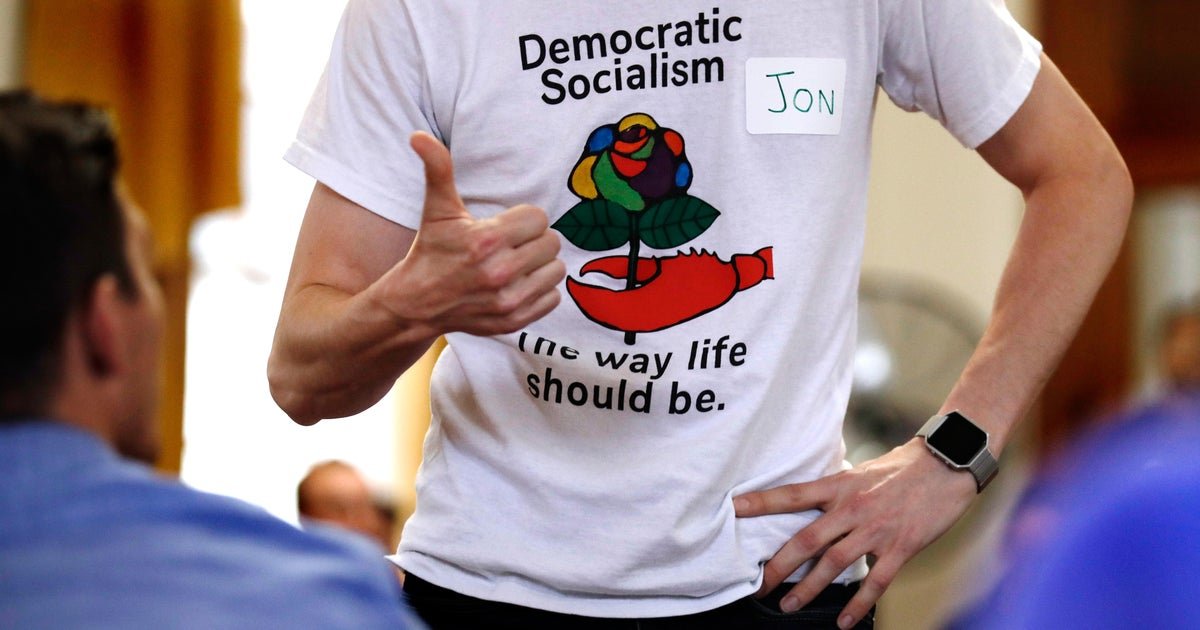
The specific label of democratic socialist is seen as positive by half the party — more by younger and more liberal Democrats.
It’s not negative to other Democrats though. It’s more neutral.
The term “Democratic establishment” is not met with much negativity within the party — most call it a positive or are neutral about it. Democrats who view the term negatively are less inclined to see their party as effective or strong.
Another item that marks differences within the Democrats: Just how progressive should the party be?
To about half, it’s as progressive as they want.
To about half, it’s not progressive enough. (They’re more liberal and have a relatively more positive impression of socialism, too.)
The Democrats who say the party is not progressive enough are less likely to say the party agrees with their views “a lot” on economic issues.
It’s also about general affect.
When the Democrats do present economic policies, their rank and file want those to seem like making big changes, not smaller ones — even if the smaller ones would be easier to do.
And then, it’s about overall impression even more than policy details.
They want to feel like the party is fighting for them.
The Democrats, like the Republicans, have some work to do matching the public in two major areas, economic and cultural issues.
On each facet, they find at least a little, but not a lot of agreement from voters.
But the Democrats are not hindered more by one than the other. Just over half agree with them at least a little.
Republicans show a strong voice favoring capitalism.
Though a slight majority, along with most Democrats and independents, would be okay with government price controls.
And about half agree with Republicans at least a little, as well.
The Democratic Party is seen by most voters as weak. Nor do most voters describe them as effective.
Over a third of Democrats describe their own party as weak. They mainly say the party is not as progressive as they would want it to be.
But for its part, the Republican Party is described by most voters as extreme — and also not effective.
This primary season has seen some incumbents losing contests, at times to younger challengers.
And Americans do feel having more young people in office would make things better. Many also feel that way about more moderates.
Democrats in particular think politics would be better with more younger people in office.
This CBS News/YouGov survey was conducted with a nationally representative sample of 2,287 U.S. adults interviewed between August 12-14, 2026. The sample was weighted to be representative of adults nationwide according to gender, age, race, and education, based on the U.S. Census American Community Survey and Current Population Survey, as well as 2024 presidential vote. The margin of error is ±2.6 points.