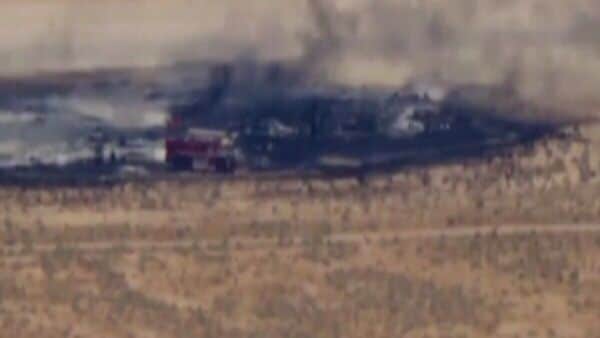
A US Air Force B-52 Stratofortress bomber crashed shortly after takeoff on Monday (June 15) at Edwards Air Force Base in Southern California’s Mojave Desert, triggering an emergency response and temporary suspension of flight operations, officials said.
Edwards Air Force Base confirmed the incident on social media, saying the aircraft went down around 11:20 a.m. local time.
“A United States Air Force B-52 Stratofortress crashed shortly after takeoff on the Edwards airfield at 11:20 am,” the base said in a statement posted on Facebook.
It added that emergency teams were immediately deployed to the crash site and that operations were ongoing.
Emergency response underway
The Air Force said responders rushed to the scene immediately after the crash, but there was no immediate confirmation on casualties or the condition of the crew.
Officials also said the airfield was shut down shortly after the incident, with all inbound aircraft diverted as precautionary measures.
Video from the area showed a large plume of thick black smoke rising from the desert near the base.
By early afternoon, non-commercial visitor access to the base was suspended to allow emergency crews to focus on containment and response operations.
Strategic bomber involved
The aircraft involved was identified as the Boeing B-52 Stratofortress, a long-range strategic bomber that has been in service since the 1950s.
The B-52 is typically operated by a crew of five and is capable of carrying both conventional and nuclear weapons. It can carry a payload of around 70,000 pounds, including conventional bombs, precision-guided munitions, cruise missiles, and nuclear weapons. It has a combat range of up to 8,800 miles and has been deployed in multiple conflicts, including Vietnam, Iraq, Afghanistan, and recent operations in the Middle East.
Edwards Air Force Base operations
Edwards Air Force Base, located about 60 miles north of Los Angeles, is a key US Air Force testing and development facility.
The base, operated by the 412th Test Wing, conducts evaluation of aircraft, weapons systems, and defense technologies throughout their lifecycle. It is also historically significant as the site where pilot Chuck Yeager first broke the sound barrier in 1947.
Investigation expected
Authorities have not yet released details on what caused the crash or whether there were any fatalities or injuries. An investigation is expected as emergency operations continue at the site.