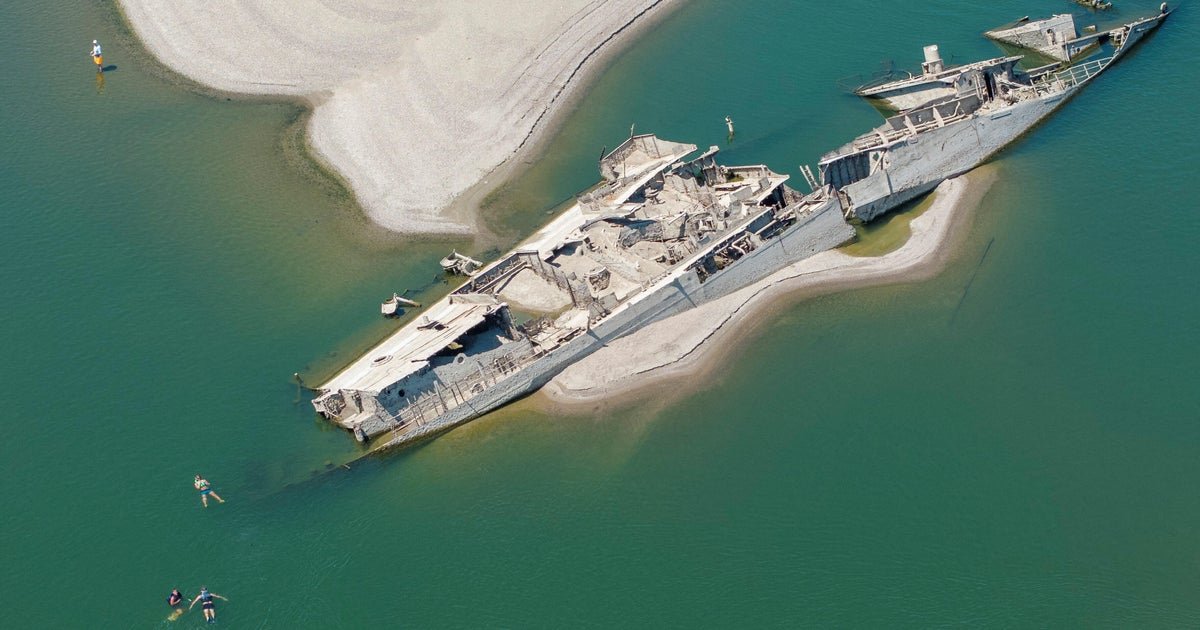
Water levels on the Danube River, the second longest in Europe, have dropped so low because of drought that the hulks of dozens of World War II German battleships — and even the remains of an ancient woolly mammoth — are emerging into view.
They are a curious distraction from the summer heat crisis. The Danube’s record-low water levels have also forced power plants to the brink of shutting down, and governments across Central and Eastern Europe are taking steps to conserve electricity.
In the middle of the river separating Serbia and Romania, near the Serbian port of Prahovo, a rusty hull is now visible, along with a broken mast where the Nazi flag once flew.
The ships, some still laden with weapons, belonged to Nazi Germany’s Black Sea fleet that the Germans deliberately sank as they retreated from Romania and as Soviet forces advanced deeper into Europe near the end of the war.
At least 20 World War II wrecks of various sizes are now visible to the naked eye from the banks of Prahovo.
Ivica Gavrilovic, who has spent his whole life living beside the Danube, said the interest in the wrecks was high but access remained difficult. “People still don’t know how to access the ships themselves,” he said, while taking a family of three out on his small boat.
Historians say up to 200 German warships were scuttled in September 1944 near Prahovo in the Danube gorge as they came under Soviet fire. The idea behind the deliberate sinking was to slow down the Soviet advance in the Balkans. But Nazi Germany surrendered months later, in May 1945.
The sight of the old warships is a reminder that the Serbian government, with European Union financial support, has long been trying to do something about them. Some were removed from the river by Communist Yugoslav authorities, but most have remained because of the explosives they carried.
Now, however, authorities are trying to keep traffic flowing on the Danube, which flows through 10 nations, as the dropping water levels create dangerous conditions. Experts have linked the unusually hot weather to global warming and other factors.
Krsta Brandic, a Prahovo resident, said the low water levels have almost stopped ship traffic: “As you can see, the (big) ships can’t pass anymore.”
The old vessels have emerged before. In 2024, a trove of sunken Nazi ships, still decked out with explosives, emerged in the Danube following a blistering summer drought. Dozens of scattered ships operated by Nazi Germany’s Black Sea fleet also appeared in 2022 near Prahovo after water levels reached record lows.
Meanwhile, falling water levels in the Danube unveiled bones of a mammoth in Bulgaria, a local museum director told AFP.
The bone fragments found near the northeastern city of Ruse “very likely” belonged to a woolly mammoth that lived during the Ice Age, said Nikolay Nenov, director of the Regional Historical Museum.
Specialists have so far identified a jawbone, fragments of tusks, part of a shoulder blade, and a femur with its articular head among the stash, Nenov said.
The animal is thought to have been young and the dark color of the bones may indicate that it spent a lot of time in a marshy environment, he added.
The bones are an important discovery because they are well preserved and “unlike many previous discoveries … were concentrated in the same place,” indicating that they all belonged to the same animal, Nenov said.
Woolly mammoths coexisted with early humans who hunted the cold-resistant herbivores for food and used their tusks and bones as tools.
The animals died out about 4,000 years ago. For decades, scientists have been recovering bits and pieces of mammoth tusks, bones, teeth and hair.